
基线血浆 PCSK9 水平低与晚期非小细胞肺癌免疫检查点抑制剂的良好临床结局相关。
Low baseline plasma PCSK9 level is associated with good clinical outcomes of immune checkpoint inhibitors in advanced non-small cell lung cancer.
机构信息
Department of Oncology, Shanghai Pulmonary Hospital & Thoracic Cancer Institute, Tongji University School of Medicine, Shanghai, China.
Department of Pathology, Shanghai Pulmonary Hospital & Thoracic Cancer Institute, Tongji University School of Medicine, Shanghai, China.
出版信息
Thorac Cancer. 2022 Feb;13(3):353-360. doi: 10.1111/1759-7714.14259. Epub 2021 Dec 27.
BACKGROUND
Proprotein convertase subtilisin/kexin type 9 (PCSK9) is a crucial protein involved in the metabolism of low-density lipoprotein cholesterol. However, the role of plasma PCSK9 in predicting the efficacy of ICIs in advanced non-small cell lung cancer (NSCLC) remains to be clarified.
METHODS
We retrospectively reviewed the medical records of NSCLC patients who presented at Shanghai Pulmonary Hospital between April 2019 and June 2020. ELISA was conducted to detect the concentration of PCSK9. Clinical efficacy was evaluated according to Response Evaluation Criteria in Solid Tumors (RECIST, version 1.1).
RESULTS
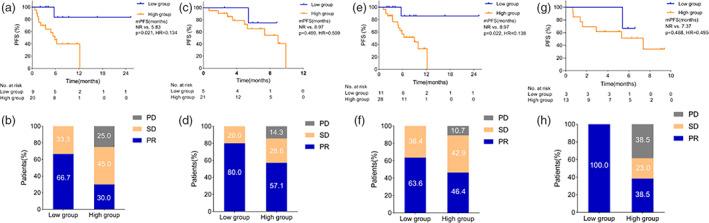
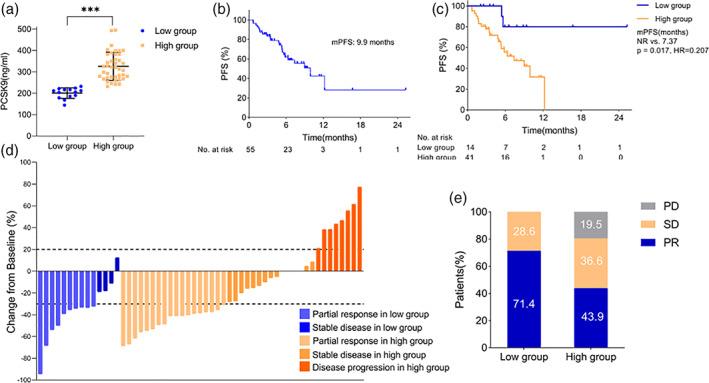
A total of 55 patients were enrolled in the study. The median progression-free survival (PFS) following treatment with ICIs in all patients was 9.9 months. The optimal threshold of baseline plasma PCSK9 was 232.2 ng/ml. Patients with low baseline plasma PCSK9 had a longer PFS (NR vs. 7.37 months, p = 0.017, HR = 0.207, 95% CI: 0.086-0.498) and a better response (ORR 71.4% vs. 43.9%, p = 0.075, DCR 100% vs. 80.5%, p = 0.098) to ICIs. Younger patients (≤66 years) with a lower PCSK9 had a significantly longer PFS and higher treatment response than those with a high baseline level of PCSK9 (NR vs. 5.83 months, p = 0.021, HR = 0.134, 95% CI: 0.044-0.409; ORR 66.7% vs. 30.0%, p = 0.106, DCR 100% vs. 75%, p = 0.153). The situation was similar in patients who received first-line therapy (NR vs. 8.97 months, p = 0.022, HR = 0.138, 95% CI: 0.047-0.400; ORR 63.6% vs. 46.4%, p = 0.480, DCR 100% vs. 89.3%, p = 0.545). Multivariate analysis showed that low PCSK9 concentration was independently associated with PFS (p = 0.032, HR = 0.201).
CONCLUSIONS
Low baseline plasma PCSK9 level may predict good outcomes in patients with advanced NSCLC treated with ICIs.
背景
前蛋白转化酶枯草溶菌素 9(PCSK9)是一种参与低密度脂蛋白胆固醇代谢的关键蛋白。然而,血浆 PCSK9 预测晚期非小细胞肺癌(NSCLC)免疫检查点抑制剂(ICI)疗效的作用仍有待阐明。
方法
我们回顾性分析了 2019 年 4 月至 2020 年 6 月期间在上海肺科医院就诊的 NSCLC 患者的病历。采用 ELISA 法检测 PCSK9 浓度。根据实体瘤反应评价标准(RECIST,1.1 版)评估临床疗效。
结果
共纳入 55 例患者。所有患者接受 ICI 治疗后的中位无进展生存期(PFS)为 9.9 个月。基线血浆 PCSK9 的最佳截断值为 232.2ng/ml。基线时血浆 PCSK9 水平较低的患者 PFS 更长(NR 与 7.37 个月,p=0.017,HR=0.207,95%CI:0.086-0.498),且对 ICI 的反应更好(ORR 为 71.4%与 43.9%,p=0.075,DCR 为 100%与 80.5%,p=0.098)。年轻(≤66 岁)患者 PCSK9 水平较低者的 PFS 和治疗反应明显长于 PCSK9 水平较高者(NR 与 5.83 个月,p=0.021,HR=0.134,95%CI:0.044-0.409;ORR 为 66.7%与 30.0%,p=0.106,DCR 为 100%与 75%,p=0.153)。在接受一线治疗的患者中也存在类似的情况(NR 与 8.97 个月,p=0.022,HR=0.138,95%CI:0.047-0.400;ORR 为 63.6%与 46.4%,p=0.480,DCR 为 100%与 89.3%,p=0.545)。多因素分析显示,低 PCSK9 浓度与 PFS 独立相关(p=0.032,HR=0.201)。
结论
晚期 NSCLC 患者基线血浆 PCSK9 水平较低可能预示着免疫检查点抑制剂治疗的良好预后。


 Zotero 插件