
帕博利珠单抗治疗晚期非小细胞肺癌患者的 5 年总生存结果:来自 I 期 KEYNOTE-001 研究的结果。
Five-Year Overall Survival for Patients With Advanced Non‒Small-Cell Lung Cancer Treated With Pembrolizumab: Results From the Phase I KEYNOTE-001 Study.
机构信息
University of California, Los Angeles, Los Angeles, CA.
Memorial Sloan Kettering Cancer Center, New York, NY.
出版信息
J Clin Oncol. 2019 Oct 1;37(28):2518-2527. doi: 10.1200/JCO.19.00934. Epub 2019 Jun 2.
PURPOSE
Pembrolizumab monotherapy has demonstrated durable antitumor activity in advanced programmed death ligand 1 (PD-L1)-expressing nonsmall-cell lung cancer (NSCLC). We report 5-year outcomes from the phase Ib KEYNOTE-001 study. These data provide the longest efficacy and safety follow-up for patients with NSCLC treated with pembrolizumab monotherapy.
PATIENTS AND METHODS
Eligible patients had confirmed locally advanced/metastatic NSCLC and provided a contemporaneous tumor sample for PD-L1 evaluation by immunohistochemistry using the 22C3 antibody. Patients received intravenous pembrolizumab 2 mg/kg every 3 weeks or 10 mg/kg every 2 or 3 weeks. Investigators assessed response per immune-related response criteria. The primary efficacy end point was objective response rate. Overall survival (OS) and duration of response were secondary end points.
RESULTS
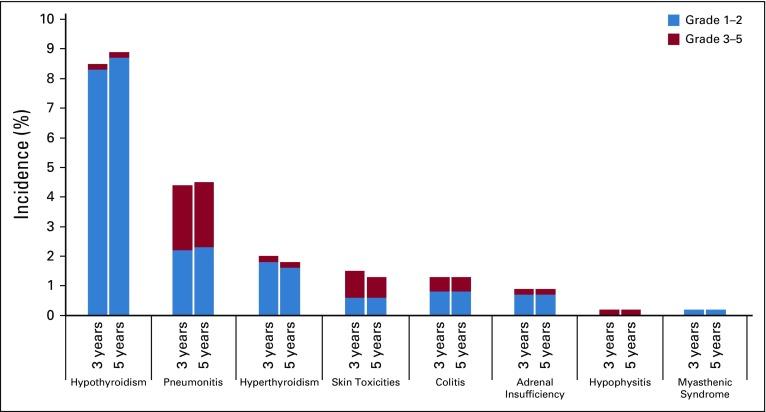
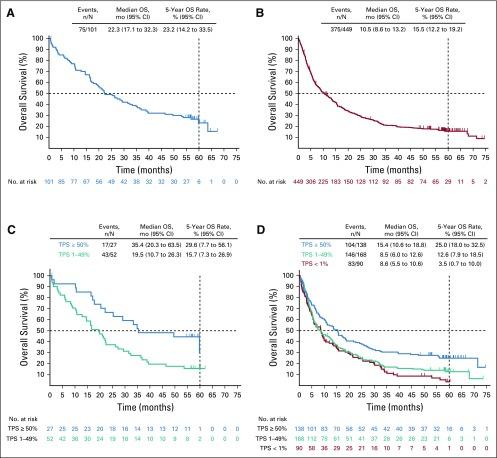
We enrolled 101 treatment-naive and 449 previously treated patients. Median follow-up was 60.6 months (range, 51.8 to 77.9 months). At data cutoff-November 5, 2018-450 patients (82%) had died. Median OS was 22.3 months (95% CI, 17.1 to 32.3 months) in treatment-naive patients and 10.5 months (95% CI, 8.6 to 13.2 months) in previously treated patients. Estimated 5-year OS was 23.2% for treatment-naive patients and 15.5% for previously treated patients. In patients with a PD-L1 tumor proportion score of 50% or greater, 5-year OS was 29.6% and 25.0% in treatment-naive and previously treated patients, respectively. Compared with analysis at 3 years, only three new-onset treatment-related grade 3 adverse events occurred (hypertension, glucose intolerance, and hypersensitivity reaction, all resolved). No late-onset grade 4 or 5 treatment-related adverse events occurred.
CONCLUSION
Pembrolizumab monotherapy provided durable antitumor activity and high 5-year OS rates in patients with treatment-naive or previously treated advanced NSCLC. Of note, the 5-year OS rate exceeded 25% among patients with a PD-L1 tumor proportion score of 50% or greater. Pembrolizumab had a tolerable long-term safety profile with little evidence of late-onset or new toxicity.
目的
帕博利珠单抗单药治疗在晚期程序性死亡配体 1(PD-L1)表达的非小细胞肺癌(NSCLC)中显示出持久的抗肿瘤活性。我们报告了来自 Ib 期 KEYNOTE-001 研究的 5 年结果。这些数据为接受帕博利珠单抗单药治疗的 NSCLC 患者提供了最长的疗效和安全性随访。
方法
符合条件的患者患有局部晚期/转移性 NSCLC,并通过免疫组织化学使用 22C3 抗体对 PD-L1 进行了同期肿瘤样本评估。患者接受静脉注射帕博利珠单抗 2 mg/kg,每 3 周一次,或 10 mg/kg,每 2 或 3 周一次。研究者根据免疫相关反应标准评估反应。主要疗效终点是客观缓解率。总生存期(OS)和缓解持续时间是次要终点。
结果
我们招募了 101 名未经治疗的患者和 449 名先前治疗的患者。中位随访时间为 60.6 个月(范围,51.8 至 77.9 个月)。在数据截止日期-2018 年 11 月 5 日,450 名患者(82%)死亡。在未经治疗的患者中,中位 OS 为 22.3 个月(95%CI,17.1 至 32.3 个月),在先前治疗的患者中为 10.5 个月(95%CI,8.6 至 13.2 个月)。未经治疗的患者 5 年 OS 估计为 23.2%,先前治疗的患者为 15.5%。在 PD-L1 肿瘤比例评分≥50%的患者中,未经治疗和先前治疗的患者 5 年 OS 分别为 29.6%和 25.0%。与 3 年分析相比,仅发生了三例新的与治疗相关的 3 级不良事件(高血压、葡萄糖不耐受和过敏反应,均已解决)。没有发生迟发性 4 或 5 级与治疗相关的不良事件。
结论
帕博利珠单抗单药治疗在治疗初治或先前治疗的晚期 NSCLC 患者中提供了持久的抗肿瘤活性和高 5 年 OS 率。值得注意的是,PD-L1 肿瘤比例评分≥50%的患者 5 年 OS 率超过 25%。帕博利珠单抗具有可耐受的长期安全性特征,几乎没有迟发性或新毒性的证据。
 Zotero 插件