
利用抗菌肽开发抗菌协同作用。
Developing Antimicrobial Synergy With AMPs.
作者信息
Duong Leora, Gross Steven P, Siryaporn Albert
机构信息
Department of Molecular Biology & Biochemistry, University of California, Irvine, Irvine, CA, United States.
Department of Developmental and Cell Biology, University of California, Irvine, Irvine, CA, United States.
出版信息
Front Med Technol. 2021 Mar 12;3:640981. doi: 10.3389/fmedt.2021.640981. eCollection 2021.
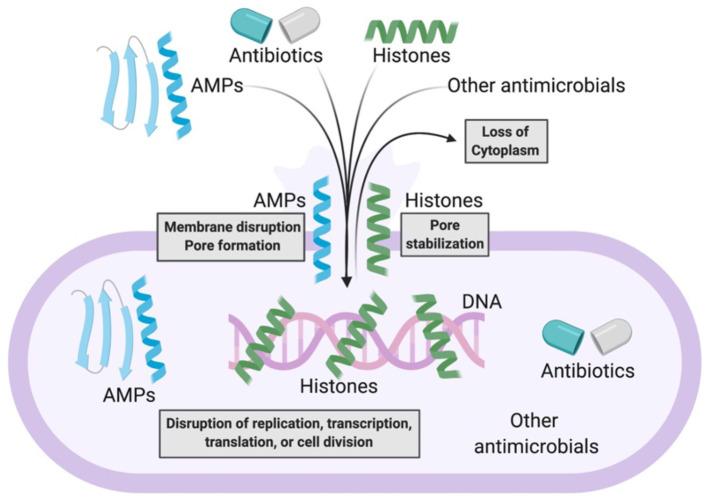
Antimicrobial peptides (AMPs) have been extensively studied due to their vast natural abundance and ability to kill microbes. In an era critically lacking in new antibiotics, manipulating AMPs for therapeutic application is a promising option. However, bacterial pathogens resistant to AMPs remain problematic. To improve AMPs antimicrobial efficacy, their use in conjunction with other antimicrobials has been proposed. How might this work? AMPs kill bacteria by forming pores in bacterial membranes or by inhibiting bacterial macromolecular functions. What remains unknown is the duration for which AMPs keep bacterial pores open, and the extent to which bacteria can recover by repairing these pores. In this mini-review, we discuss various antimicrobial synergies with AMPs. Such synergies might arise if the antimicrobial agents helped to keep bacterial pores open for longer periods of time, prevented pore repair, perturbed bacterial intracellular functions at greater levels, or performed other independent bacterial killing mechanisms. We first discuss combinations of AMPs, and then focus on histones, which have antimicrobial activity and co-localize with AMPs on lipid droplets and in neutrophil extracellular traps (NETs). Recent work has demonstrated that histones can enhance AMP-induced membrane permeation. It is possible that histones, histone fragments, and histone-like peptides could amplify the antimicrobial effects of AMPs, giving rise to antimicrobial synergy. If so, clarifying these mechanisms will thus improve our overall understanding of the antimicrobial processes and potentially contribute to improved drug design.
抗菌肽(AMPs)因其丰富的天然存在和杀灭微生物的能力而受到广泛研究。在严重缺乏新型抗生素的时代,操控抗菌肽用于治疗是一个有前景的选择。然而,对抗菌肽耐药的细菌病原体仍然是个问题。为提高抗菌肽的抗菌效力,人们提出将其与其他抗菌剂联合使用。这是如何起作用的呢?抗菌肽通过在细菌膜上形成孔道或抑制细菌大分子功能来杀死细菌。尚不清楚的是抗菌肽使细菌孔道保持开放的持续时间,以及细菌通过修复这些孔道能够恢复的程度。在这篇小型综述中,我们讨论了与抗菌肽的各种抗菌协同作用。如果抗菌剂有助于使细菌孔道开放更长时间、防止孔道修复、更大程度地扰乱细菌细胞内功能或执行其他独立的细菌杀灭机制,就可能会产生这种协同作用。我们首先讨论抗菌肽的组合,然后重点关注组蛋白,其具有抗菌活性,并与抗菌肽共定位于脂滴和中性粒细胞胞外诱捕网(NETs)中。最近的研究表明,组蛋白可以增强抗菌肽诱导的膜通透性。组蛋白、组蛋白片段和类组蛋白肽有可能放大抗菌肽的抗菌效果,从而产生抗菌协同作用。如果是这样,阐明这些机制将因此提高我们对抗菌过程的整体理解,并可能有助于改进药物设计。

 Zotero 插件