
血清可溶性程序性死亡受体-1及ADV评分对既往未治疗的肝细胞癌患者活体肝移植的预后影响
Prognostic impact of serum soluble PD-1 and ADV score for living donor liver transplantation in patients with previously untreated hepatocellular carcinoma.
作者信息
Hwang Shin, Lee Kyung Jin, Moon Deok-Bog, Song Gi-Won, Jung Dong-Hwan, Kim Yun Kyu, Yang Hunji, An Da Eun, Lee Sion, Lee Sung-Gyu
机构信息
Division of Hepatobiliary Surgery and Liver Transplantation, Department of Surgery, Asan Medical Center, University of Ulsan College of Medicine, Seoul, Korea.
Asan Institute of Life Sciences, Asan Medical Center, University of Ulsan College of Medicine, Seoul, Korea.
出版信息
Ann Surg Treat Res. 2022 Jan;102(1):46-54. doi: 10.4174/astr.2022.102.1.46. Epub 2022 Jan 3.
PURPOSE
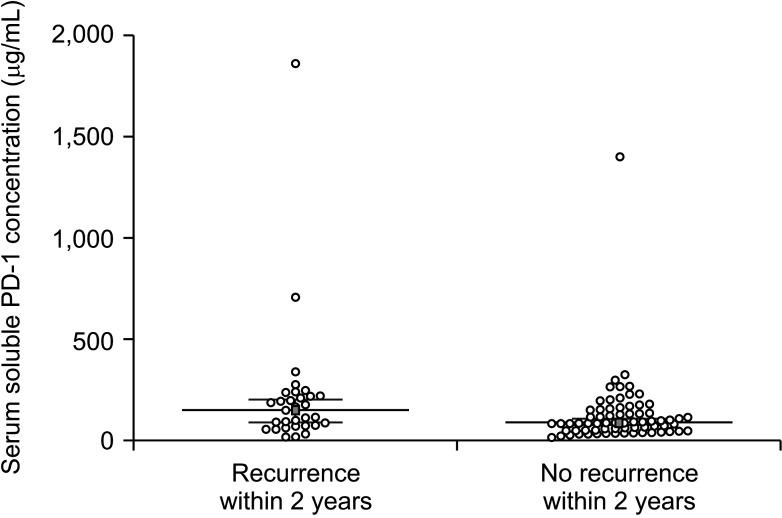
The programmed death protein 1 (PD-1) pathway is the critical mechanism in development of hepatocellular carcinoma (HCC). The present study analyzed the prognostic impact of pretransplant serum soluble PD-1 (sPD-1) concentration and α-FP-des-γ-carboxyprothrombin-tumor volume (ADV) score in patients with previously untreated HCC undergone liver transplantation (LT).
METHODS
This retrospective single-center study enrolled 100 patients with HCC who underwent living donor LT from 2010 to 2016. Concentrations of sPD-1 were measured in stored serum samples.
RESULTS
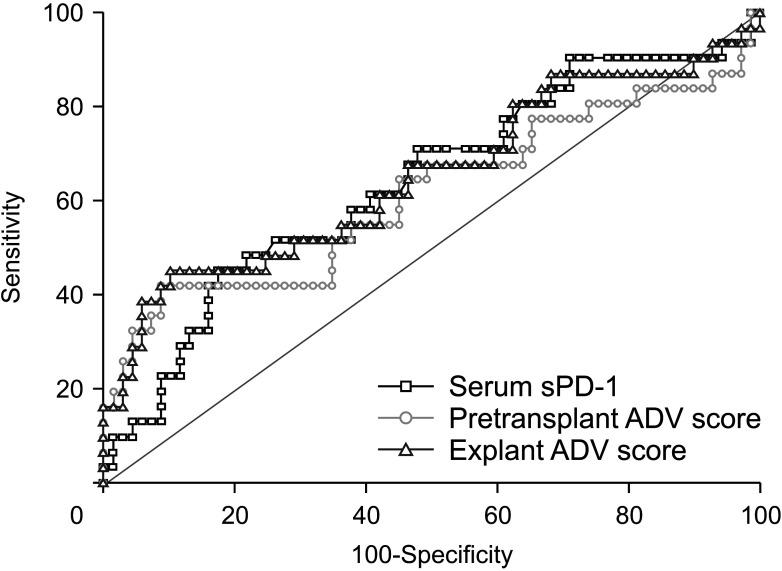
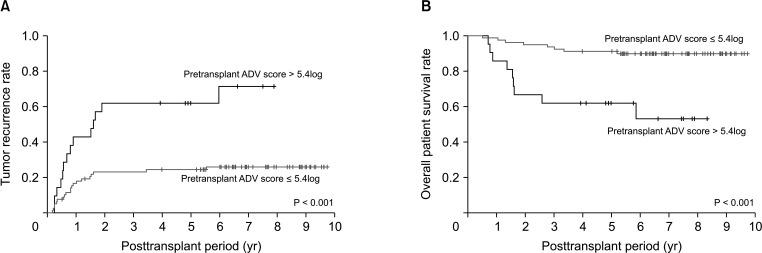
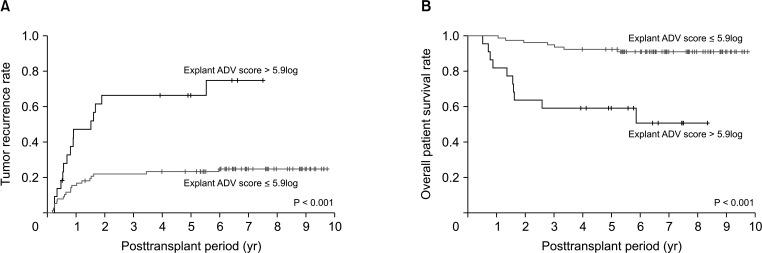
Receiver operating characteristic curve analysis of 2-year tumor recurrence resulted in an sPD-1 cutoff of 177.1 µg/mL, which was associated with higher rates of tumor recurrence (P = 0.022), but not with overall patient survival (P = 0.460). The derived cutoff for pretransplant ADV score was 5.4log, which was associated with higher tumor recurrence rate (P < 0.001) and lower overall patient survival rate (P < 0.001). Both sPD-1 of >177.1 µg/mL (hazard ratio [HR], 2.26; P = 0.020) and pretransplant ADV score of >5.4log (HR, 3.56; P < 0.001) were independent risk factors for posttransplant HCC recurrence. The combination of these 2 factors enabled the stratification of patients into 3 groups, with groups having 0, 1, and 2 risk factors differing significantly in the prognosis of tumor recurrence (P < 0.001) and overall patient survival (P = 0.006).
CONCLUSION
Both sPD-1 concentration and ADV score have prognostic impacts in patients who underwent LT for untreated HCCs. These factors, both individually and combined, can help in predicting posttransplant prognosis.
目的
程序性死亡蛋白1(PD-1)通路是肝细胞癌(HCC)发生发展的关键机制。本研究分析了移植前血清可溶性PD-1(sPD-1)浓度和α-甲胎蛋白-脱γ-羧基凝血酶原-肿瘤体积(ADV)评分对既往未接受治疗的HCC患者行肝移植(LT)后的预后影响。
方法
这项回顾性单中心研究纳入了2010年至2016年接受活体供肝LT的100例HCC患者。在储存的血清样本中检测sPD-1浓度。
结果
对2年肿瘤复发情况进行的受试者工作特征曲线分析得出sPD-1的截断值为177.1μg/mL,这与较高的肿瘤复发率相关(P = 0.022),但与患者总体生存率无关(P = 0.460)。移植前ADV评分的推导截断值为5.4log,这与较高的肿瘤复发率(P < 0.001)和较低的患者总体生存率(P < 0.001)相关。sPD-1>177.1μg/mL(风险比[HR],2.26;P = 0.020)和移植前ADV评分>5.4log(HR,3.56;P < 0.001)均为移植后HCC复发的独立危险因素。这两个因素的组合可将患者分为3组,具有0、1和2个危险因素的组在肿瘤复发预后(P < 0.001)和患者总体生存预后(P = 0.006)方面存在显著差异。
结论
sPD-1浓度和ADV评分对未治疗的HCC患者行LT后的预后均有影响。这些因素单独或联合使用都有助于预测移植后的预后。


 Zotero 插件