
染色体外环状DNA(eccDNA):从无序到功能
Extrachromosomal Circular DNA (eccDNA): From Chaos to Function.
作者信息
Zuo Shanru, Yi Yihu, Wang Chen, Li Xueguang, Zhou Mingqing, Peng Qiyao, Zhou Junhua, Yang Yide, He Quanyuan
机构信息
Department of Pharmacy, The Third Xiangya Hospital, Central South University, Changsha, China.
The Key Laboratory of Model Animals and Stem Cell Biology in Hunan Province, School of Medicine, Hunan Normal University, Changsha, China.
出版信息
Front Cell Dev Biol. 2022 Jan 6;9:792555. doi: 10.3389/fcell.2021.792555. eCollection 2021.
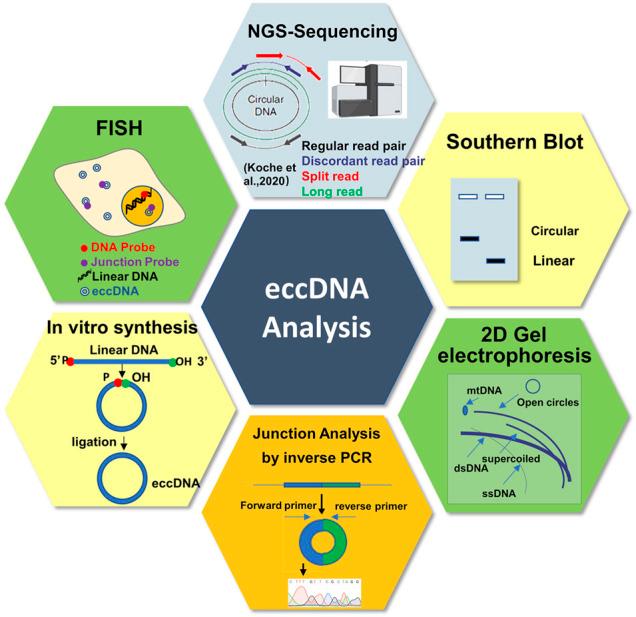
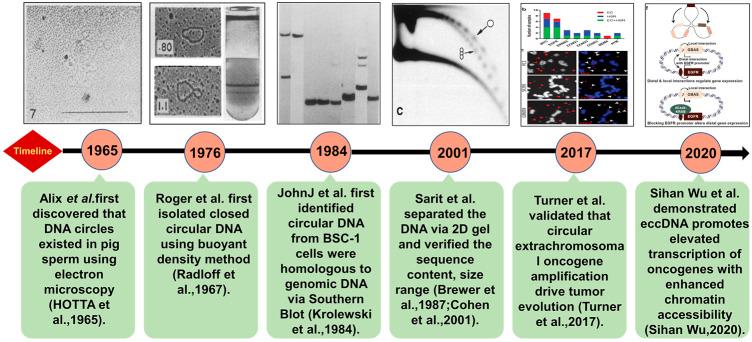
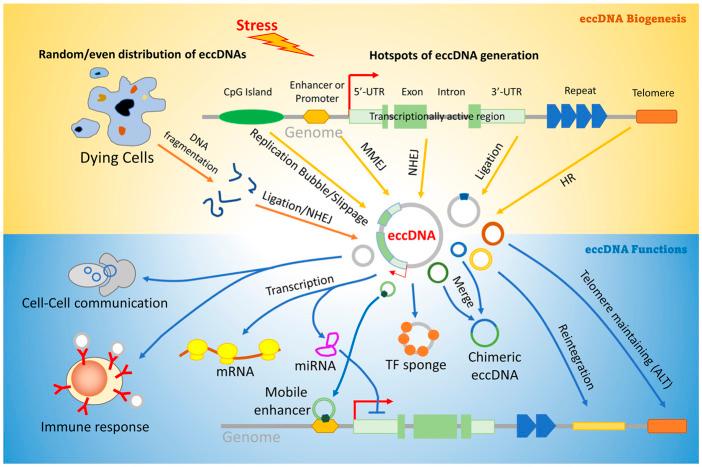
Extrachromosomal circular DNA (eccDNA) is a type of double-stranded circular DNA that is derived and free from chromosomes. It has a strong heterogeneity in sequence, length, and origin and has been identified in both normal and cancer cells. Although many studies suggested its potential roles in various physiological and pathological procedures including aging, telomere and rDNA maintenance, drug resistance, and tumorigenesis, the functional relevance of eccDNA remains to be elucidated. Recently, due to technological advancements, accumulated evidence highlighted that eccDNA plays an important role in cancers by regulating the expression of oncogenes, chromosome accessibility, genome replication, immune response, and cellular communications. Here, we review the features, biogenesis, physiological functions, potential functions in cancer, and research methods of eccDNAs with a focus on some open problems in the field and provide a perspective on how eccDNAs evolve specific functions out of the chaos in cells.
染色体外环状DNA(eccDNA)是一种双链环状DNA,它源自染色体但游离于染色体之外。它在序列、长度和起源方面具有很强的异质性,已在正常细胞和癌细胞中均被鉴定出来。尽管许多研究表明其在包括衰老、端粒和核糖体DNA维持、耐药性及肿瘤发生等各种生理和病理过程中具有潜在作用,但eccDNA的功能相关性仍有待阐明。最近,由于技术进步,积累的证据突出表明,eccDNA通过调节癌基因表达、染色体可及性、基因组复制、免疫反应和细胞通讯在癌症中发挥重要作用。在此,我们综述eccDNA的特征、生物发生、生理功能、在癌症中的潜在功能以及研究方法,重点关注该领域的一些未解决问题,并就eccDNA如何在细胞的混乱状态中演化出特定功能提供一个观点。

 Zotero 插件