
筛选大流行应对框,确定苯并咪唑氨基甲酸酯、奥洛福米和拉夫康唑为治疗外耳真菌病的有希望的药物候选物。
Screening the pandemic response box identified benzimidazole carbamates, Olorofim and ravuconazole as promising drug candidates for the treatment of eumycetoma.
机构信息
Erasmus MC, University Medical Center Rotterdam, Department of Microbiology and Infectious Diseases, Rotterdam, The Netherlands.
Mycetoma Research Centre, University of Khartoum, Khartoum, Sudan.
出版信息
PLoS Negl Trop Dis. 2022 Feb 4;16(2):e0010159. doi: 10.1371/journal.pntd.0010159. eCollection 2022 Feb.
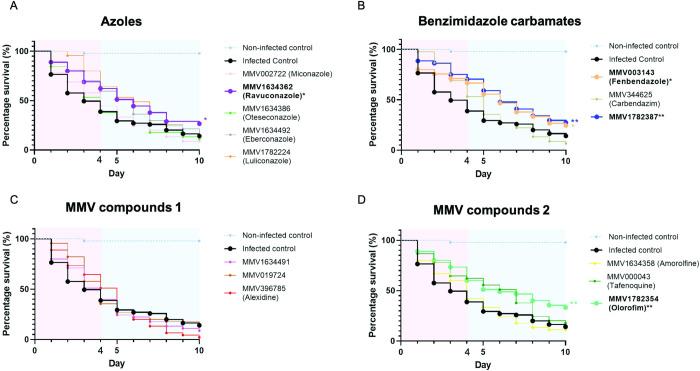
Eumycetoma is a chronic subcutaneous neglected tropical disease that can be caused by more than 40 different fungal causative agents. The most common causative agents produce black grains and belong to the fungal orders Sordariales and Pleosporales. The current antifungal agents used to treat eumycetoma are itraconazole or terbinafine, however, their cure rates are low. To find novel drugs for eumycetoma, we screened 400 diverse drug-like molecules from the Pandemic Response Box against common eumycetoma causative agents as part of the Open Source Mycetoma initiative (MycetOS). 26 compounds were able to inhibit the growth of Madurella mycetomatis, Madurella pseudomycetomatis and Madurella tropicana, 26 compounds inhibited Falciformispora senegalensis and seven inhibited growth of Medicopsis romeroi in vitro. Four compounds were able to inhibit the growth of all five species of fungi tested. They are the benzimidazole carbamates fenbendazole and carbendazim, the 8-aminoquinolone derivative tafenoquine and MMV1578570. Minimal inhibitory concentrations were then determined for the compounds active against M. mycetomatis. Compounds showing potent activity in vitro were further tested in vivo. Fenbendazole, MMV1782387, ravuconazole and olorofim were able to significantly prolong Galleria mellonella larvae survival and are promising candidates to explore in mycetoma treatment and to also serve as scaffolds for medicinal chemistry optimisation in the search for novel antifungals to treat eumycetoma.
球腔菌病是一种慢性皮下热带病,可由 40 多种不同的真菌病原体引起。最常见的病原体产生黑色颗粒,属于子囊菌门和腔菌门。目前用于治疗球腔菌病的抗真菌药物是伊曲康唑或特比萘芬,但它们的治愈率较低。为了寻找治疗球腔菌病的新药,我们作为开源球腔菌倡议(MycetOS)的一部分,从大流行性疾病应对工具箱中筛选了 400 种不同的类药物分子,针对常见的球腔菌病原体进行了筛选。有 26 种化合物能够抑制Madurella mycetomatis、Madurella pseudomycetomatis 和 Madurella tropicana 的生长,有 26 种化合物能够抑制Falciformispora senegalensis 的生长,有 7 种化合物能够抑制Medicopsis romeroi的生长。有 4 种化合物能够抑制所有 5 种测试真菌的生长。它们是苯并咪唑氨基甲酸酯芬苯达唑和多菌灵、8-氨基喹啉衍生物tafenoquine 和 MMV1578570。然后确定了对 M. mycetomatis 有活性的化合物的最小抑菌浓度。对在体外表现出有效活性的化合物进行了进一步的体内测试。芬苯达唑、MMV1782387、拉夫康唑和奥洛福林能够显著延长金龟子幼虫的存活时间,是探索球腔菌病治疗的有希望的候选药物,也可作为药物化学优化的支架,以寻找治疗球腔菌病的新型抗真菌药物。


 Zotero 插件