
儿童重症 COVID-19 的危险因素:系统评价和荟萃分析。
Risk Factors for Severe COVID-19 in Children: A Systematic Review and Meta-Analysis.
机构信息
Department of Pediatrics, Jeju National University School of Medicine, Jeju, Korea.
Department of Pediatrics, Pusan National University Hospital, Busan, Korea.
出版信息
J Korean Med Sci. 2022 Feb 7;37(5):e35. doi: 10.3346/jkms.2022.37.e35.
BACKGROUND
Coronavirus disease 2019 (COVID-19) has been the most important global issue since December 2019. Although the clinical course of COVID-19 is known to be milder in children than in adults, associated hospitalizations among children have increased since the emergence of contagious severe acute respiratory syndrome coronavirus 2 (SARS-CoV-2) variants and the achievement of a high vaccination rate in adults. Considering these global and domestic situations, we believe that risk stratification in children with COVID-19 is urgently needed for decision making regarding hospitalization priority in children infected with SARS-CoV-2 and vaccination priority against COVID-19.
METHODS
This systematic review and meta-analysis was performed by comprehensively searching the PubMed, EMBASE, Scopus and KoreaMed databases through August 25, 2021. The criteria for enrollment were "severe COVID-19" as poor outcomes (intensive care unit admission, invasive mechanical ventilation, and/or death) and underlying comorbidities before SARS-CoV-2 infection.
RESULTS
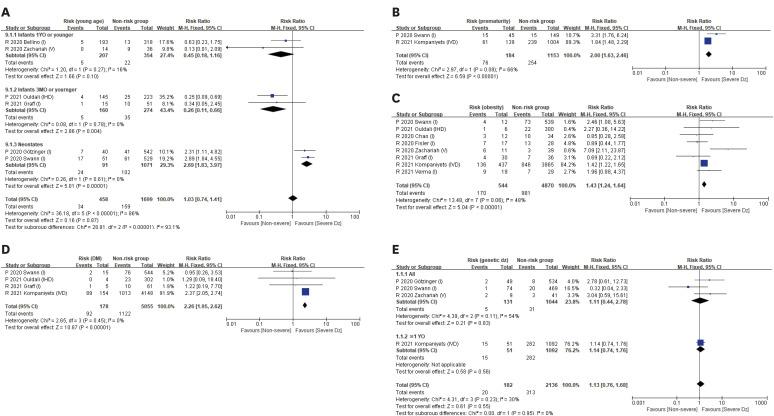
Among 872 screened studies, 17 articles were included in the systematic review, and 10 articles were included in the meta-analysis. Neonate (risk ratio [RR], 2.69; 95% confidence interval [CI], 1.83-3.97), prematurity in young infants (RR, 2.00; 95% CI, 1.63-2.46), obesity (RR, 1.43; 95% CI, 1.24-1.64), diabetes (RR, 2.26; 95% CI, 1.95-2.62), chronic lung disease (RR, 2.62; 95% CI, 1.71-4.00), heart disease (RR, 1.82; 95% CI, 1.58-2.09), neurologic disease (RR, 1.18; 95% CI, 1.05-1.33), and immunocompromised status (RR, 1.44; 95% CI, 1.01-2.04) were significant risk factors for severe COVID-19 in children. In the subgroup analysis, age younger than 3 months (RR, 0.26; 95% CI, 0.11-0.66), asthma (RR, 1.08; 95% CI, 0.98-1.20), and neurodevelopmental disorders (RR, 0.88; 95% CI, 0.75-1.04) were not risk factors for severe COVID-19.
CONCLUSION
Children with comorbidities such as obesity, diabetes, heart disease, chronic lung diseases other than asthma, seizure disorders, and an immunocompromised status had a high prevalence of severe COVID-19. Neonate and premature infants had a high risk of severe COVID-19. Defining the high-risk group for severe COVID-19 could help to guide hospital admission and priority for vaccination against SARS-CoV-2.
背景
自 2019 年 12 月以来,新型冠状病毒病 2019(COVID-19)一直是全球最重要的问题。尽管 COVID-19 的临床过程在儿童中比在成人中较轻,但随着传染性严重急性呼吸综合征冠状病毒 2(SARS-CoV-2)变异株的出现和成人疫苗接种率的提高,儿童相关住院人数有所增加。考虑到这些全球和国内情况,我们认为迫切需要对 COVID-19 患儿进行风险分层,以便对感染 SARS-CoV-2 的儿童的住院优先级和 COVID-19 疫苗接种优先级做出决策。
方法
本系统评价和荟萃分析通过全面搜索 PubMed、EMBASE、Scopus 和 KoreaMed 数据库,于 2021 年 8 月 25 日进行。纳入标准为“严重 COVID-19”作为不良结局(重症监护病房入院、有创机械通气和/或死亡)和 SARS-CoV-2 感染前存在合并症。
结果
在 872 项筛选研究中,17 项研究纳入系统评价,10 项研究纳入荟萃分析。新生儿(风险比 [RR],2.69;95%置信区间 [CI],1.83-3.97)、婴幼儿早产(RR,2.00;95%CI,1.63-2.46)、肥胖(RR,1.43;95%CI,1.24-1.64)、糖尿病(RR,2.26;95%CI,1.95-2.62)、慢性肺部疾病(RR,2.62;95%CI,1.71-4.00)、心脏病(RR,1.82;95%CI,1.58-2.09)、神经系统疾病(RR,1.18;95%CI,1.05-1.33)和免疫功能低下状态(RR,1.44;95%CI,1.01-2.04)是儿童发生严重 COVID-19 的显著危险因素。在亚组分析中,年龄小于 3 个月(RR,0.26;95%CI,0.11-0.66)、哮喘(RR,1.08;95%CI,0.98-1.20)和神经发育障碍(RR,0.88;95%CI,0.75-1.04)不是严重 COVID-19 的危险因素。
结论
肥胖、糖尿病、心脏病、除哮喘以外的慢性肺部疾病、癫痫发作障碍和免疫功能低下等合并症的儿童发生严重 COVID-19 的患病率较高。新生儿和早产儿有发生严重 COVID-19 的高风险。确定严重 COVID-19 的高危人群有助于指导住院和 SARS-CoV-2 疫苗接种的优先级。


 Zotero 插件