
cPLA2 阻断通过抑制免疫抑制性肿瘤微环境来减弱 S100A7 介导的乳腺癌发生。
cPLA2 blockade attenuates S100A7-mediated breast tumorigenicity by inhibiting the immunosuppressive tumor microenvironment.
机构信息
Department of Pathology, College of Medicine, The Ohio State University, Columbus, OH, 43210, USA.
Comprehensive Cancer Center, The Ohio State University, Columbus, OH, 43210, USA.
出版信息
J Exp Clin Cancer Res. 2022 Feb 8;41(1):54. doi: 10.1186/s13046-021-02221-0.
BACKGROUND
Molecular mechanisms underlying inflammation-associated breast tumor growth are poorly studied. S100A7, a pro-inflammatory molecule has been shown to enhance breast cancer growth and metastasis. However, the S100A7-mediated molecular mechanisms in enhancing tumor growth and metastasis are unclear.
METHODS
Human breast cancer tissue and plasma samples were used to analyze the expression of S100A7, cPLA2, and PGE2. S100A7-overexpressing or downregulated human metastatic breast cancer cells were used to evaluate the S100A7-mediated downstream signaling mechanisms. Bi-transgenic mS100a7a15 overexpression, TNBC C3 (1)/Tag transgenic, and humanized patient-derived xenograft mouse models and cPLA2 inhibitor (AACOCF3) were used to investigate the role of S100A7/cPLA2/PGE2 signaling in tumor growth and metastasis. Additionally, CODEX, a highly advanced multiplexed imaging was employed to delineate the effects of S100A7/cPLA2 inhibition on the recruitment of various immune cells.
RESULTS
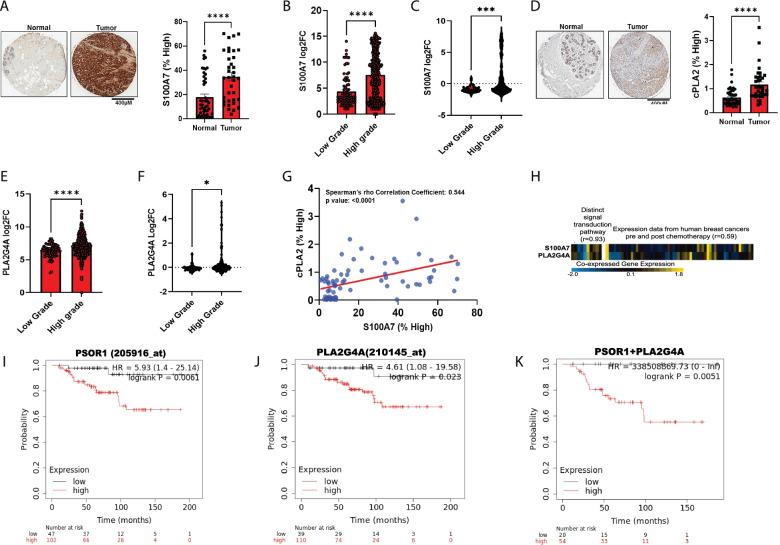
In this study, we found that S100A7 and cPLA2 are highly expressed and correlate with decreased overall survival in breast cancer patients. Further mechanistic studies revealed that S100A7/RAGE signaling promotes the expression of cPLA2 to mediate its oncogenic effects. Pharmacological inhibition of cPLA2 suppressed S100A7-mediated tumor growth and metastasis in multiple pre-clinical models including transgenic and humanized patient-derived xenograft (PDX) mouse models. The attenuation of cPLA2 signaling reduced S100A7-mediated recruitment of immune-suppressive myeloid cells in the tumor microenvironment (TME). Interestingly, we discovered that the S100A7/cPLA2 axis enhances the immunosuppressive microenvironment by increasing prostaglandin E2 (PGE2). Furthermore, CO-Detection by indEXing (CODEX) imaging-based analyses revealed that cPLA2 inhibition increased the infiltration of activated and proliferating CD4 and CD8 T cells in the TME. In addition, CD163 tumor associated-macrophages were positively associated with S100A7 and cPLA2 expression in malignant breast cancer patients.
CONCLUSIONS
Our study provides new mechanistic insights on the cross-talk between S100A7/cPLA2 in enhancing breast tumor growth and metastasis by generating an immunosuppressive TME that inhibits the infiltration of cytotoxic T cells. Furthermore, our studies indicate that S100A7/cPLA2 could be used as novel prognostic marker and cPLA2 inhibitors as promising drugs against S100A7-overexpressing aggressive breast cancer.
背景
炎症相关的乳腺癌生长的分子机制研究甚少。S100A7 是一种促炎分子,已被证明可增强乳腺癌的生长和转移。然而,S100A7 介导的增强肿瘤生长和转移的分子机制尚不清楚。
方法
使用人乳腺癌组织和血浆样本分析 S100A7、cPLA2 和 PGE2 的表达。使用 S100A7 过表达或下调的人转移性乳腺癌细胞评估 S100A7 介导的下游信号通路机制。使用双转基因 mS100a7a15 过表达、三阴性乳腺癌 C3(1)/Tag 转基因和人源化患者衍生异种移植小鼠模型以及 cPLA2 抑制剂(AACOCF3)研究 S100A7/cPLA2/PGE2 信号在肿瘤生长和转移中的作用。此外,使用高度先进的多重成像 CODEX 来描绘 S100A7/cPLA2 抑制对各种免疫细胞募集的影响。
结果
在这项研究中,我们发现 S100A7 和 cPLA2 在乳腺癌患者中高表达且与总生存期缩短相关。进一步的机制研究表明,S100A7/RAGE 信号促进 cPLA2 的表达以介导其致癌作用。cPLA2 的药理学抑制抑制了多种临床前模型(包括转基因和人源化患者衍生异种移植(PDX)小鼠模型)中 S100A7 介导的肿瘤生长和转移。cPLA2 信号的衰减减少了 S100A7 介导的肿瘤微环境(TME)中免疫抑制性髓样细胞的募集。有趣的是,我们发现 S100A7/cPLA2 轴通过增加前列腺素 E2(PGE2)来增强免疫抑制微环境。此外,基于 CO-Detection by indEXing(CODEX)成像的分析表明,cPLA2 抑制增加了 TME 中活化和增殖的 CD4 和 CD8 T 细胞的浸润。此外,CD163 肿瘤相关巨噬细胞与恶性乳腺癌患者中 S100A7 和 cPLA2 的表达呈正相关。
结论
我们的研究通过产生抑制细胞毒性 T 细胞浸润的免疫抑制 TME,提供了 S100A7/cPLA2 增强乳腺癌肿瘤生长和转移的相互作用的新机制见解。此外,我们的研究表明,S100A7/cPLA2 可作为新型预后标志物,cPLA2 抑制剂可作为治疗 S100A7 过表达侵袭性乳腺癌的有前途的药物。



 Zotero 插件