
在意大利德尔塔变异株流行期间,mRNA 疫苗对 SARS-CoV-2 感染和重症 COVID-19 的有效性及其保护作用的衰减:回顾性队列研究。
Effectiveness of mRNA vaccines and waning of protection against SARS-CoV-2 infection and severe covid-19 during predominant circulation of the delta variant in Italy: retrospective cohort study.
机构信息
Italian National Institute of Health (ISS), Rome, Italy
Italian National Institute of Health (ISS), Rome, Italy.
出版信息
BMJ. 2022 Feb 10;376:e069052. doi: 10.1136/bmj-2021-069052.
OBJECTIVES
To estimate the effectiveness of mRNA vaccines against SARS-CoV-2 infection and severe covid-19 at different time after vaccination.
DESIGN
Retrospective cohort study.
SETTING
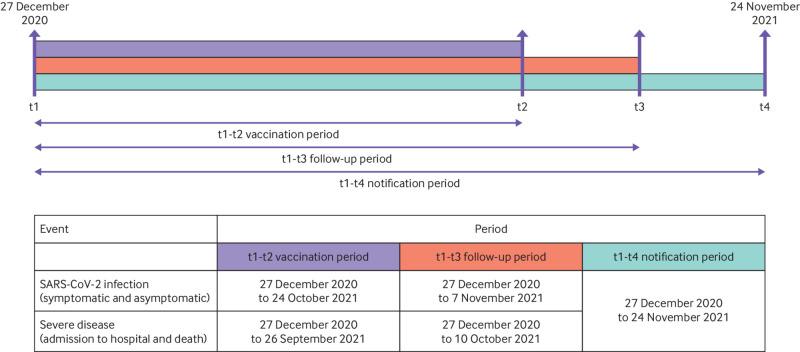
Italy, 27 December 2020 to 7 November 2021.
PARTICIPANTS
33 250 344 people aged ≥16 years who received a first dose of BNT162b2 (Pfizer-BioNTech) or mRNA-1273 (Moderna) vaccine and did not have a previous diagnosis of SARS-CoV-2 infection.
MAIN OUTCOME MEASURES
SARS-CoV-2 infection and severe covid-19 (admission to hospital or death). Data were divided by weekly time intervals after vaccination. Incidence rate ratios at different time intervals were estimated by multilevel negative binomial models with robust variance estimator. Sex, age group, brand of vaccine, priority risk category, and regional weekly incidence in the general population were included as covariates. Geographic region was included as a random effect. Adjusted vaccine effectiveness was calculated as (1-IRR)×100, where IRR=incidence rate ratio, with the time interval 0-14 days after the first dose of vaccine as the reference.
RESULTS
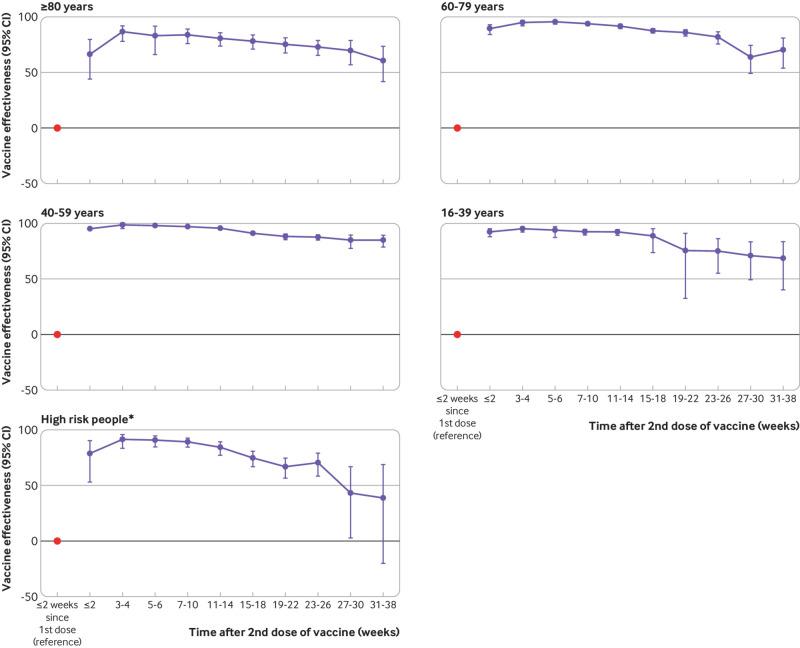
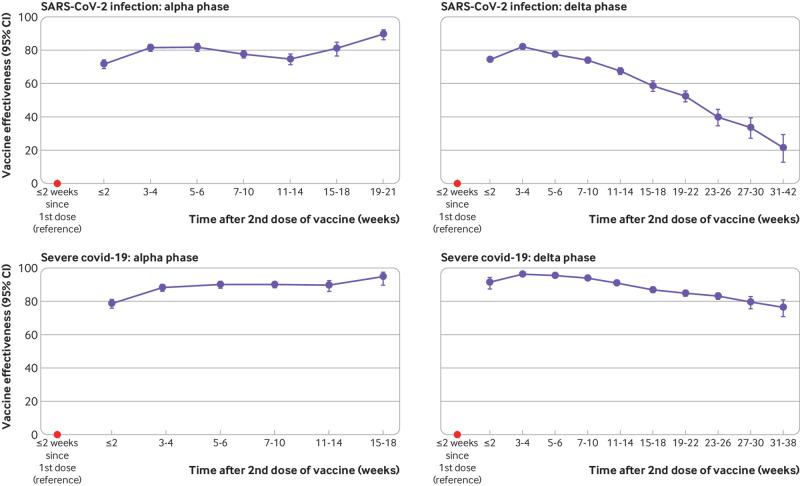
During the epidemic phase when the delta variant was the predominant strain of the SARS-CoV-2 virus, vaccine effectiveness against SARS-CoV-2 infection significantly decreased (P<0.001) from 82% (95% confidence interval 80% to 84%) at 3-4 weeks after the second dose of vaccine to 33% (27% to 39%) at 27-30 weeks after the second dose. In the same time intervals, vaccine effectiveness against severe covid-19 also decreased (P<0.001), although to a lesser extent, from 96% (95% to 97%) to 80% (76% to 83%). High risk people (vaccine effectiveness -6%, -28% to 12%), those aged ≥80 years (11%, -15% to 31%), and those aged 60-79 years (2%, -11% to 14%) did not seem to be protected against infection at 27-30 weeks after the second dose of vaccine.
CONCLUSIONS
The results support the vaccination campaigns targeting high risk people, those aged ≥60 years, and healthcare workers to receive a booster dose of vaccine six months after the primary vaccination cycle. The results also suggest that timing the booster dose earlier than six months after the primary vaccination cycle and extending the offer of the booster dose to the wider eligible population might be warranted.
目的
评估不同时间点接种 mRNA 疫苗后对 SARS-CoV-2 感染和重症 COVID-19 的有效性。
设计
回顾性队列研究。
地点
意大利,2020 年 12 月 27 日至 2021 年 11 月 7 日。
参与者
33250344 名年龄≥16 岁的人群,他们接受了 BNT162b2(辉瑞-生物科技)或 mRNA-1273(莫德纳)疫苗的第一剂,且此前未被诊断为 SARS-CoV-2 感染。
主要结局指标
SARS-CoV-2 感染和重症 COVID-19(住院或死亡)。数据按接种后每周时间间隔进行划分。采用具有稳健方差估计的多层次负二项式模型估计不同时间间隔的发病率比值。性别、年龄组、疫苗品牌、优先风险类别和一般人群的区域每周发病率被纳入协变量。地理区域被纳入随机效应。调整后的疫苗有效性计算为(1-IRR)×100,其中 IRR=发病率比值,以第一剂疫苗接种后 0-14 天的时间间隔为参考。
结果
在 delta 变异株为主导 SARS-CoV-2 病毒株的流行阶段,疫苗对 SARS-CoV-2 感染的有效性显著下降(P<0.001),从第二剂疫苗接种后 3-4 周的 82%(95%置信区间 80%-84%)降至第二剂疫苗接种后 27-30 周的 33%(27%-39%)。在相同的时间间隔内,疫苗对重症 COVID-19 的有效性也有所下降(P<0.001),尽管程度较轻,从 96%(95%置信区间 97%-98%)降至 80%(76%-83%)。高风险人群(疫苗有效性-6%,-28%至 12%)、≥80 岁人群(11%,-15%至 31%)和 60-79 岁人群(2%,-11%至 14%)在第二剂疫苗接种后 27-30 周似乎并未免受感染。
结论
结果支持针对高风险人群、≥60 岁人群和卫生保健工作者的疫苗接种运动,在初次疫苗接种周期后 6 个月接种加强针。结果还表明,在初次疫苗接种周期后 6 个月之前更早接种加强针,并将加强针的接种范围扩大到更广泛的合格人群,可能是合理的。

 Zotero 插件