
CD44/ERM/F-actin 复合物在脓毒症中介导靶向性核脱粒和过度中性粒细胞细胞外陷阱形成。
CD44/ERM/F-actin complex mediates targeted nuclear degranulation and excessive neutrophil extracellular trap formation during sepsis.
机构信息
Department of Burns and Plastic Surgery, Affiliated Suzhou Hospital of Nanjing Medical University, Suzhou, Jiangsu Province, China.
School of Medicine, Jiangsu University, Zhenjiang, Jiangsu Province, China.
出版信息
J Cell Mol Med. 2022 Apr;26(7):2089-2103. doi: 10.1111/jcmm.17231. Epub 2022 Feb 11.
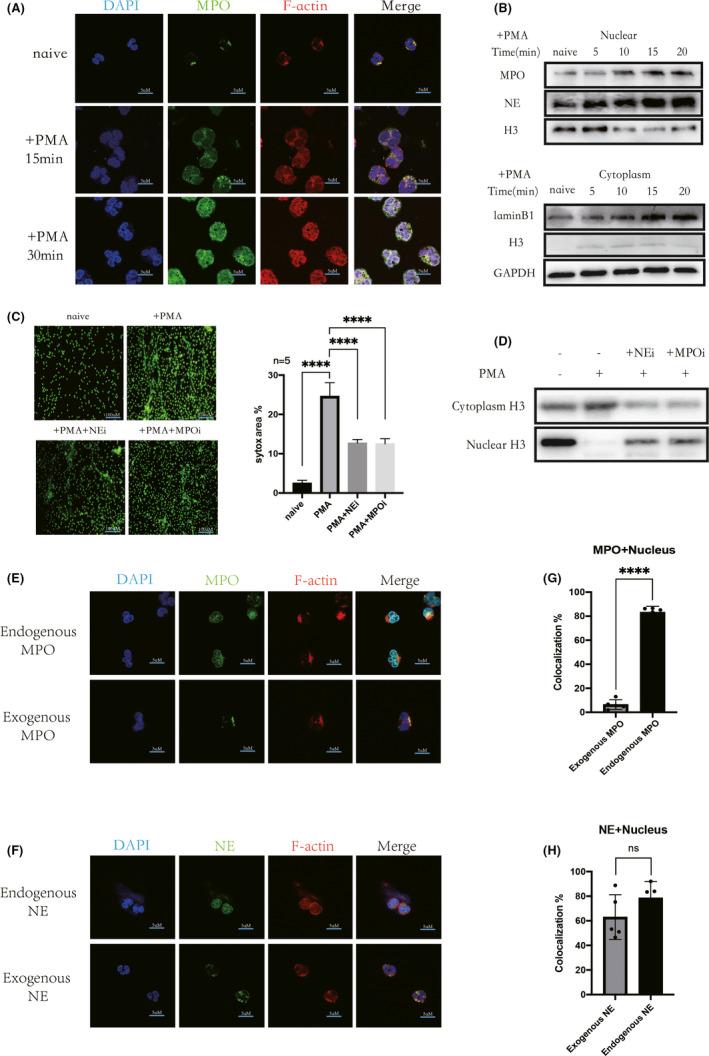
Neutrophils release neutrophil extracellular traps (NETs) to capture and kill pathogens, but excessive NET release can damage the surrounding tissues. Myeloperoxidase (MPO) and neutrophil elastase (NE) are thought to be important in promoting histone depolymerization and DNA breakage in the nucleus. However, the detailed path by which MPO and NE enter the nucleus is unknown. In the present study, we observed that delayed fusion of azurophilic granules with the nuclear membrane 15-20 min after extracellular degranulation in activated neutrophils. In a subsequent experiment, we further demonstrated that this fusion leads to MPO entry into the nucleus and promotes nuclear histone depolymerization and DNA breakage, a process called 'targeted nuclear degranulation'. This process can be effectively inhibited by dexamethasone and accompanied by the continuous low levels of MPO in the nucleus after PMA stimulation. Meanwhile, we found that 'targeted nuclear degranulation' is dependent on the CD44 translocation and subsequent redistribution of CD44 / ERM (Ezrin/Radixin/Moesin) / F-actin complexes, which guides the movement of azurophilic granules towards the nucleus. Application of ERM phosphorylation inhibitors and importin activity inhibitors significantly reduced the complexes formation and redistribution. Taken together, these findings indicate for the first time that delayed 'targeted nuclear degranulation' after neutrophil activation is a key mechanism of NET formation. CD44/ERM/F-actin complex mediates this process, which providing targets with promising prospects for the precise regulation of NET formation.
中性粒细胞通过释放中性粒细胞胞外诱捕网(NETs)来捕获和杀死病原体,但过多的 NET 释放会损害周围组织。髓过氧化物酶(MPO)和中性粒细胞弹性蛋白酶(NE)被认为在促进核内组蛋白解聚和 DNA 断裂中起重要作用。然而,MPO 和 NE 进入细胞核的详细途径尚不清楚。在本研究中,我们观察到在激活的中性粒细胞胞外脱颗粒后 15-20 分钟,嗜天青颗粒与核膜融合延迟。在随后的实验中,我们进一步证明这种融合导致 MPO 进入细胞核,并促进核内组蛋白解聚和 DNA 断裂,这一过程称为“靶向核脱颗粒”。该过程可被地塞米松有效抑制,并伴随着 PMA 刺激后核内 MPO 持续低水平。同时,我们发现“靶向核脱颗粒”依赖于 CD44 的易位和随后 CD44/ERM(Ezrin/Radixin/Moesin)/F-肌动蛋白复合物的重新分布,该复合物指导嗜天青颗粒向细胞核移动。ERM 磷酸化抑制剂和核输入蛋白活性抑制剂的应用显著减少了复合物的形成和重新分布。总之,这些发现首次表明,中性粒细胞激活后延迟的“靶向核脱颗粒”是 NET 形成的关键机制。CD44/ERM/F-肌动蛋白复合物介导了这一过程,为 NET 形成的精确调控提供了有前途的靶点。
 Zotero 插件