
营养保健品和饮食策略对调控巨自噬的作用
Nutraceutical and Dietary Strategies for Up-Regulating Macroautophagy.
机构信息
Catalytic Longevity Foundation, San Diego, CA 92109, USA.
出版信息
Int J Mol Sci. 2022 Feb 12;23(4):2054. doi: 10.3390/ijms23042054.
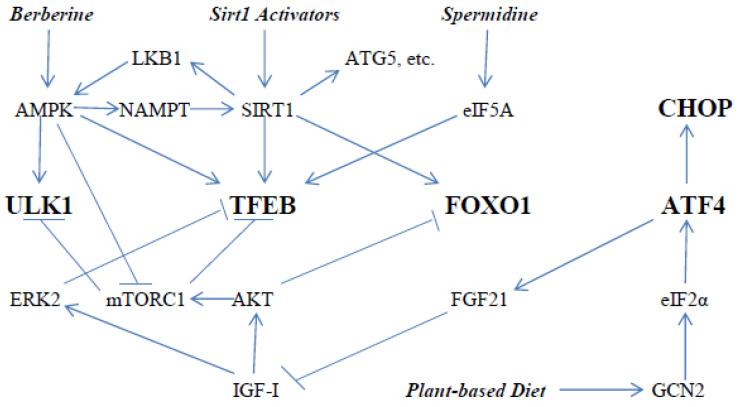
Macroautophagy is a "cell cleansing" process that rids cells of protein aggregates and damaged organelles that may contribute to disease pathogenesis and the dysfunctions associated with aging. Measures which boost longevity and health span in rodents typically up-regulate macroautophagy, and it has often been suggested that safe strategies which can promote this process in humans may contribute to healthful aging. The kinase ULK1 serves as a trigger for autophagy initiation, and the transcription factors TFEB, FOXO1, ATF4 and CHOP promote expression of a number of proteins which mediate macroautophagy. Nutraceutical or dietary measures which stimulate AMPK, SIRT1, eIF5A, and that diminish the activities of AKT and mTORC1, can be expected to boost the activities of these pro-autophagic factors. The activity of AMPK can be stimulated with the phytochemical berberine. SIRT1 activation may be achieved with a range of agents, including ferulic acid, melatonin, urolithin A, N1-methylnicotinamide, nicotinamide riboside, and glucosamine; correction of ubiquinone deficiency may also be useful in this regard, as may dietary strategies such as time-restricted feeding or intermittent fasting. In the context of an age-related decrease in cellular polyamine levels, provision of exogenous spermidine can boost the hypusination reaction required for the appropriate post-translational modification of eIF5A. Low-protein plant-based diets could be expected to increase ATF4 and CHOP expression, while diminishing IGF-I-mediated activation of AKT and mTORC1. Hence, practical strategies for protecting health by up-regulating macroautophagy may be feasible.
自噬是一种“细胞自清洁”过程,可清除可能导致疾病发病机制和与衰老相关的功能障碍的蛋白质聚集体和受损细胞器。在啮齿动物中,延长寿命和健康寿命的措施通常会上调自噬,并且通常认为可以促进人类自噬过程的安全策略可能有助于健康衰老。激酶 ULK1 是自噬起始的触发因素,转录因子 TFEB、FOXO1、ATF4 和 CHOP 促进了许多介导自噬的蛋白质的表达。刺激 AMPK、SIRT1、eIF5A 的营养或饮食措施,以及降低 AKT 和 mTORC1 活性的措施,预计会增强这些促自噬因子的活性。植物化学物质小檗碱可以刺激 AMPK 的活性。SIRT1 的激活可以通过一系列试剂来实现,包括阿魏酸、褪黑素、尿石素 A、N1-甲基烟酰胺、烟酰胺核苷和葡糖胺;纠正泛醌缺乏在这方面可能也很有用,例如限时喂养或间歇性禁食等饮食策略。在与年龄相关的细胞多胺水平下降的情况下,提供外源性亚精胺可以促进 eIF5A 适当的翻译后修饰所需的 hypusination 反应。低蛋白植物性饮食可能会增加 ATF4 和 CHOP 的表达,同时减少 IGF-I 介导的 AKT 和 mTORC1 的激活。因此,通过上调自噬来保护健康的实用策略可能是可行的。
 Zotero 插件