
年轻乳腺癌女性在抗癌治疗前后进行生育力保存技术的安全性:系统评价和荟萃分析。
Safety of fertility preservation techniques before and after anticancer treatments in young women with breast cancer: a systematic review and meta-analysis.
机构信息
U.O. Clinica di Oncologia Medica, IRCCS Ospedale Policlinico San Martino, Genova, Italy.
Department of Internal Medicine and Medical Sciences (DiMI), School of Medicine, University of Genova, Genova, Italy.
出版信息
Hum Reprod. 2022 May 3;37(5):954-968. doi: 10.1093/humrep/deac035.
STUDY QUESTION
Is it safe to perform controlled ovarian stimulation (COS) for fertility preservation before starting anticancer therapies or ART after treatments in young breast cancer patients?
SUMMARY ANSWER
Performing COS before, or ART following anticancer treatment in young women with breast cancer does not seem to be associated with detrimental prognostic effect in terms of breast cancer recurrence, mortality or event-free survival (EFS).
WHAT IS KNOWN ALREADY
COS for oocyte/embryo cryopreservation before starting chemotherapy is standard of care for young women with breast cancer wishing to preserve fertility. However, some oncologists remain concerned on the safety of COS, particularly in patients with hormone-sensitive tumors, even when associated with aromatase inhibitors. Moreover, limited evidence exists on the safety of ART in breast cancer survivors for achieving pregnancy after the completion of anticancer treatments.
STUDY DESIGN, SIZE, DURATION: The present systematic review and meta-analysis was carried out by three blinded investigators using the keywords 'breast cancer' and 'fertility preservation'; keywords were combined with Boolean operators. Eligible studies were identified by a systematic literature search of Medline, Web of Science, Embase and Cochrane library with no language or date restriction up to 30 June 2021.
PARTICIPANTS/MATERIALS, SETTING, METHODS: To be included in this meta-analysis, eligible studies had to be case-control or cohort studies comparing survival outcomes of women who underwent COS or ART before or after breast cancer treatments compared to breast cancer patients not exposed to these strategies. Survival outcomes of interest were cancer recurrence rate, relapse rate, overall survival and number of deaths. Adjusted relative risk (RR) and hazard ratio (HR) with 95% CI were extracted. When the number of events for each group were available but the above measures were not reported, HRs were estimated using the Watkins and Bennett method. We excluded case reports or case series with <10 patients and studies without a control group of breast cancer patients who did not pursue COS or ART. Quality of data and risk of bias were assessed using the Newcastle-Ottawa Assessment Scale.
MAIN RESULTS AND THE ROLE OF CHANCE
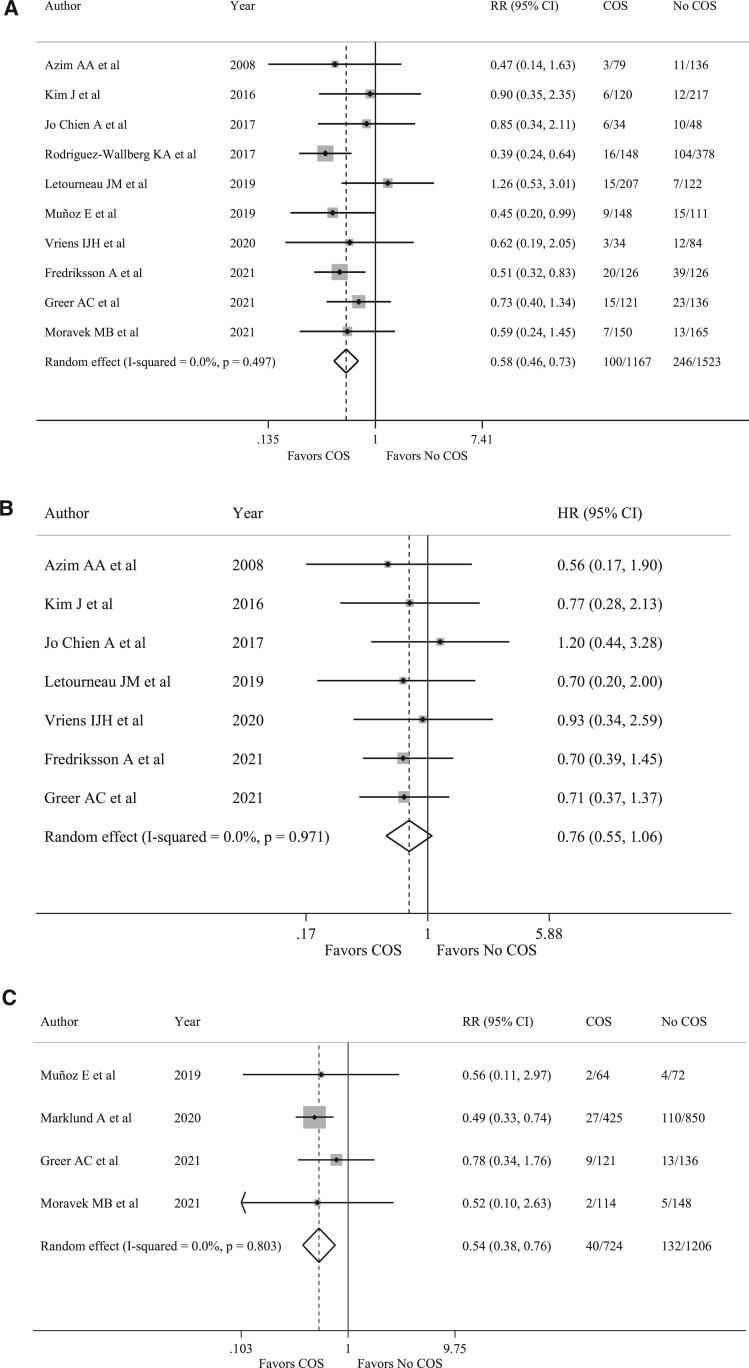
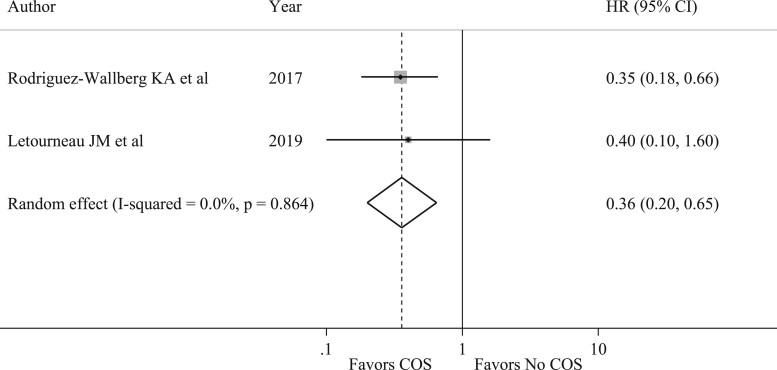
A total of 1835 records were retrieved. After excluding ineligible publications, 15 studies were finally included in the present meta-analysis (n = 4643). Among them, 11 reported the outcomes of breast cancer patients who underwent COS for fertility preservation before starting chemotherapy, and 4 the safety of ART following anticancer treatment completion. Compared to women who did not receive fertility preservation at diagnosis (n = 2386), those who underwent COS (n = 1594) had reduced risk of recurrence (RR 0.58, 95% CI 0.46-0.73) and mortality (RR 0.54, 95% CI 0.38-0.76). No detrimental effect of COS on EFS was observed (HR 0.76, 95% CI 0.55-1.06). A similar trend of better outcomes in terms of EFS was observed in women with hormone-receptor-positive disease who underwent COS (HR 0.36, 95% CI 0.20-0.65). A reduced risk of recurrence was also observed in patients undergoing COS before neoadjuvant chemotherapy (RR 0.22, 95% CI 0.06-0.80). Compared to women not exposed to ART following completion of anticancer treatments (n = 540), those exposed to ART (n = 123) showed a tendency for better outcomes in terms of recurrence ratio (RR 0.34, 95% CI 0.17-0.70) and EFS (HR 0.43, 95% CI 0.17-1.11).
LIMITATIONS, REASONS FOR CAUTION: This meta-analysis is based on abstracted data and most of the studies included are retrospective cohort studies. Not all studies had matching criteria between the study population and the controls, and these criteria often differed between the studies. Moreover, rate of recurrence is reported as a punctual event and it is not possible to establish when recurrences occurred and whether follow-up, which was shorter than 5 years in some of the included studies, is adequate to capture late recurrences.
WIDER IMPLICATIONS OF THE FINDINGS
Our results demonstrate that performing COS at diagnosis or ART following treatment completion does not seem to be associated with detrimental prognostic effect in young women with breast cancer, including among patients with hormone receptor-positive disease and those receiving neoadjuvant chemotherapy.
STUDY FUNDING/COMPETING INTEREST(S): Partially supported by the Associazione Italiana per la Ricerca sul Cancro (AIRC; grant number MFAG 2020 ID 24698) and the Italian Ministry of Health-5 × 1000 funds 2017 (no grant number). M.L. acted as consultant for Roche, Pfizer, Novartis, Lilly, AstraZeneca, MSD, Exact Sciences, Gilead, Seagen and received speaker honoraria from Roche, Pfizer, Novartis, Lilly, Ipsen, Takeda, Libbs, Knight, Sandoz outside the submitted work. F.S. acted as consultant for Novartis, MSD, Sun Pharma, Philogen and Pierre Fabre and received speaker honoraria from Roche, Novartis, BMS, MSD, Merck, Sun Pharma, Sanofi and Pierre Fabre outside the submitted work. I.D. has acted as a consultant for Roche, has received research grants from Roche and Ferring, has received reagents for academic clinical trial from Roche diagnostics, speaker's fees from Novartis, and support for congresses from Theramex and Ferring outside the submitted work. L.D.M. reported honoraria from Roche, Novartis, Eli Lilly, MSD, Pfizer, Ipsen, Novartis and had an advisory role for Roche, Eli Lilly, Novartis, MSD, Genomic Health, Pierre Fabre, Daiichi Sankyo, Seagen, AstraZeneca, Eisai outside the submitted work. The other authors declare no conflict of interest. The funding organizations had no role in the design and conduct of the study; collection, management, analysis, and interpretation of the data; preparation, review, or approval of the manuscript and decision to submit the manuscript for publication.
REGISTRATION NUMBER
N/A.
研究问题
在年轻乳腺癌患者开始抗癌治疗之前或之后进行控制性卵巢刺激(COS)以进行生育保存,这样做安全吗?
总结答案
在年轻患有乳腺癌的女性中,在开始化疗之前或在癌症治疗后进行 COS 似乎不会对乳腺癌复发、死亡率或无事件生存率(EFS)产生不利的预后影响。
已知情况
对于希望保留生育能力的年轻乳腺癌患者,在开始化疗之前进行卵母细胞/胚胎冷冻保存的 COS 是标准的护理方法。然而,一些肿瘤学家仍然对 COS 的安全性表示担忧,尤其是对于激素敏感肿瘤患者,即使与芳香化酶抑制剂联合使用也是如此。此外,对于完成抗癌治疗后希望怀孕的乳腺癌幸存者,关于 ART 安全性的有限证据。
研究设计、大小、持续时间:本系统评价和荟萃分析由三名盲法调查员使用“乳腺癌”和“生育保存”这两个关键词进行,使用布尔运算符组合关键词。通过系统地搜索 Medline、Web of Science、Embase 和 Cochrane 图书馆,无语言或日期限制,截至 2021 年 6 月 30 日,确定了符合条件的研究。
参与者/材料、设置、方法:为了纳入本荟萃分析,合格的研究必须是病例对照或队列研究,比较接受 COS 或 ART 治疗的女性与未接受这些策略的乳腺癌患者的生存结果。感兴趣的生存结果是癌症复发率、复发率、总生存率和死亡人数。提取调整后的相对风险(RR)和危险比(HR)及 95%CI。当每个组的事件数可用但未报告上述措施时,使用 Watkins 和 Bennett 方法估计 HR。我们排除了每组患者人数<10 例的病例报告或病例系列研究,以及没有进行 COS 或 ART 以保留生育能力的乳腺癌患者的对照研究。使用纽卡斯尔-渥太华评估量表评估数据质量和偏倚风险。
主要结果和机遇的作用
共检索到 1835 条记录。排除不合格的出版物后,最终纳入了 15 项研究(n=4643)进行荟萃分析。其中 11 项报告了接受生育保存的乳腺癌患者的结局,4 项报告了癌症治疗完成后 ART 的安全性。与未在诊断时接受生育保存的女性(n=2386)相比,接受 COS(n=1594)的女性复发率(RR 0.58,95%CI 0.46-0.73)和死亡率(RR 0.54,95%CI 0.38-0.76)降低。COS 对 EFS 无不良影响(HR 0.76,95%CI 0.55-1.06)。在激素受体阳性疾病患者中,也观察到 EFS 方面更好结局的类似趋势(HR 0.36,95%CI 0.20-0.65)。在新辅助化疗前接受 COS 的患者中,复发率也降低(RR 0.22,95%CI 0.06-0.80)。与未接受癌症治疗后 ART 的女性(n=540)相比,接受 ART 的女性(n=123)在复发率(RR 0.34,95%CI 0.17-0.70)和 EFS(HR 0.43,95%CI 0.17-1.11)方面显示出更好的结果趋势。
局限性、谨慎的原因:本荟萃分析基于提取的数据,大多数纳入的研究都是回顾性队列研究。并非所有研究的研究人群与对照组都有匹配标准,而且这些标准在研究之间往往不同。此外,复发率作为一个点状事件报告,无法确定复发发生的时间,并且在一些纳入的研究中,随访时间短于 5 年,不足以捕捉到晚期复发。
研究结果的更广泛意义
我们的结果表明,在年轻的乳腺癌患者中,在诊断时进行 COS 或在治疗完成后进行 ART 似乎不会对预后产生不利影响,包括激素受体阳性疾病患者和接受新辅助化疗的患者。
研究资金/利益冲突:部分由意大利癌症研究协会(AIRC;赠款编号 MFAG 2020 ID 24698)和意大利卫生部 5×1000 基金 2017 年(无赠款编号)支持。M.L. 曾担任 Roche、Pfizer、Novartis、Lilly、AstraZeneca、MSD、Exact Sciences、Gilead、Seagen 的顾问,并从 Roche、Pfizer、Novartis、Lilly、Ipsen、Takeda、Libbs、Knight、Sandoz 获得演讲酬金,这些均在提交的工作之外。F.S. 曾担任 Novartis、MSD、Sun Pharma、Philogen 和 Pierre Fabre 的顾问,并从 Roche、Novartis、BMS、MSD、Merck、Sun Pharma、Sanofi 和 Pierre Fabre 获得演讲酬金,这些均在提交的工作之外。I.D. 曾担任 Roche 的顾问,从 Roche 和 Ferring 获得研究经费,从 Roche diagnostics 获得用于学术临床试验的试剂,从 Novartis、Msd、Pfizer、Ipsen、Novartis 和 Ferring 获得演讲酬金,并从 Theramex 和 Ferring 获得大会支持,所有这些均在提交的工作之外。L.D.M. 报告了 Roche、Novartis、Eli Lilly、MSD、Pfizer、Ipsen、Novartis 和 Novartis 的酬金,并在 Roche、Eli Lilly、Novartis、MSD、Genomic Health、Pierre Fabre、Daiichi Sankyo、Seagen、AstraZeneca、Eisai 担任顾问,所有这些均在提交的工作之外。其他作者均无利益冲突。资助组织对研究的设计和实施、数据的收集、管理、分析和解释、报告、审查或批准手稿以及决定提交手稿发表没有任何作用。
注册号
无。



 Zotero 插件