
基于示踪缺氧糖酵解的实时切除乳腺阳性腔侧缘的癌症诊断探针(CDP)的人体研究;检查非新辅助病例中的诊断准确性。
Human study on cancer diagnostic probe (CDP) for real-time excising of breast positive cavity side margins based on tracing hypoxia glycolysis; checking diagnostic accuracy in non-neoadjuvant cases.
机构信息
Nano Bio Electronic Devices Lab, School of Electrical and Computer Engineering, College of Engineering, University of Tehran, Tehran, Iran.
Nano Electronic Center of Excellence, Thin Film and Nanoelectronics Lab, School of Electrical and Computer Engineering, College of Engineering, University of Tehran, Tehran, Iran.
出版信息
Cancer Med. 2022 Apr;11(7):1630-1645. doi: 10.1002/cam4.4503. Epub 2022 Feb 28.
BACKGROUND
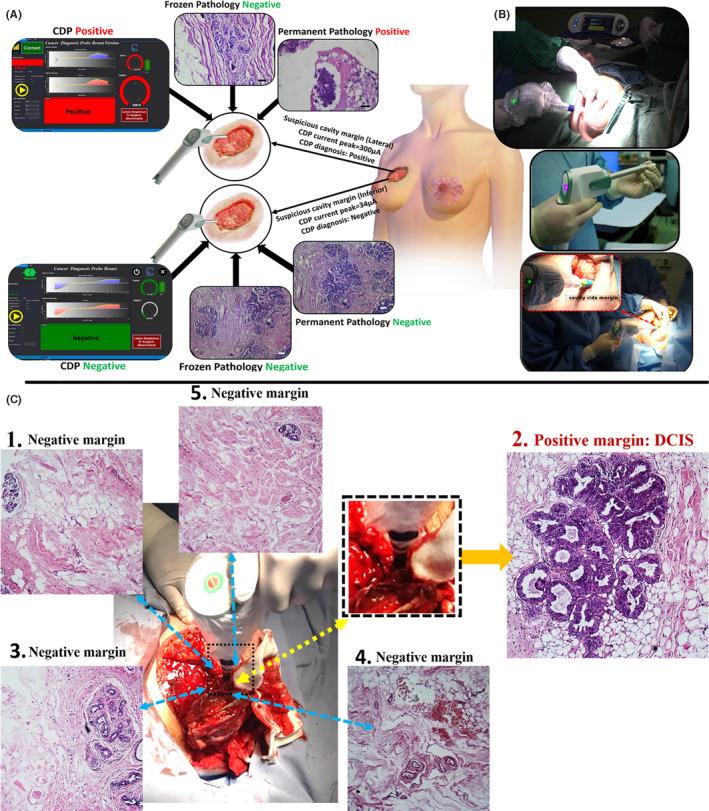
Cancer diagnostic probe (CDP) had been developed to detect involved breast cavity side margins in real-time (Miripour et al. Bioeng Transl Med. e10236.). Here, we presented the results of the in vivo human model CDP studies on non-neoadjuvant cases.
METHODS
This study is a prospective, blind comparison to a gold standard, and the medical group recruited patients. CDP and frozen data were achieved before the permanent pathology experiment. The main outcome of the study is surgical margin status. From November 2018 to April 2020, 202 patients were registered, and 188 were assigned for the study. Breast-conserving surgery at any age or gender, re-surgery due to re-currency, or involved margins are acceptable. Patients must be non-neoadjuvant. The reliability of CDP scoring had been evaluated by the pathology of the scored IMs. Then, three models of the study were designed to compare CDP with the frozen sections. Receiver operating characteristic (ROC) curves and AUC were measured based on the permanent postoperative pathology gold standard.
RESULTS
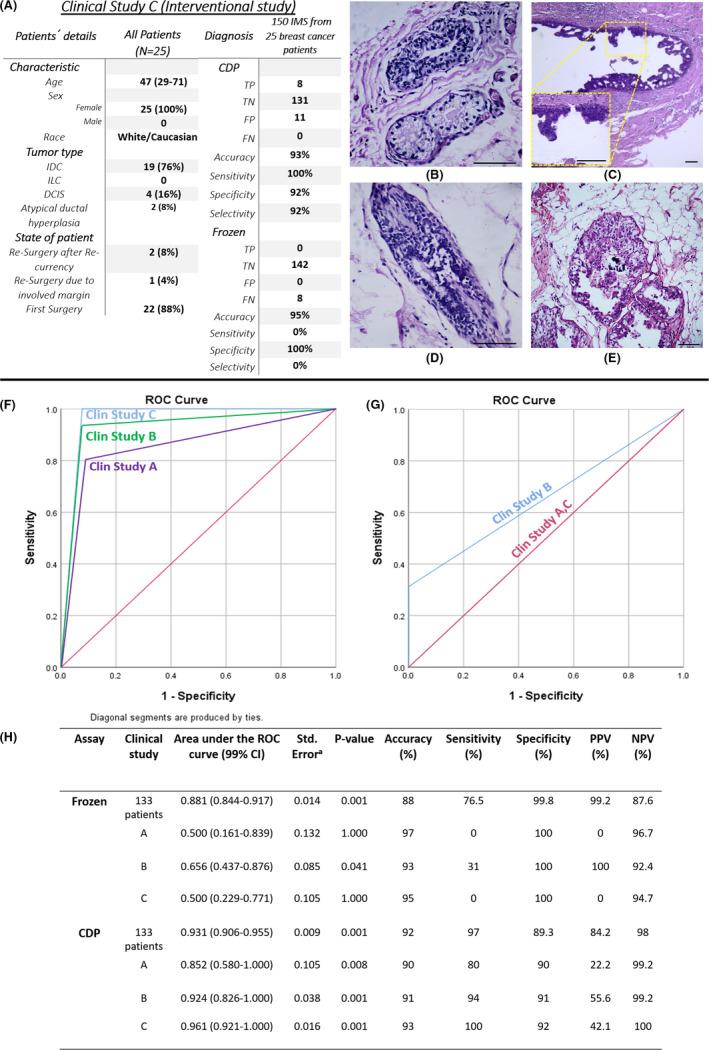
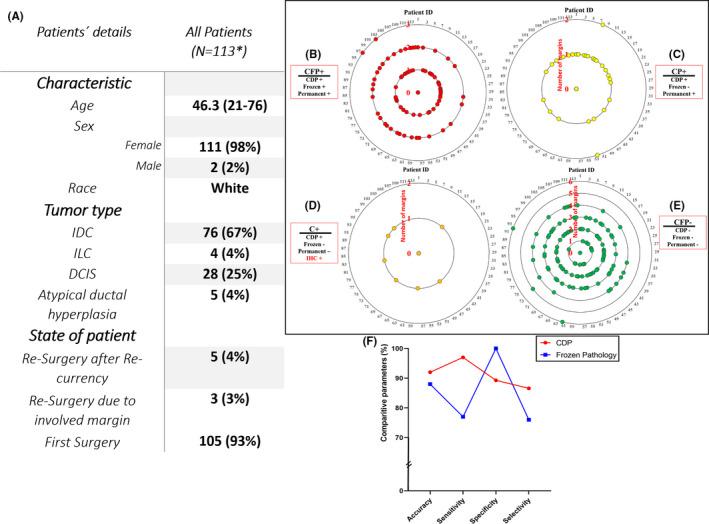
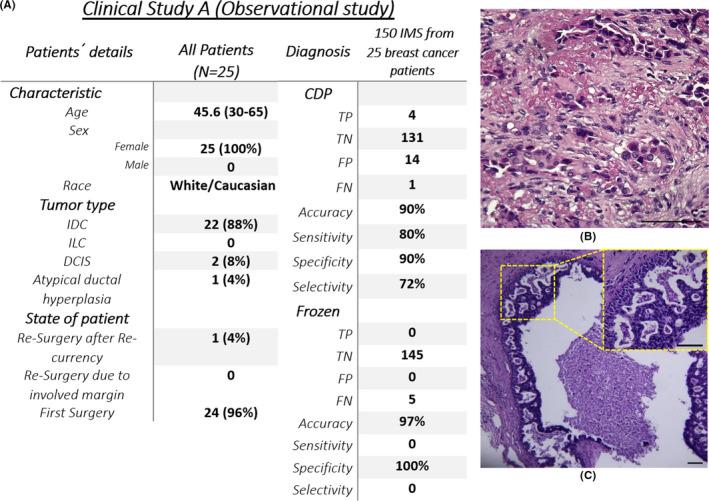
A matched clinical diagnostic categorization between the pathological results of the tested IMs and response peaks of CDP on 113 cases, was reported (sensitivity = 97%, specificity = 89.3%, accuracy = 92%, positive predictive value (PPV) = 84.2%, and negative predictive value (NPV) = 98%). Study A showed the independent ability of CDP for IM scoring (sensitivity = 80%, specificity = 90%, accuracy = 90%, PPV = 22.2%, and NPV = 99.2%). Study B showed the complementary role of CDP to cover the missed lesions of frozen sections (sensitivity = 93.8%, specificity = 91%, accuracy = 91%, PPV = 55.6%, and NPV = 99.2%). Study C showed the ability of CDP in helping the pathologist to reduce his/her frozen miss judgment (specificity = 92%, accuracy = 93%, PPV = 42.1%, and NPV = 100%). Results were reported based on the post-surgical permanent pathology gold standard.
CONCLUSION
CDP scoring ability in intra-operative margin detection was verified on non-neoadjuvant breast cancer patients. Non-invasive real-time diagnosis of IMs with pathological values may make CDP a distinct tool with handheld equipment to increase the prognosis of breast cancer patients.
背景
癌症诊断探针 (CDP) 已被开发用于实时检测受累乳房腔侧缘(Miripour 等人,《生物工程转化医学》,e10236.)。在这里,我们介绍了非新辅助病例中体内人模型 CDP 研究的结果。
方法
这是一项前瞻性、盲法比较的研究,与金标准相比,医学组招募了患者。CDP 和冷冻数据在永久性病理实验之前获得。研究的主要结果是手术切缘状态。2018 年 11 月至 2020 年 4 月,登记了 202 例患者,其中 188 例被分配用于研究。可接受任何年龄或性别的保乳手术、因复发而再次手术或受累切缘。患者必须是非新辅助的。通过对评分 IM 的病理评估,已经评估了 CDP 评分的可靠性。然后,设计了三种研究模型来比较 CDP 与冷冻切片。基于永久性术后病理金标准,测量了接收器操作特征 (ROC) 曲线和 AUC。
结果
报告了在 113 例病例中,对经测试的 IM 的病理结果和 CDP 反应峰之间的匹配临床诊断分类(敏感性为 97%,特异性为 89.3%,准确性为 92%,阳性预测值(PPV)为 84.2%,阴性预测值(NPV)为 98%)。研究 A 显示了 CDP 对 IM 评分的独立能力(敏感性为 80%,特异性为 90%,准确性为 90%,PPV 为 22.2%,NPV 为 99.2%)。研究 B 显示了 CDP 覆盖冷冻切片遗漏病变的补充作用(敏感性为 93.8%,特异性为 91%,准确性为 91%,PPV 为 55.6%,NPV 为 99.2%)。研究 C 显示了 CDP 帮助病理学家减少冷冻切片漏判的能力(特异性为 92%,准确性为 93%,PPV 为 42.1%,NPV 为 100%)。结果基于术后永久性病理金标准报告。
结论
在非新辅助乳腺癌患者中验证了 CDP 在术中切缘检测中的评分能力。具有病理价值的 IM 的非侵入性实时诊断可能使 CDP 成为一种独特的手持设备工具,提高乳腺癌患者的预后。

 Zotero 插件