
大规模中国胰腺癌患者的基因组特征分析。
Characterization of the genomic landscape in large-scale Chinese patients with pancreatic cancer.
机构信息
State Key Laboratory of Oncogenes and Related Genes, Shanghai Cancer Institute, Department of Oncology, Renji Hospital, School of Medicine, Shanghai Jiao Tong University, Shanghai, China.
The Medical Department, 3D Medicines Inc., Shanghai, China.
出版信息
EBioMedicine. 2022 Mar;77:103897. doi: 10.1016/j.ebiom.2022.103897. Epub 2022 Feb 26.
BACKGROUND
Pancreatic ductal adenocarcinoma (PDAC) is a malignant tumor with an extremely poor prognosis. Effective targets for anticancer therapy confirmed in PDAC are limited. However, the characteristics of genomics have not been fully elucidated in large-scale patients with PDAC from China.
METHODS
We collected both blood and tissue samples from 1080 Chinese patients with pancreatic cancer and retrospectively investigated the genomic landscape using next-generation sequencing (NGS).
FINDINGS
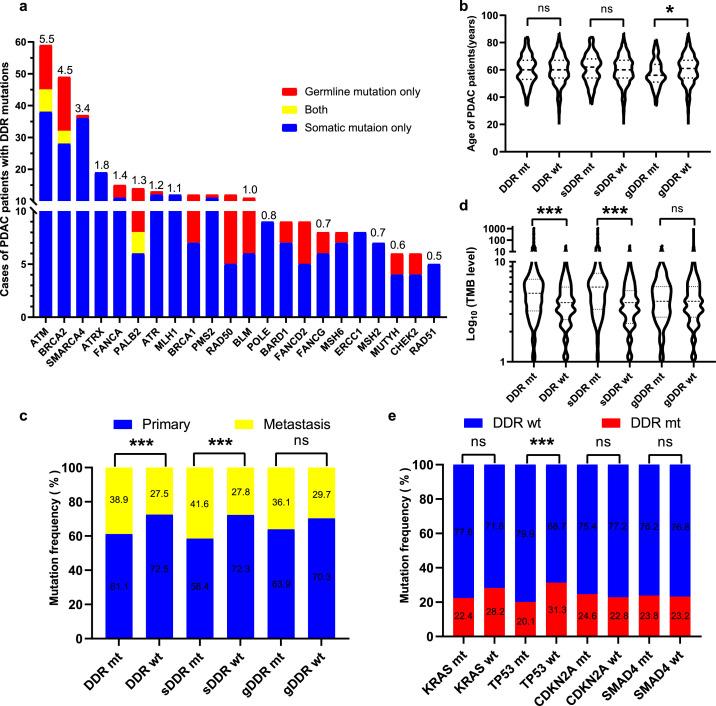
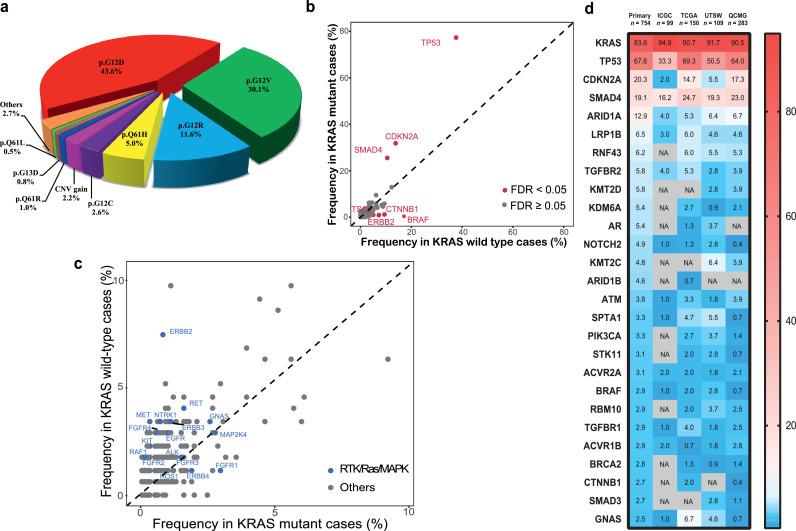
We found recurrent somatic mutations in KRAS (83.2%), TP53 (70.6%), CDKN2A (28.8%), SMAD4 (23.0%), ARID1A (12.8%) and CDKN2B (8.9%) in Chinese PDAC patients. Compared with primary pancreatic cancers, more genomic alterations accumulated especially cell cycle regulatory gene variants (45.4% vs 31.6%, P < 0.001) were observed in metastatic tumors. The most common mutation site of KRAS is p.G12D (43.6%) in pancreatic cancer. Patients with KRAS mutations were significantly associated with older age and mutations in the other three driver genes, while KRAS wild-type patients contained more fusion mutations and alternative mechanisms of RTK/Ras/MAPK pathway including a number of clinically targetable mutations. KRAS mutations in Chinese cohort were significantly lower than those in Western cohorts (all P < 0.05). A total of 252 (23.3%) patients with the core DNA damage response (DDR) gene mutations were detected. ATM (n =59, 5.5%) was the most frequent mutant DDR gene in patients with pancreatic cancer from China. Patients with germline DDR gene mutations were younger (P = 0.018), while patients with somatic DDR gene mutations were more likely to accumulate in metastatic lesions (P < 0.001) and had higher TMB levels (P < 0.001). In addition, patients with mutant DDR genes and patients carrying TP53 mutation were observed mutually exclusive (P < 0.001).
INTERPRETATION
We demonstrated the real-world genomic characteristics of large-scale patients with pancreatic cancer from China which may have promising implications for further clinical significance and drug development.
FUNDING
The funders are listed in the Acknowledgement.
背景
胰腺导管腺癌(PDAC)是一种预后极差的恶性肿瘤。在 PDAC 中已证实的有效抗癌治疗靶点有限。然而,在中国大规模 PDAC 患者中,其基因组学特征尚未得到充分阐明。
方法
我们收集了 1080 名中国胰腺癌患者的血液和组织样本,并使用下一代测序(NGS)对其基因组图谱进行了回顾性研究。
结果
我们发现中国 PDAC 患者中存在 KRAS(83.2%)、TP53(70.6%)、CDKN2A(28.8%)、SMAD4(23.0%)、ARID1A(12.8%)和 CDKN2B(8.9%)的复发性体细胞突变。与原发性胰腺癌相比,转移性肿瘤中累积了更多的基因组改变,尤其是细胞周期调节基因变异(45.4%比 31.6%,P < 0.001)。KRAS 中最常见的突变位点是胰腺癌中的 p.G12D(43.6%)。KRAS 突变患者与年龄较大以及其他三个驱动基因突变显著相关,而 KRAS 野生型患者则含有更多融合突变和 RTK/Ras/MAPK 通路的其他替代机制,包括许多临床上可靶向的突变。中国队列的 KRAS 突变明显低于西方队列(均 P < 0.05)。共检测到 252 例(23.3%)核心 DNA 损伤反应(DDR)基因突变患者。ATM(n = 59,5.5%)是中国胰腺癌患者中最常见的突变 DDR 基因。携带种系 DDR 基因突变的患者年龄较小(P = 0.018),而携带体细胞 DDR 基因突变的患者更有可能在转移性病变中积累(P < 0.001),且具有更高的 TMB 水平(P < 0.001)。此外,观察到携带突变 DDR 基因的患者与携带 TP53 突变的患者相互排斥(P < 0.001)。
结论
我们展示了中国大规模胰腺癌患者的真实世界基因组特征,这可能对进一步的临床意义和药物开发具有重要意义。
资助
资助者列在致谢中。


 Zotero 插件