
量化 COVID-19 大流行对健康、社会和经济指标性别平等的影响:对 2020 年 3 月至 2021 年 9 月数据的综合审查。
Quantifying the effects of the COVID-19 pandemic on gender equality on health, social, and economic indicators: a comprehensive review of data from March, 2020, to September, 2021.
机构信息
Institute for Health Metrics and Evaluation, University of Washington, Seattle, WA, USA; Department of Health Metrics Sciences, School of Medicine, University of Washington, Seattle, WA, USA.
Institute for Health Metrics and Evaluation, University of Washington, Seattle, WA, USA.
出版信息
Lancet. 2022 Jun 25;399(10344):2381-2397. doi: 10.1016/S0140-6736(22)00008-3. Epub 2022 Mar 2.
BACKGROUND
Gender is emerging as a significant factor in the social, economic, and health effects of COVID-19. However, most existing studies have focused on its direct impact on health. Here, we aimed to explore the indirect effects of COVID-19 on gender disparities globally.
METHODS
We reviewed publicly available datasets with information on indicators related to vaccine hesitancy and uptake, health care services, economic and work-related concerns, education, and safety at home and in the community. We used mixed effects regression, Gaussian process regression, and bootstrapping to synthesise all data sources. We accounted for uncertainty in the underlying data and modelling process. We then used mixed effects logistic regression to explore gender gaps globally and by region.
FINDINGS
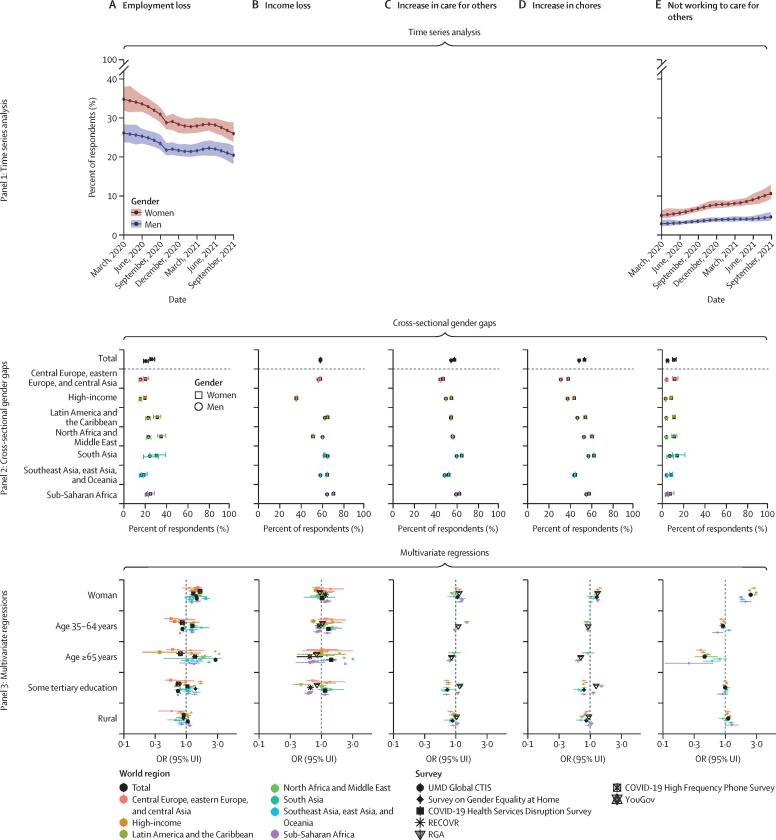
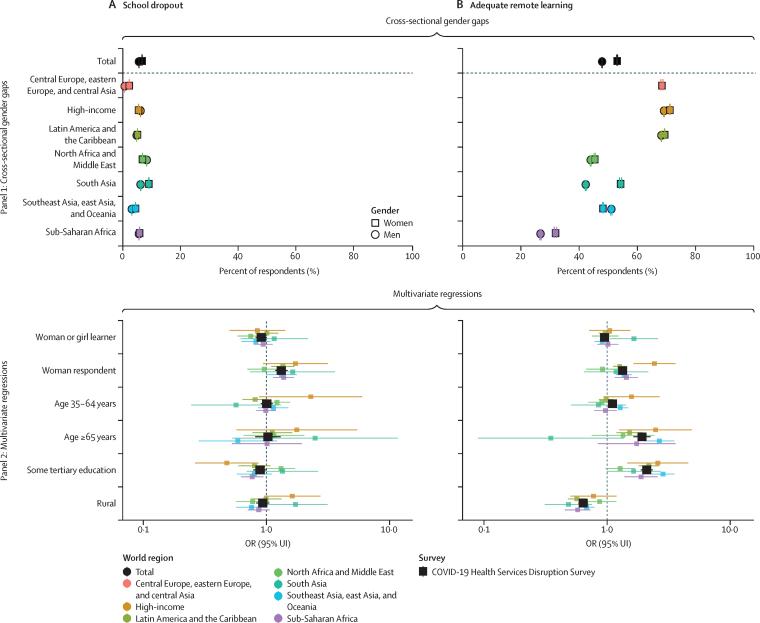
Between March, 2020, and September, 2021, women were more likely to report employment loss (26·0% [95% uncertainty interval 23·8-28·8, by September, 2021) than men (20·4% [18·2-22·9], by September, 2021), as well as forgoing work to care for others (ratio of women to men: 1·8 by March, 2020, and 2·4 by September, 2021). Women and girls were 1·21 times (1·20-1·21) more likely than men and boys to report dropping out of school for reasons other than school closures. Women were also 1·23 (1·22-1·23) times more likely than men to report that gender-based violence had increased during the pandemic. By September 2021, women and men did not differ significantly in vaccine hesitancy or uptake.
INTERPRETATION
The most significant gender gaps identified in our study show intensified levels of pre-existing widespread inequalities between women and men during the COVID-19 pandemic. Political and social leaders should prioritise policies that enable and encourage women to participate in the labour force and continue their education, thereby equipping and enabling them with greater ability to overcome the barriers they face.
FUNDING
The Bill & Melinda Gates Foundation.
背景
性别因素正逐渐成为新冠疫情对社会、经济和健康影响的一个重要因素。然而,大多数现有研究都集中在其对健康的直接影响上。在这里,我们旨在探索新冠疫情对全球性别差距的间接影响。
方法
我们回顾了公开的数据集,这些数据集提供了与疫苗犹豫和接种、医疗保健服务、经济和工作相关问题、教育以及家庭和社区安全相关的指标信息。我们使用混合效应回归、高斯过程回归和自举法综合所有数据源。我们考虑了基础数据和建模过程中的不确定性。然后,我们使用混合效应逻辑回归来探索全球以及各地区的性别差距。
发现
在 2020 年 3 月至 2021 年 9 月期间,女性比男性更有可能报告失业(2021 年 9 月为 26.0%[95%置信区间为 23.8-28.8]),也更有可能放弃工作照顾他人(女性与男性的比例:2020 年 3 月为 1.8,2021 年 9 月为 2.4)。女性和女孩因非学校关闭原因而辍学的可能性比男性和男孩高 1.21 倍(1.20-1.21)。在疫情期间,女性报告性别暴力增加的可能性也比男性高 1.23 倍(1.22-1.23)。到 2021 年 9 月,女性和男性在疫苗犹豫或接种方面没有显著差异。
解释
我们的研究中发现的最显著的性别差距表明,在新冠疫情期间,男女之间普遍存在的不平等现象加剧。政治和社会领导人应优先制定政策,使妇女能够参与劳动力市场并继续接受教育,从而使她们具备更大的能力克服面临的障碍。
资助
比尔及梅琳达·盖茨基金会。


 Zotero 插件