
日本重症 COVID-19 患者体内的 I 型干扰素中和自身抗体
Neutralizing Type I Interferon Autoantibodies in Japanese Patients With Severe COVID-19.
作者信息
Eto Shohei, Nukui Yoko, Tsumura Miyuki, Nakagama Yu, Kashimada Kenichi, Mizoguchi Yoko, Utsumi Takanori, Taniguchi Maki, Sakura Fumiaki, Noma Kosuke, Yoshida Yusuke, Ohshimo Shinichiro, Nagashima Shintaro, Okamoto Keisuke, Endo Akifumi, Imai Kohsuke, Kanegane Hirokazu, Ohnishi Hidenori, Hirata Shintaro, Sugiyama Eiji, Shime Nobuaki, Ito Masanori, Ohge Hiroki, Kido Yasutoshi, Bastard Paul, Casanova Jean-Laurent, Tanaka Junko, Morio Tomohiro, Okada Satoshi
机构信息
Hiroshima University Graduate School of Biomedical and Health Science.
Kyoto Prefectural University of Medicine.
出版信息
Res Sq. 2022 Mar 11:rs.3.rs-1430985. doi: 10.21203/rs.3.rs-1430985/v1.
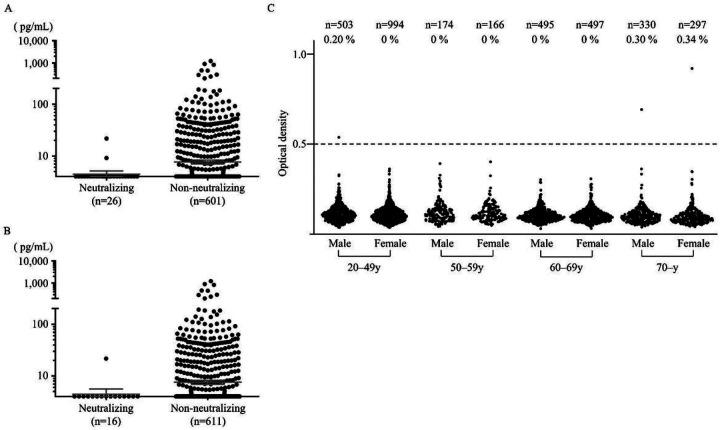
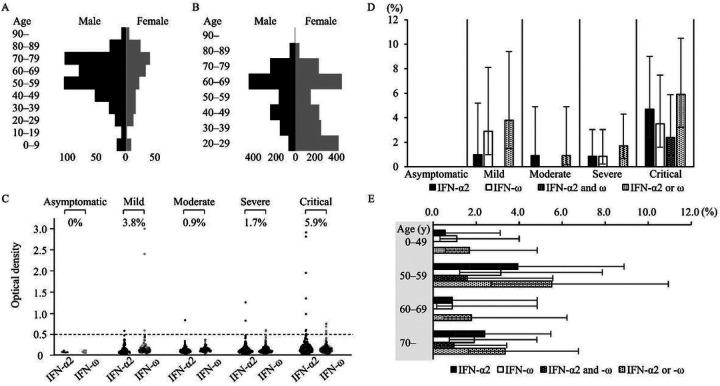
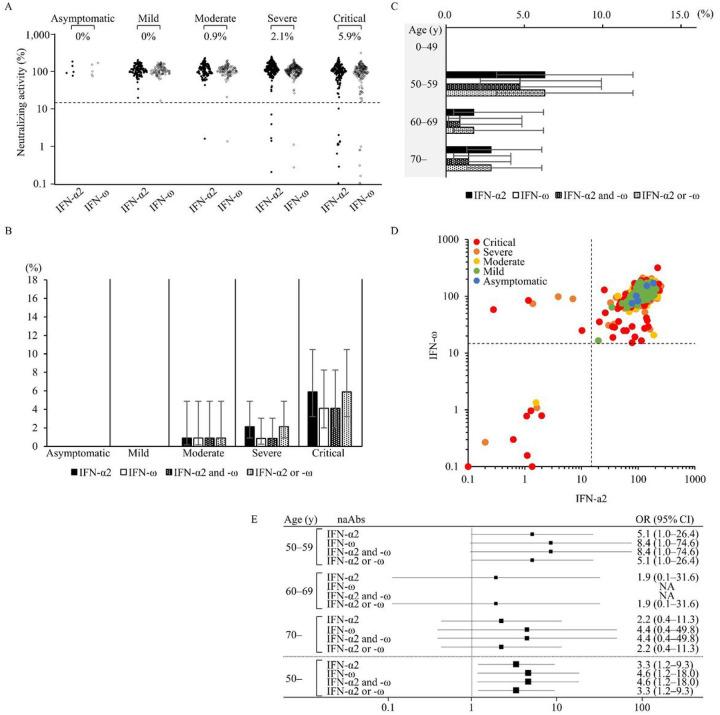
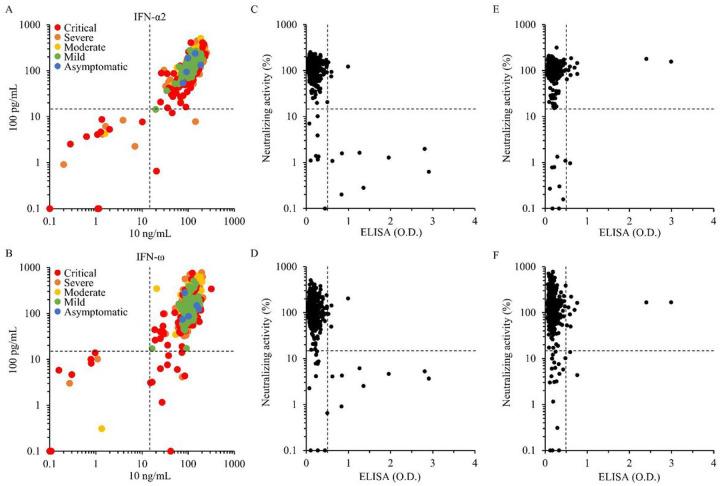
Autoantibodies (aAbs) to type I interferons (IFNs) have been found in <1% of individuals under the age of 60 in the general population, with the prevalence increasing among those over 65. Neutralizing autoantibodies (naAbs) to type I IFNs have been found in at least 15% of patients with life-threatening COVID-19 pneumonia in several cohorts of primarily European descent. We aimed to define the prevalence of aAbs to IFN-α2 in 3,456 Japanese controls aged 20-91 and of aAbs and naAbs to IFN-α2 and IFN-ω in 627 Japanese COVID-19 patients aged 0-104, among whom were 170 critical, 235 severe, 112 moderate, 105 mild, and 5 asymptomatic infections. ELISA and ISRE reporter assays were used to detect aAbs and naAbs using E. coli-produced IFNs. In an uninfected general Japanese population aged 20-91, we found aAbs in 0.087% of individuals. naAbs to type I IFNs (IFN-α2 and/or IFN-ω, 100 pg/mL) were detected in 10.6% of patients with critical infections, 2.6% of patients with severe infections, and ≤1% of patients with asymptomatic to mild infections. They were higher in COVID-19 patients over 50 (5.8%) than in younger patients (0%) and higher in men (5.5%) than in women (1.1%). A significant but not strong correlation between aAbs and naAbs to IFN-α2 existed (r=-0.307, p-value<0.0001), stressing the importance of measuring naAbs. In the largest study focusing on a single ethnic and geographic group, we show that Japanese individuals with pre-existing naAbs have a much higher risk of life-threatening COVID-19 pneumonia.
在普通人群中,60岁以下个体中抗I型干扰素(IFN)自身抗体(aAbs)的检出率低于1%,65岁以上人群中的患病率则有所上升。在几个人数主要为欧洲裔的队列中,至少15%的患有危及生命的COVID-19肺炎的患者体内发现了抗I型干扰素的中和自身抗体(naAbs)。我们旨在确定3456名年龄在20至91岁的日本对照人群中抗IFN-α2自身抗体的患病率,以及627名年龄在0至104岁的日本COVID-19患者中抗IFN-α2和抗IFN-ω自身抗体及中和自身抗体的患病率,其中包括170例危重症、235例重症、112例中症、105例轻症和5例无症状感染者。采用酶联免疫吸附测定(ELISA)和干扰素刺激反应元件(ISRE)报告基因检测法,使用大肠杆菌生产的干扰素来检测自身抗体和中和自身抗体。在年龄为20至91岁未感染的普通日本人群中,我们发现0.087%的个体存在自身抗体。在危重症感染患者中,10.6%检测到抗I型干扰素(IFN-α2和/或IFN-ω,100 pg/mL)的中和自身抗体,重症感染患者中为2.6%,无症状至轻症感染患者中≤1%。50岁以上的COVID-19患者(5.8%)中的中和自身抗体高于年轻患者(0%),男性(5.5%)高于女性(1.1%)。抗IFN-α2自身抗体与中和自身抗体之间存在显著但不强的相关性(r = -0.307,p值<0.0001),这凸显了检测中和自身抗体的重要性。在针对单一民族和地理群体的最大规模研究中,我们表明,预先存在中和自身抗体的日本个体患危及生命的COVID-19肺炎的风险要高得多。

 Zotero 插件