
PRAME 蛋白在 DICER1 相关肿瘤中的表达。
PRAME protein expression in DICER1-related tumours.
机构信息
Department of Laboratory Medicine and Pathobiology, University of Toronto, Toronto, ON, Canada.
Department of Human Genetics, McGill University, Montreal, QC, Canada.
出版信息
J Pathol Clin Res. 2022 May;8(3):294-304. doi: 10.1002/cjp2.264. Epub 2022 Mar 16.
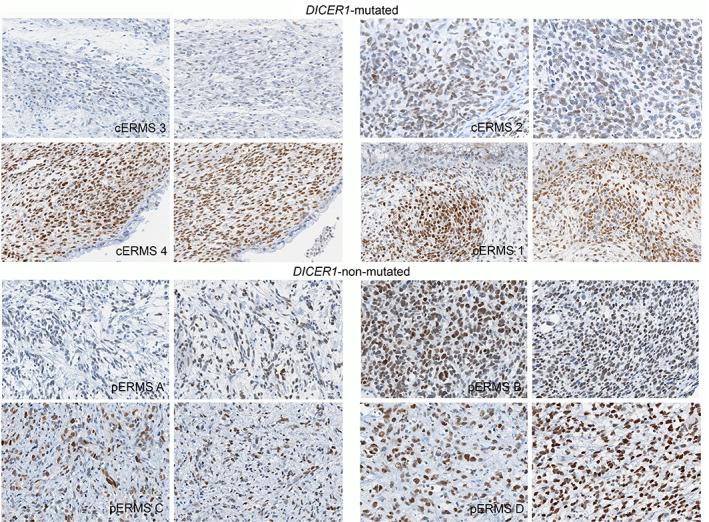
DICER1 syndrome is an autosomal dominant tumour predisposition syndrome usually affecting persons under 30 years of age. Many of the associated benign and malignant lesions occur almost exclusively in DICER1 syndrome. One such tumour, pituitary blastoma (pitB), overexpresses PRAME 500x above control levels. PRAME (PReferentially expressed Antigen in MElanoma) is expressed in malignancies that are not DICER1-related (e.g. melanoma). To address whether PRAME expression is part of the DICER1 phenotype, or simply a feature of pitB, a series of 75 DICER1-mutated specimens and 33 non-mutated specimens was surveyed using immunohistochemistry for PRAME, together with EZH2, which complexes with PRAME. In DICER1-mutated specimens, positive staining for PRAME was only seen in malignant tumours; 7 of 11 histological types and 34/62 individual tumours were positive, while non-tumourous lesions were always negative. Pleuropulmonary blastoma (PPB) showed a continuum in staining, with type I lesions being PRAME negative (n = 7) but all type II and type III lesions PRAME positive (n = 7). Similarly, cystic nephroma (CN) was negative (n = 8), with anaplastic sarcoma of the kidney being positive (n = 2). However, one atypical CN with mesenchymal cell proliferation was PRAME-positive. Embryonal rhabdomyosarcoma (RMS) with DICER1 pathogenic variants (PVs) was positive for PRAME (5/6), but the same tumour type without DICER1 PVs was also positive (9/15). Staining for EZH2 corresponded to that seen with PRAME, validating the latter. This study leads us to conclude that (1) PRAME expression occurs in two-thirds of DICER1-related malignancies; (2) PRAME may be a marker for the progression that certain DICER1-related lesions are thought to undergo, such as PPB and CN; and (3) PRAME expression in some tumours, such as RMS, appears to be an intrinsic feature of the tumour, rather than specifically related to DICER1 PVs. Therapy directed against PRAME may offer novel treatment options in patients with the DICER1 syndrome.
DICER1 综合征是一种常染色体显性遗传肿瘤易感性综合征,通常影响 30 岁以下的人群。许多相关的良性和恶性病变几乎仅在 DICER1 综合征中发生。其中一种肿瘤,垂体胚细胞瘤(pitB),过度表达 PRAME 达对照水平的 500 倍。PRAME(黑色素瘤中优先表达的抗原)在与 DICER1 无关的恶性肿瘤(如黑色素瘤)中表达。为了确定 PRAME 表达是否是 DICER1 表型的一部分,还是仅仅是 pitB 的特征,我们使用免疫组织化学法对 75 例 DICER1 突变标本和 33 例非突变标本进行了一系列调查,检测了 PRAME 以及与 PRAME 结合的 EZH2。在 DICER1 突变标本中,PRAME 的阳性染色仅见于恶性肿瘤;11 种组织学类型中的 7 种和 62 个肿瘤中的 34 个为阳性,而非肿瘤性病变均为阴性。肺胸膜胚细胞瘤(PPB)的染色呈连续分布,I 型病变 PRAME 阴性(n=7),但 II 型和 III 型病变均为 PRAME 阳性(n=7)。同样,囊性肾母细胞瘤(CN)为阴性(n=8),肾间叶肉瘤为阳性(n=2)。然而,一个具有间充质细胞增殖的不典型 CN 为 PRAME 阳性。伴有 DICER1 致病性变异(PV)的胚胎性横纹肌肉瘤(RMS)PRAME 阳性(5/6),但同一肿瘤类型无 DICER1 PV 也为阳性(9/15)。EZH2 的染色与 PRAME 相符,验证了后者。本研究得出结论:(1)PRAME 表达发生在三分之二的 DICER1 相关恶性肿瘤中;(2)PRAME 可能是某些 DICER1 相关病变进展的标志物,如 PPB 和 CN;(3)在某些肿瘤中,如 RMS,PRAME 表达似乎是肿瘤的固有特征,而不是特异性地与 DICER1 PV 相关。针对 PRAME 的治疗可能为 DICER1 综合征患者提供新的治疗选择。


 Zotero 插件