
基于认知行为疗法的智能手机应用在中国戒烟的可行性与可接受性:单组队列研究
Feasibility and Acceptability of a Cognitive Behavioral Therapy-Based Smartphone App for Smoking Cessation in China: A Single-Group Cohort Study.
作者信息
Liao Yanhui, Tang Jinsong
机构信息
Department of Psychiatry, Sir Run Run Shaw Hospital, Zhejiang University School of Medicine, Hangzhou, China.
Key Laboratory of Medical Neurobiology of Zhejiang Province, Hangzhou, China.
出版信息
Front Psychiatry. 2022 Mar 3;12:759896. doi: 10.3389/fpsyt.2021.759896. eCollection 2021.
BACKGROUND
Previous research has suggested that mobile phone applications (apps) may potentially increase quit rates. The purpose of this single-group cohort study sought to examine the feasibility and acceptability of a novel smartphone-based smoking cessation app designed for smoking cessation in China: smoking quit rate.
METHODS
A total of 180 smokers from two cities of mainland China with willingness to make a quit attempt were invited to this smoking cessation app program, a cognitive behavioral theory (CBT)-based smoking cessation intervention via a smartphone app. Participants received 37- to 44-day intervention (including 7- to 14-day pre-quit preparation and 33-day intervention from quit date). Feasibility and acceptability of the program, and smoking status were assessed at baseline stage (initial installation), pre-quit stage, and post-quit stage (days 7, 15, and 33 after quit date).
RESULTS
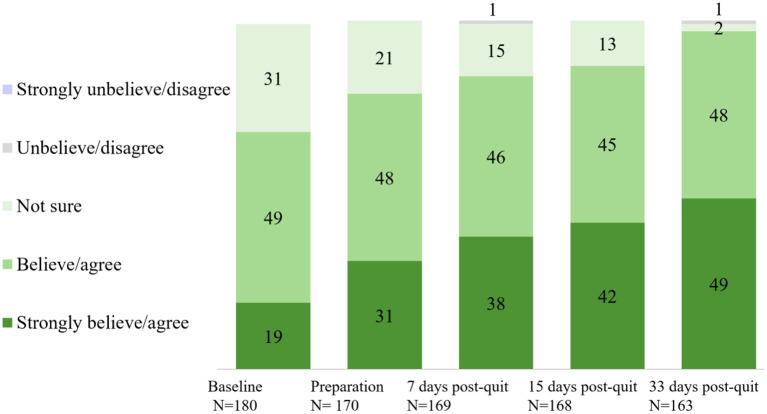
A total of 163 (90.6%) participants completed the study. Among them, 76-89% of the participants logged into the app ≥1 time per day across stages (at baseline, during pre-quit stage, and on days 7, 15, and 33 of post-quit stage); approximately 90% of the participants were satisfied with the app across stages. A significant rise in self-reported overall satisfaction with the app is observed from baseline (93% at Time 1) to the end of the program (98% at Time 2, 33 days after quit date) ( = 0.021). Participants who believed/agreed this app can help them to quit smoking significantly increased from 69% at baseline to 97% at day 33 after quit date ( < 0.001). Participants were satisfied with most (80-90%) of the features, especially the information feature. Intention-to-treat analysis showed that the percentage of 33-day self-reported continuous prevalence abstinence was 63.9%, and 7-day point prevalence abstinence rate was 81.7, 87.2, and 77.8% on days 7, 15, and 33 after quit date, respectively.
CONCLUSIONS
This study demonstrated the feasibility and acceptability of the smartphone app intervention for smoking cessation and introduced a new digital treatment model, which is expected to overcome barriers facing accessing traditional in-person smoking cessation services and extend nationwide smoking cessation services in China.
背景
先前的研究表明,手机应用程序(应用)可能会提高戒烟成功率。这项单组队列研究的目的是检验一款专为中国戒烟设计的新型智能手机戒烟应用的可行性和可接受性:戒烟成功率。
方法
来自中国大陆两个城市的180名有意愿尝试戒烟的吸烟者被邀请参加这个戒烟应用程序项目,这是一种通过智能手机应用进行的基于认知行为理论(CBT)的戒烟干预。参与者接受了37至44天的干预(包括7至14天的戒烟前准备和从戒烟日开始的33天干预)。在基线阶段(初始安装)、戒烟前阶段和戒烟后阶段(戒烟日之后的第7天、第15天和第33天)评估该项目的可行性和可接受性以及吸烟状况。
结果
共有163名(90.6%)参与者完成了研究。其中,76%至89%的参与者在各个阶段每天登录应用程序≥1次(在基线阶段、戒烟前阶段以及戒烟后阶段的第7天、第15天和第33天);各阶段约90%的参与者对该应用程序感到满意。从基线(第1次时为93%)到项目结束(第2次时为98%,即戒烟日之后33天),自我报告的对应用程序的总体满意度显著上升(P = 0.021)。认为/同意这款应用能帮助他们戒烟显著增加,从基线时的69%上升到戒烟日之后第33天的97%(P < 0.001)。参与者对大多数(80%至90%)功能感到满意,尤其是信息功能。意向性分析显示,33天自我报告的持续戒烟率为63.9%,戒烟日之后第7天、第15天和第33天的7天点患病率戒烟率分别为81.7%、87.2%和77.8%。
结论
本研究证明了智能手机应用干预戒烟的可行性和可接受性,并引入了一种新的数字治疗模式,有望克服获得传统面对面戒烟服务所面临的障碍,并在中国推广全国性的戒烟服务。


 Zotero 插件