
评价认知行为疗法改善慢性下背痛患者疼痛、恐惧回避和自我效能的效果:系统评价和荟萃分析。
Evaluation of Cognitive Behavioral Therapy on Improving Pain, Fear Avoidance, and Self-Efficacy in Patients with Chronic Low Back Pain: A Systematic Review and Meta-Analysis.
机构信息
Department of Rehabilitation Medicine, The First Affiliated Hospital, Sun Yat-Sen University, Guangzhou, China.
Guangdong Engineering and Technology Research Center for Rehabilitation Medicine and Translation, The First Affiliated Hospital, Sun Yat-Sen University, Guangzhou, China.
出版信息
Pain Res Manag. 2022 Mar 19;2022:4276175. doi: 10.1155/2022/4276175. eCollection 2022.
BACKGROUND
Cognitive-behavioral therapy (CBT) is commonly adopted in pain management programs for patients with chronic low back pain (CLBP). However, the benefits of CBT are still unclear.
OBJECTIVES
This review investigated the effectiveness of CBT on pain, disability, fear avoidance, and self-efficacy in patients with CLBP.
METHODS
Databases including PubMed, EMBASE, Web of Science, Cochrane Library, and PsycINFO were searched. RCTs examining the effects of CBT in adults with CLBP were included. The data about the outcome of pain, disability, fear avoidance, and self-efficacy were retained. Subgroup analysis about the effects of CBT on posttreatment was conducted according to CBT versus control groups (waiting list/usual care, active therapy) and concurrent CBT versus CBT alone. A random-effects model was used, and statistical heterogeneity was explored.
RESULTS
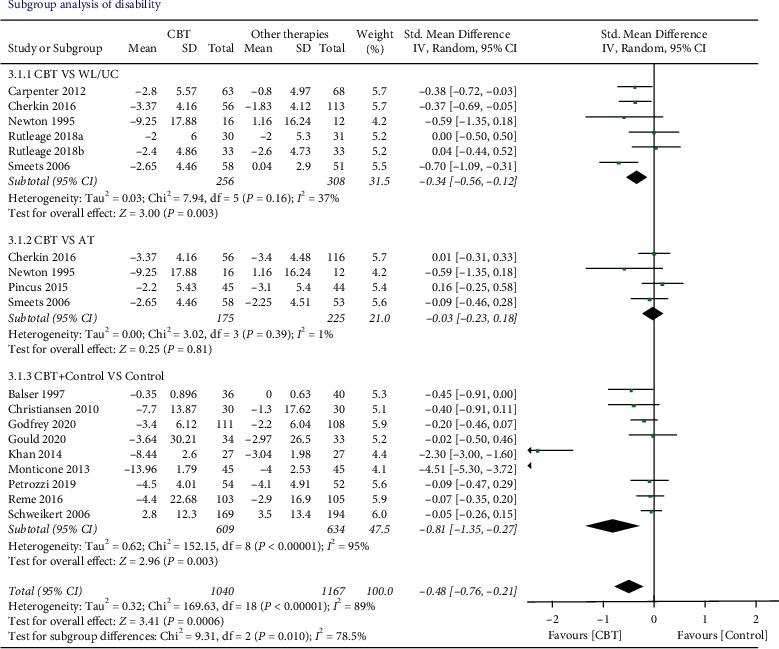
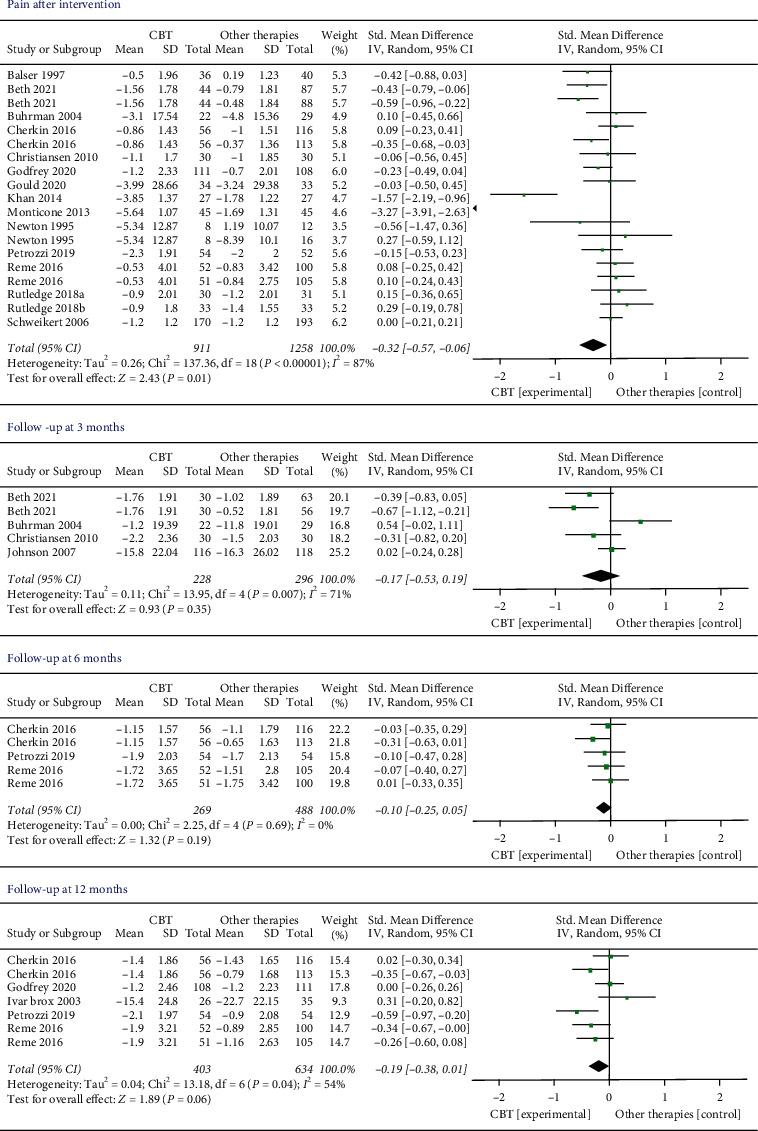
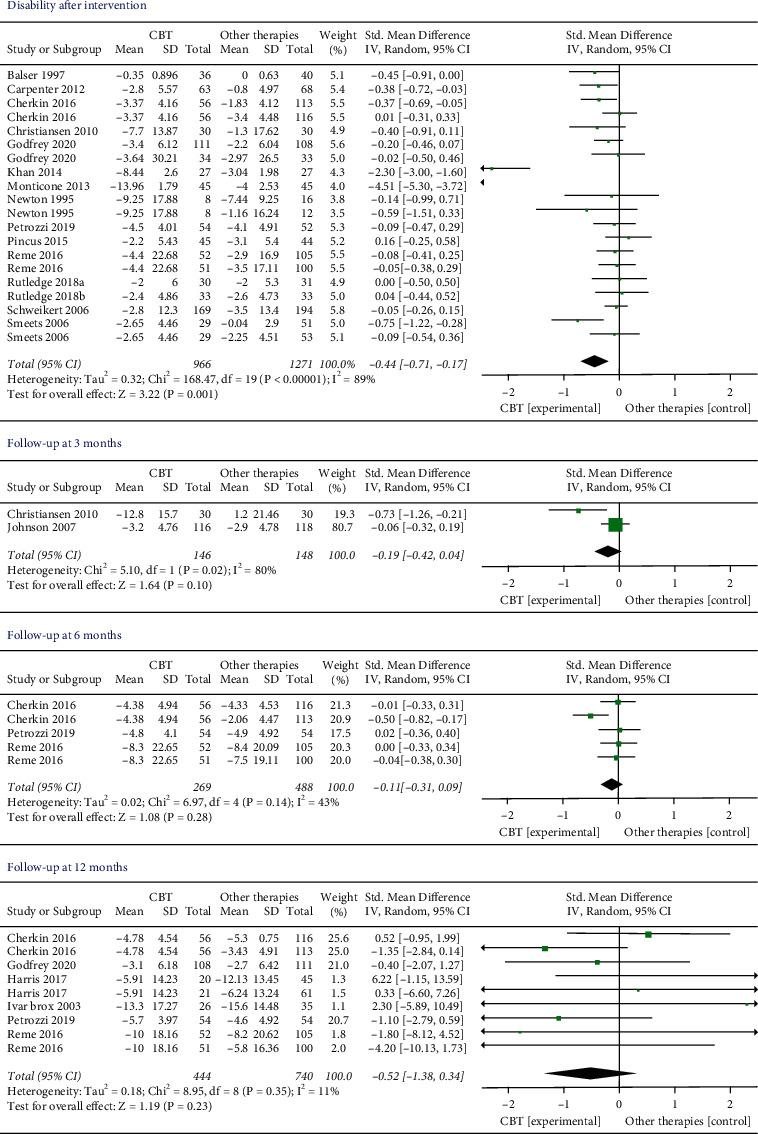
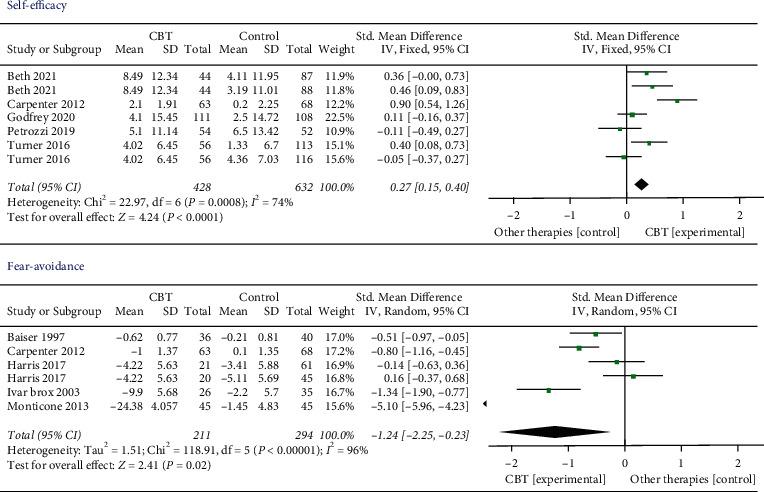
22 articles were included. The results indicated that CBT was superior to other therapies in improving disability (SMD -0.44, 95% CI -0.71 to -0.17, < 0.05), pain (SMD -0.32, 95% CI -0.57 to -0.06, < 0.05), fear avoidance (SMD -1.24, 95% CI -2.25 to -0.23, < 0.05), and self-efficacy (SMD 0.27, 95% CI 0.15 to 0.40, < 0.05) after intervention. No different effect was observed between CBT and other therapies in all the follow-up terms. Subgroup analysis suggested that CBT in conjunction with other interventions was in favor of other interventions alone to reduce pain and disability ( < 0.05).
CONCLUSION
CBT is beneficial in patients with CLBP for improving pain, disability, fear avoidance, and self-efficacy in CLBP patients. Further study is recommended to investigate the long-term benefits of CBT. This meta-analysis is registered with Prospero (registration number CRD42021224837).
背景
认知行为疗法(CBT)常用于慢性腰痛(CLBP)患者的疼痛管理计划中。然而,CBT 的益处仍不清楚。
目的
本综述调查了 CBT 对 CLBP 患者疼痛、残疾、恐惧回避和自我效能的影响。
方法
检索了包括 PubMed、EMBASE、Web of Science、Cochrane 图书馆和 PsycINFO 在内的数据库。纳入了评估 CBT 对 CLBP 成人影响的 RCT。保留了有关疼痛、残疾、恐惧回避和自我效能结局的数据。根据 CBT 与对照组(等待名单/常规护理、积极治疗)和同期 CBT 与单独 CBT 进行了 CBT 对治疗后效果的亚组分析。使用随机效应模型,并探索了统计异质性。
结果
纳入了 22 篇文章。结果表明,CBT 在改善残疾(SMD -0.44,95%CI -0.71 至 -0.17,<0.05)、疼痛(SMD -0.32,95%CI -0.57 至 -0.06,<0.05)、恐惧回避(SMD -1.24,95%CI -2.25 至 -0.23,<0.05)和自我效能(SMD 0.27,95%CI 0.15 至 0.40,<0.05)方面优于其他疗法。在所有随访项中,CBT 与其他疗法之间的效果无差异。亚组分析表明,CBT 与其他干预措施联合应用有利于其他干预措施单独应用,可降低疼痛和残疾(<0.05)。
结论
CBT 对 CLBP 患者有益,可改善 CLBP 患者的疼痛、残疾、恐惧回避和自我效能。建议进一步研究 CBT 的长期益处。本荟萃分析已在 Prospero 注册(注册号 CRD42021224837)。


 Zotero 插件