
由于睑板腺功能障碍导致脂质层变薄,引起泪膜不稳定和反射性泪液分泌。
Lipid layer thickness decrease due to meibomian gland dysfunction leads to tear film instability and reflex tear secretion.
机构信息
Gwangjin St. Mary's Eye Clinic, Seoul, Republic of Korea.
Department of Ophthalmology, College of Medicine, The Catholic University of Korea, Seoul, Republic of Korea.
出版信息
Ann Med. 2022 Dec;54(1):893-899. doi: 10.1080/07853890.2022.2056238.
PURPOSE
To determine the clinical effects of ocular surface and Meibomian gland parameters on tear film stability among individuals with Meibomian gland dysfunction (MGD), those with aqueous deficient dry eye (ADDE), individuals with both conditions and normal controls.
METHODS
Patients were divided into four groups: normal controls, patients with ADDE, patients with MGD, and patients who fulfilled diagnostic criteria for ADDE and MGD (Mixed Group). Data for ocular symptom score, lid margin abnormality, ocular staining, tear break-up time, meiboscore, and lipid layer thickness (LLT) measured by a Lipiview interferometer, Schirmer test, and MGD severity score were collected.
RESULTS
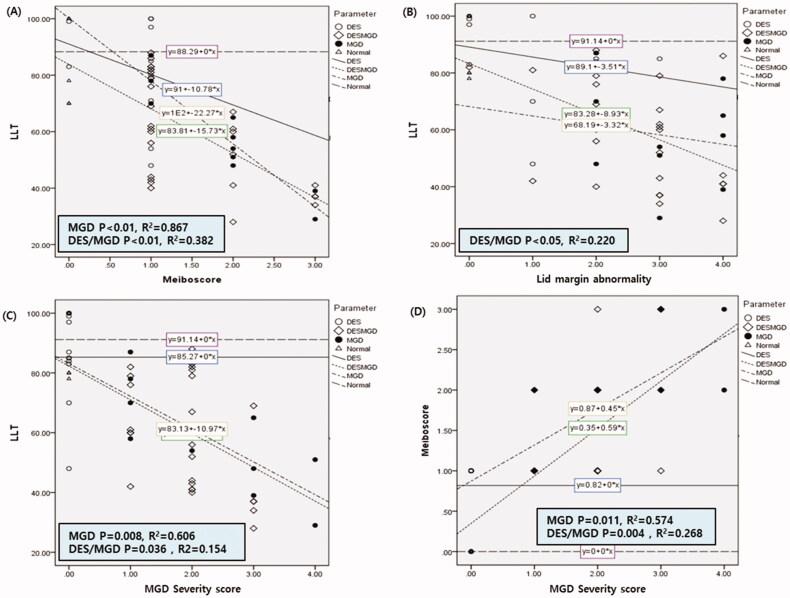
A total of 109 patients (109 eyes) were evaluated. In patients with MGD, LLT was significantly lower than the ADDE patients. However, the Schirmer test value was the highest in the MGD group. The LLT negatively correlated with meiboscore and MGD severity score in the MGD group. Significant correlation between Schirmer test value and meiboscore was definite in the MGD group.
CONCLUSIONS
Tear fluid secretion is more increased and lipid layer thickness is more decreased in MGD patients than in ADDE patients. Decreased lipid layer thickness caused by MGD-related tear film instability may stimulate reflex tear secretion. The obstructive MGD is more prevalent than hypersecretary MGD.Key messagesThe tear film stability is affected by Mebomian gland dysfunction (MGD). The measurement of the tear film parameters including lipid layer thickness suggests that the obstructive MGD is more prevalent than hypersecretary MGD and the aqueous layer compensates the decreased lipid layer caused by MGD.
目的
评估患有睑板腺功能障碍(MGD)、水液缺乏性干眼(ADDE)、MGD 合并 ADDE 以及单纯 ADDE 患者的眼表及睑板腺参数对泪膜稳定性的临床影响。
方法
患者被分为四组:正常对照组、ADDE 组、MGD 组和 ADDE 合并 MGD 混合组。收集眼部症状评分、眼睑边缘异常、眼表面染色、泪膜破裂时间、睑板腺评分、Lipiview 干涉仪测量的脂质层厚度(LLT)、Schirmer 试验和 MGD 严重程度评分等数据。
结果
共评估了 109 例患者(109 只眼)。MGD 患者的 LLT 明显低于 ADDE 患者。然而,MGD 组的 Schirmer 试验值最高。MGD 组中,LLT 与睑板腺评分和 MGD 严重程度评分呈负相关。MGD 组中 Schirmer 试验值与睑板腺评分之间存在显著相关性。
结论
与 ADDE 患者相比,MGD 患者的泪液分泌增加,脂质层厚度降低。MGD 相关的泪膜不稳定导致的脂质层厚度减少可能会刺激反射性泪液分泌。阻塞性 MGD 比高分泌性 MGD 更为普遍。
关键信息
泪膜稳定性受睑板腺功能障碍(MGD)的影响。泪膜参数的测量,包括脂质层厚度,表明阻塞性 MGD 比高分泌性 MGD 更为普遍,而水液层代偿了 MGD 引起的脂质层减少。

 Zotero 插件