
褪黑素工程化脂肪来源仿生纳米囊泡调节线粒体功能并促进心肌梗死中的心肌修复。
Melatonin Engineered Adipose-Derived Biomimetic Nanovesicles Regulate Mitochondrial Functions and Promote Myocardial Repair in Myocardial Infarction.
作者信息
Zhang Yang, Yang Ning, Huang Xu, Zhu Yan, Gao Shan, Liu Zhongyang, Cao Feng, Wang Yabin
机构信息
Department of Cardiology, The Second Medical Center and National Clinical Research Center for Geriatric Diseases, Chinese People's Liberation Army General Hospital and Medical School of Chinese People's Liberation Army, Beijing, China.
Department of Cardiology, Zhongda Hospital, School of Medicine, Southeast University, Nanjing, China.
出版信息
Front Cardiovasc Med. 2022 Mar 23;9:789203. doi: 10.3389/fcvm.2022.789203. eCollection 2022.
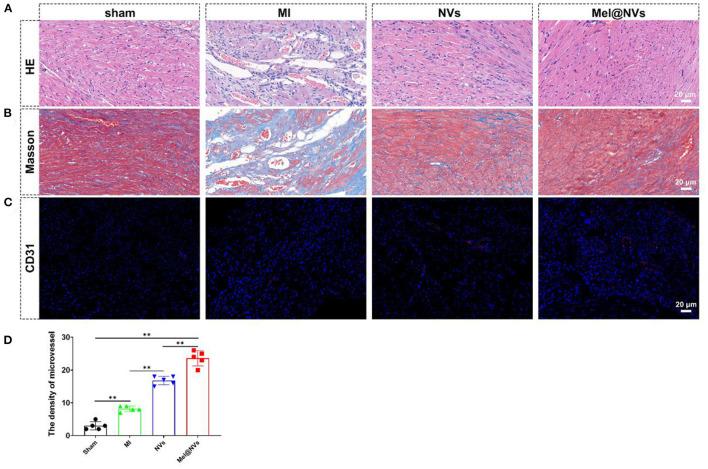
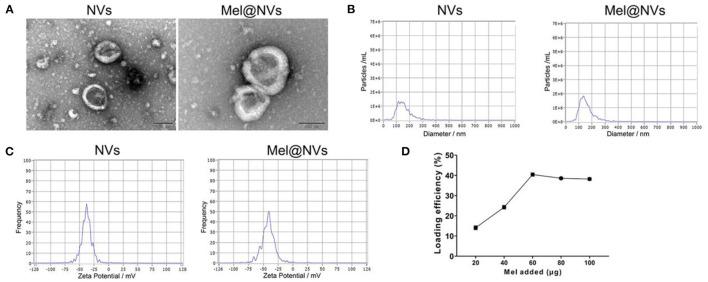
Myocardial infarction (MI), one type of ischemic heart disease, is a major cause of disability and mortality worldwide. Currently, extracellular vesicles (EVs) derived from adipose-derived stem cells (ADSC) have been proven to be a potentially promising therapeutic treatment for MI. However, the inconvenience of isolation, the low productivity, and the high cost of EVs greatly limits their application in clinic. In this study, we constructed novel biomimetic ADSC-derived nanovesicles (ADSC NVs) to achieve cell-free therapy for MI. Here, we firstly developed a novel Mel@NVs delivery system consisting of engineered ADSC NVs with melatonin (Mel). Then, the characterization and properties of Mel@NVs were performed. The effect of Mel@NVs on cellular oxidative stress and myocardial infarction repair was conducted. The results showed that Mel@NVs treatment under ischemia mimic condition reduced cell apoptosis from 42.59 ± 2.69% to 13.88 ± 1.77%. Moreover, this novel engineered Mel@NVs could ameliorate excessive ROS generation, promote microvessel formation, and attenuate cardiac fibrosis, which further alleviates mitochondrial dysfunction and finally enhance myocardial repair. Hence, the engineered NVs show a potential strategy for MI therapy.
心肌梗死(MI)是缺血性心脏病的一种类型,是全球范围内导致残疾和死亡的主要原因。目前,脂肪来源干细胞(ADSC)衍生的细胞外囊泡(EVs)已被证明是一种对心肌梗死具有潜在前景的治疗方法。然而,EVs分离不便、产量低以及成本高,极大地限制了它们在临床上的应用。在本研究中,我们构建了新型仿生ADSC衍生纳米囊泡(ADSC NVs)以实现对心肌梗死的无细胞治疗。在此,我们首先开发了一种新型的Mel@NVs递送系统,该系统由含有褪黑素(Mel)的工程化ADSC NVs组成。然后,对Mel@NVs的特性和性质进行了研究。研究了Mel@NVs对细胞氧化应激和心肌梗死修复的影响。结果表明,在模拟缺血条件下,Mel@NVs处理可使细胞凋亡率从42.59±2.69%降至13.88±1.77%。此外,这种新型工程化的Mel@NVs可以改善过量活性氧的产生,促进微血管形成,并减轻心脏纤维化,进而减轻线粒体功能障碍,最终增强心肌修复。因此,工程化纳米囊泡显示出一种治疗心肌梗死的潜在策略。



 Zotero 插件