
将衣物建模为在室内微环境中传播空气传播颗粒和病原体的载体。
Modeling Clothing as a Vector for Transporting Airborne Particles and Pathogens across Indoor Microenvironments.
机构信息
Department of Earth Sciences, University of Toronto, Toronto, Ontario M5S 3B1, Canada.
Center for Public Health and Environmental Assessment, U.S. Environmental Protection Agency, Durham, North Carolina 27711, United States.
出版信息
Environ Sci Technol. 2022 May 3;56(9):5641-5652. doi: 10.1021/acs.est.1c08342. Epub 2022 Apr 11.
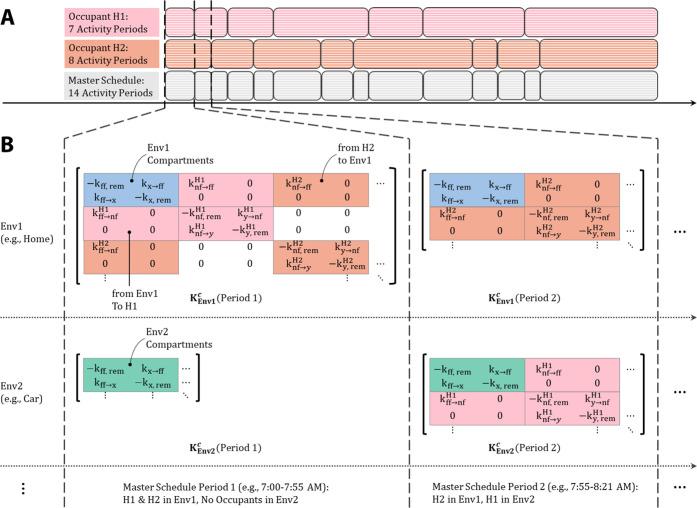
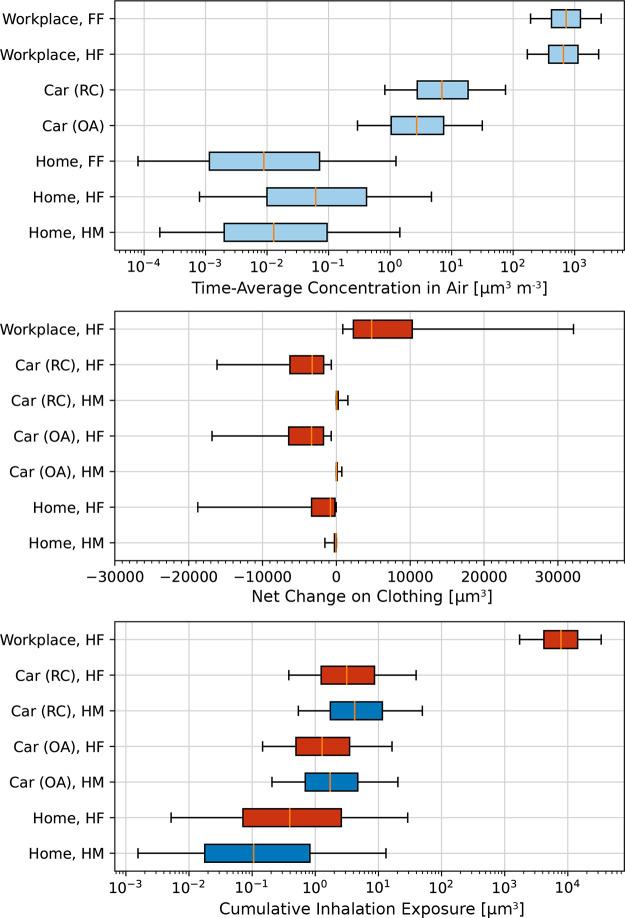
Evidence suggests that human exposure to airborne particles and associated contaminants, including respiratory pathogens, can persist beyond a single microenvironment. By accumulating such contaminants from air, clothing may function as a transport vector and source of "secondary exposure". To investigate this function, a novel microenvironmental exposure modeling framework (ABICAM) was developed. This framework was applied to a para-occupational exposure scenario involving the deposition of viable SARS-CoV-2 in respiratory particles (0.5-20 μm) from a primary source onto clothing in a nonhealthcare setting and subsequent resuspension and secondary exposure in a car and home. Variability was assessed through Monte Carlo simulations. The total volume of infectious particles on the occupant's clothing immediately after work was 4800 μm (5th-95th percentiles: 870-32 000 μm). This value was 61% (5-95%: 17-300%) of the occupant's primary inhalation exposure in the workplace while unmasked. By arrival at the occupant's home after a car commute, relatively rapid viral inactivation on cotton clothing had reduced the infectious volume on clothing by 80% (5-95%: 26-99%). Secondary inhalation exposure (after work) was low in the absence of close proximity and physical contact with contaminated clothing. In comparison, the average primary inhalation exposure in the workplace was higher by about 2-3 orders of magnitude. It remains theoretically possible that resuspension and physical contact with contaminated clothing can occasionally transmit SARS-CoV-2 between humans.
有证据表明,人类暴露于空气中的颗粒和相关污染物中,包括呼吸道病原体,可能会在单一微环境之外持续存在。通过从空气中积累这些污染物,衣物可能会起到传输载体和“二次暴露”源的作用。为了研究这种功能,开发了一种新型的微环境暴露建模框架(ABICAM)。该框架应用于一种准职业暴露场景,涉及从主要来源到非医疗环境中衣物上的呼吸道颗粒(0.5-20μm)中沉积的存活 SARS-CoV-2,以及随后在汽车和家中的再悬浮和二次暴露。通过蒙特卡罗模拟评估了变异性。工作结束后,附着在乘员衣物上的传染性颗粒的总体积立即达到 4800μm(第 5 个至第 95 个百分位数:870-32000μm)。这一数值是未戴口罩时乘员在工作场所进行初级吸入暴露的 61%(第 5 个至第 95 个百分位数:17-300%)。通过汽车通勤到达乘员家中后,棉制衣物上的病毒迅速失活,使衣物上的传染性颗粒减少了 80%(第 5 个至第 95 个百分位数:26-99%)。如果没有与受污染的衣物近距离接触和物理接触,二次吸入暴露(工作后)较低。相比之下,工作场所的平均初级吸入暴露要高约 2-3 个数量级。理论上仍有可能通过受污染的衣物再悬浮和物理接触在人与人之间偶尔传播 SARS-CoV-2。

 Zotero 插件