
玉米中铁缺乏耐受性相关数量性状位点的鉴定
Identification of Quantitative Trait Loci Associated With Iron Deficiency Tolerance in Maize.
作者信息
Xu Jianqin, Zhu Xiaoyang, Yan Fang, Zhu Huaqing, Zhou Xiuyu, Yu Futong
机构信息
Key Laboratory of Plant-Soil Interaction (MOE), Centre for Resources, Environment and Food Security, College of Resources and Environmental Sciences, China Agricultural University, Beijing, China.
Key Lab of Crop Heterosis and Utilization of Ministry of Education, Beijing Key Lab of Crop Genetic Improvement, China Agricultural University, Beijing, China.
出版信息
Front Plant Sci. 2022 Apr 14;13:805247. doi: 10.3389/fpls.2022.805247. eCollection 2022.
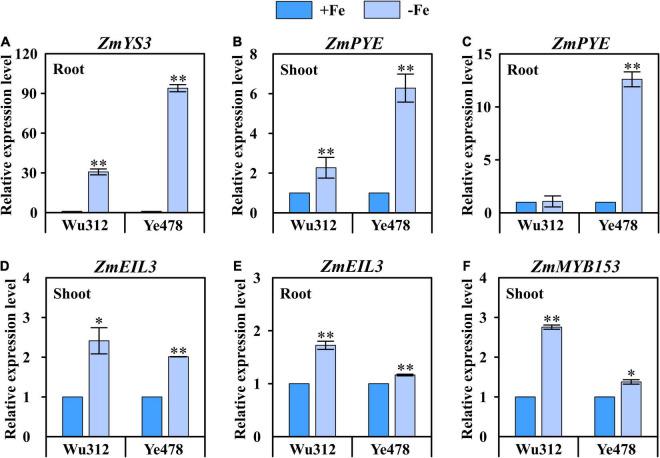
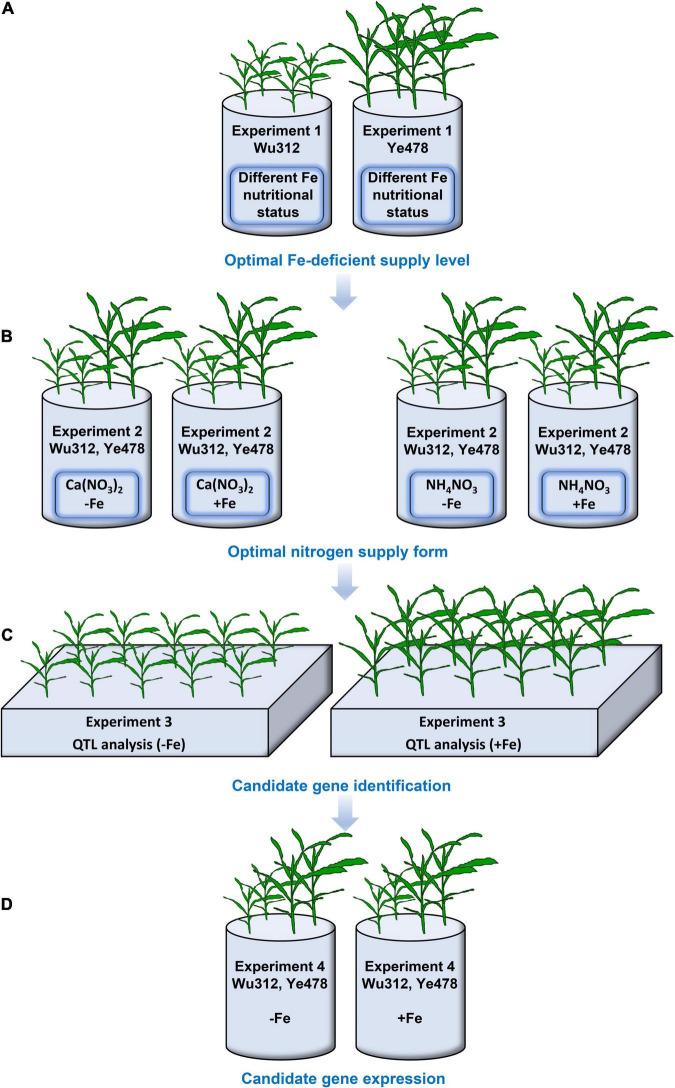
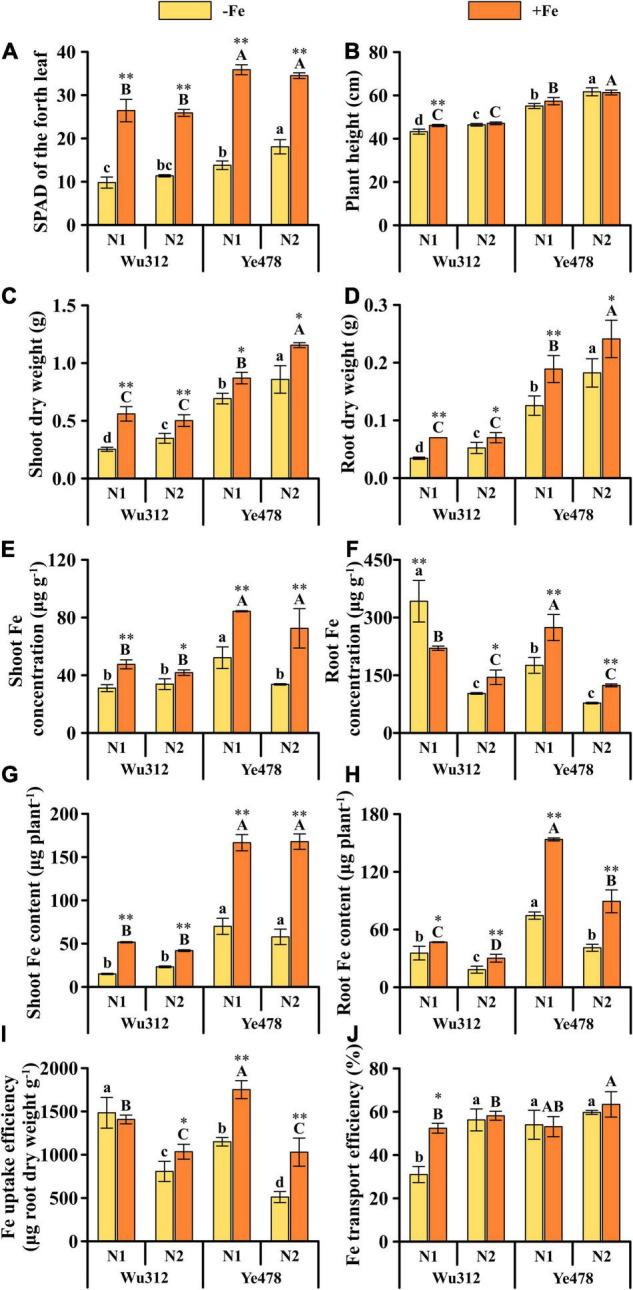
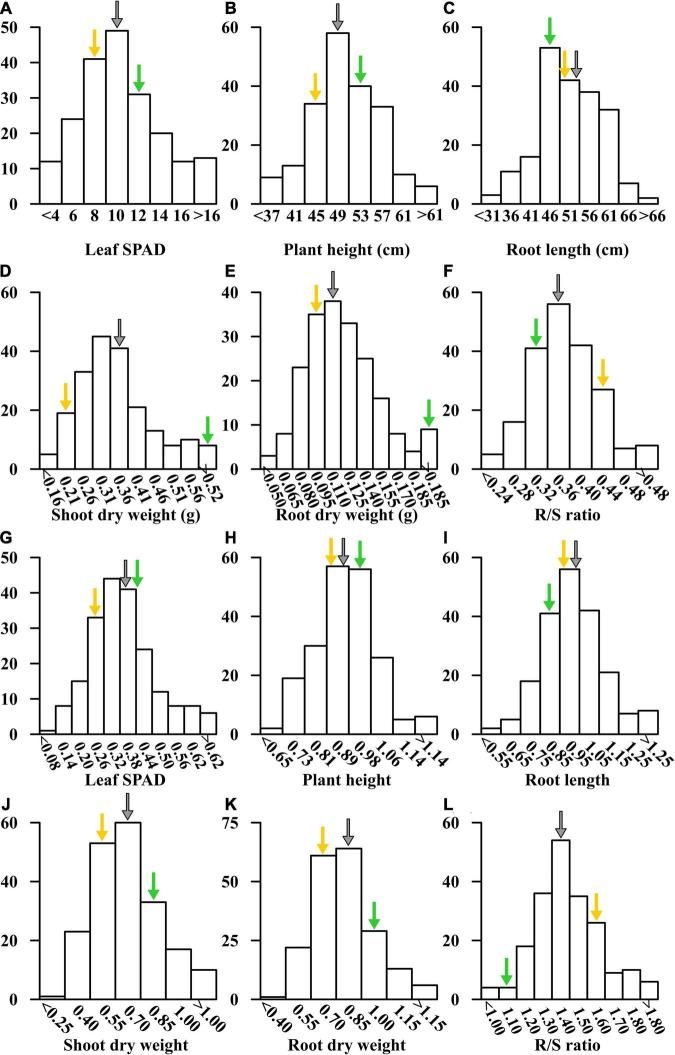
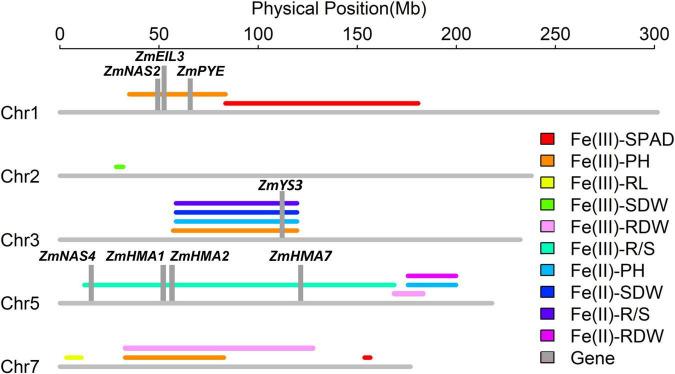
Iron (Fe) is a limiting factor in crop growth and nutritional quality because of its low solubility. However, the current understanding of how major crops respond to Fe deficiency and the genetic basis remains limited. In the present study, Fe-efficient inbred line Ye478 and Fe-inefficient inbred line Wu312 and their recombinant inbred line (RIL) population were utilized to reveal the physiological and genetic responses of maize to low Fe stress. Compared with the Fe-sufficient conditions (+Fe: 200 μM), Fe-deficient supply (-Fe: 30 μM) significantly reduced shoot and root dry weights, leaf SPAD of Fe-efficient inbred line Ye478 by 31.4, 31.8, and 46.0%, respectively; decreased Fe-inefficient inbred line Wu312 by 72.0, 45.1, and 84.1%, respectively. Under Fe deficiency, compared with the supply of calcium nitrate (N1), supplying ammonium nitrate (N2) significantly increased the shoot and root dry weights of Wu312 by 37.5 and 51.6%, respectively; and enhanced Ye478 by 23.9 and 45.1%, respectively. Compared with N1, N2 resulted in a 70.0% decrease of the root Fe concentration for Wu312 in the -Fe treatment, N2 treatment reduced the root Fe concentration of Ye478 by 55.8% in the -Fe treatment. These findings indicated that, compared with only supplying nitrate nitrogen, combined supply of ammonium nitrogen and nitrate nitrogen not only contributed to better growth in maize but also significantly reduced Fe concentration in roots. In linkage analysis, ten quantitative trait loci (QTLs) associated with Fe deficiency tolerance were detected, explaining 6.2-12.0% of phenotypic variation. Candidate genes considered to be associated with the mechanisms underlying Fe deficiency tolerance were identified within a single locus or QTL co-localization, including , , , , and , which may form a sophisticated network to regulate the uptake, transport and redistribution of Fe. Furthermore, was highly induced by Fe deficiency in the roots; and , which may be involved in Fe homeostasis in strategy I plants, were significantly upregulated in the shoots and roots under low Fe stress; was Fe-deficiency inducible in the shoots. Our findings will provide a comprehensive insight into the physiological and genetic basis of Fe deficiency tolerance.
铁(Fe)因其溶解度低,是作物生长和营养品质的限制因素。然而,目前对于主要作物如何应对缺铁以及其遗传基础的理解仍然有限。在本研究中,利用铁高效自交系掖478和铁低效自交系武312及其重组自交系(RIL)群体,揭示玉米对低铁胁迫的生理和遗传响应。与铁充足条件(+Fe:200 μM)相比,缺铁供应(-Fe:30 μM)显著降低了铁高效自交系掖478地上部和根部干重、叶片SPAD值,降幅分别为31.4%、31.8%和46.0%;铁低效自交系武312的上述指标分别降低了72.0%、45.1%和84.1%。在缺铁条件下,与供应硝酸钙(N1)相比,供应硝酸铵(N2)显著增加了武312地上部和根部干重,增幅分别为37.5%和51.6%;掖478的增幅分别为23.9%和45.1%。与N1相比,在-Fe处理中,N2使武312根部铁浓度降低了70.0%,在-Fe处理中,N2处理使掖478根部铁浓度降低了55.8%。这些结果表明,与仅供应硝态氮相比,铵态氮和硝态氮联合供应不仅有助于玉米更好地生长,还显著降低了根部铁浓度。在连锁分析中,检测到10个与缺铁耐受性相关的数量性状位点(QTL),解释了6.2%-12.0%的表型变异。在单个位点或QTL共定位区域内鉴定出被认为与缺铁耐受性潜在机制相关的候选基因,包括 、 、 、 、 和 ,它们可能形成一个复杂的网络来调节铁的吸收、运输和再分配。此外, 在根部受缺铁高度诱导; 和 可能参与策略I植物中铁的稳态,在低铁胁迫下地上部和根部显著上调; 在地上部受缺铁诱导。我们的研究结果将为缺铁耐受性的生理和遗传基础提供全面的见解。


 Zotero 插件