
印楝油负载型固体脂质纳米粒的制备及其抗弓形虫活性评价。
Formulation of Neem oil-loaded solid lipid nanoparticles and evaluation of its anti-Toxoplasma activity.
作者信息
Nemati Sara, Mohammad Rahimi Hanieh, Hesari Zahra, Sharifdini Meysam, Jalilzadeh Aghdam Nooshin, Mirjalali Hamed, Zali Mohammad Reza
机构信息
Foodborne and Waterborne Diseases Research Center, Research Institute for Gastroenterology and Liver Diseases, Shahid Beheshti University of Medical Sciences, Tehran, Iran.
Department of Pharmaceutics, School of Pharmacy, Guilan University of Medical Sciences, Rasht, Iran.
出版信息
BMC Complement Med Ther. 2022 May 4;22(1):122. doi: 10.1186/s12906-022-03607-z.
BACKGROUND
Toxoplasmosis is caused by an intracellular zoonotic protozoan, Toxoplasma gondii, which could be lethal in immunocompromised patients. This study aimed to synthesize Neem oil-loaded solid lipid nanoparticles (NeO-SLNs) and to evaluate the anti-Toxoplasma activity of this component.
METHODS
The NeO-SLNs were constructed using double emulsification method, and their shape and size distribution were evaluated using transmission electron microscope (TEM) and dynamic light scattering (DLS), respectively. An MTT assay was employed to evaluate the cell toxicity of the component. The anti-Toxoplasma activity of NeO-SLNs was investigated using vital (trypan-blue) staining. Anti-intracellular Toxoplasma activity of NeO-SLNs was evaluated in T. gondii-infected Vero cells.
RESULTS
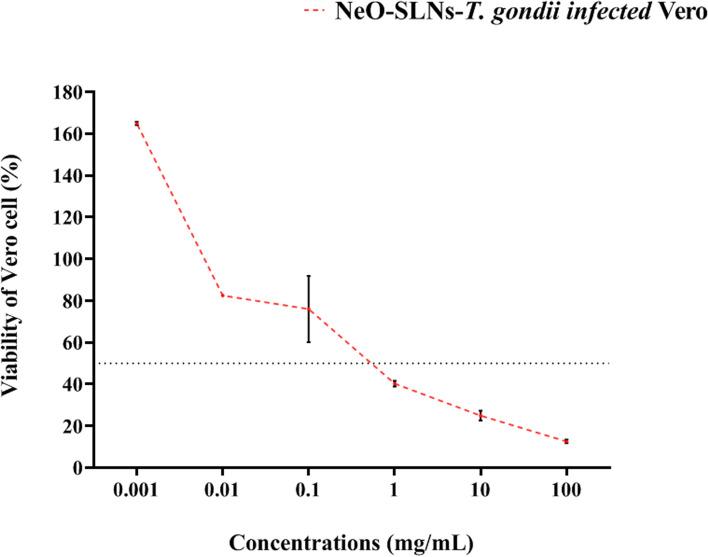
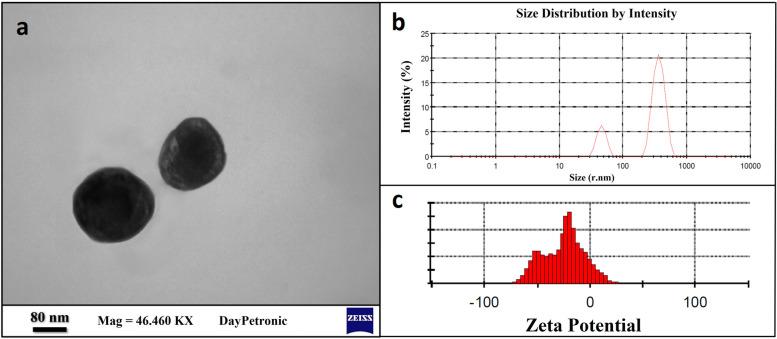
The TEM analysis represented round shape NeO-SLNs with clear and stable margins. DLS analysis showed a mean particle size 337.6 nm for SLNs, and most of nanoparticles were in range 30 to 120 nm. The cell toxicity of NeO-SLNs was directly correlated with the concentration of the component (P-value = 0.0013). The concentration of NeO-SLNs, which was toxic for at least 50% of alive T. gondii (cytotoxic concentration (CC)), was > 10 mg/mL. The ability of NeO-SLNs to kill Toxoplasma was concentration-dependent (P-value < 0.0001), and all concentrations killed at least 70% of alive tachyzoites. Furthermore, the viability of T. gondii- infected Vero cells was inversely correlated with NeO-SLNs concentrations (P-value = 0.0317), and in the concentration 100 μg/mL at least 75% of T. gondii- infected Vero cells remained alive.
CONCLUSIONS
Overall, our findings demonstrated that the NeO-SLNs was able to kill T. gondii tachyzoites in concentration 100 μg/mL with a cell toxicity lower than 20%. Such results suggest that employing SLNs as carrier for NeO can effectively kill T. gondii tachyzoites with acceptable cell toxicity. Our findings also showed that SLNs capsulation of the NeO can lead to prolonged release of the extract, suggesting that NeO-SLNs could be also employed to clear cyst stages, which should be further investigated in animal models.
背景
弓形虫病由细胞内人畜共患原生动物刚地弓形虫引起,在免疫功能低下的患者中可能致命。本研究旨在合成负载印楝油的固体脂质纳米粒(NeO-SLNs)并评估该成分的抗弓形虫活性。
方法
采用复乳法构建NeO-SLNs,分别使用透射电子显微镜(TEM)和动态光散射(DLS)评估其形状和大小分布。采用MTT法评估该成分的细胞毒性。使用活细胞(台盼蓝)染色研究NeO-SLNs的抗弓形虫活性。在刚地弓形虫感染的Vero细胞中评估NeO-SLNs的抗细胞内弓形虫活性。
结果
TEM分析显示NeO-SLNs呈圆形,边缘清晰且稳定。DLS分析显示SLNs的平均粒径为337.6nm,大多数纳米颗粒在30至120nm范围内。NeO-SLNs的细胞毒性与该成分的浓度直接相关(P值 = 0.0013)。对至少50%存活的刚地弓形虫有毒性的NeO-SLNs浓度(细胞毒性浓度(CC))>10mg/mL。NeO-SLNs杀死弓形虫的能力呈浓度依赖性(P值<0.0001),所有浓度均杀死了至少70%存活的速殖子。此外,刚地弓形虫感染的Vero细胞的活力与NeO-SLNs浓度呈负相关(P值 = 0.0317),在100μg/mL浓度下,至少75%刚地弓形虫感染的Vero细胞存活。
结论
总体而言,我们的研究结果表明,NeO-SLNs能够在浓度为100μg/mL时杀死刚地弓形虫速殖子,细胞毒性低于20%。这些结果表明,将SLNs用作NeO的载体可以有效杀死刚地弓形虫速殖子,且细胞毒性可接受。我们的研究结果还表明,NeO的SLNs包封可导致提取物的缓释,这表明NeO-SLNs也可用于清除包囊阶段,这应在动物模型中进一步研究。


 Zotero 插件