
在一大群重症监护患者中监测循环单核细胞 HLA - DR 表达:与继发感染的关系
Monitoring of circulating monocyte HLA-DR expression in a large cohort of intensive care patients: relation with secondary infections.
作者信息
de Roquetaillade C, Dupuis C, Faivre V, Lukaszewicz A C, Brumpt C, Payen D
机构信息
Anesthesiology and Critical Care Unit, Hopital Lariboisière, Paris, France.
INSERM U942, Département MASCOT, 43 Boulevard de la Chapelle, 75010, Paris, France.
出版信息
Ann Intensive Care. 2022 May 8;12(1):39. doi: 10.1186/s13613-022-01010-y.
INTRODUCTION
The reports of an early and profound acquired immunodepression syndrome (AIDs) in ICU patients had gained sufficient credence to modify the paradigm of acute inflammation. However, despite several articles published on AIDs and its assessment by monocytic HLA-DR monitoring, several missing informations remained: 1-Which patients' are more prone to benefit from mHLA-DR measurement, 2-Is the nadir or the duration of the low mHLA-DR expression the main parameter to consider? 3-What are the compared performances of leukocytes' count analyses (lymphocyte, monocyte).
MATERIAL AND METHOD
We conducted an observational study in a surgical ICU of a French tertiary hospital. A first mHLA-DR measurement (fixed flow cytometry protocol) was performed within the first 3 days following admission and a 2nd, between day 5 and 10. The other collected parameters were: SAPS II and SOFA scores, sex, age, comorbidities, mortality and ICU-acquired infections (IAI). The associations between mHLA-DR and outcomes were tested by adjusted Fine and Gray subdistribution competing risk models.
RESULTS
1053 patients were included in the study, of whom 592 had a 2nd mHLA-DR measurement. In this cohort, 223 patients (37.7%) complicated by IAI. The initial decrement in mHLA-DR was not associated with the later occurrence of IAI, (p = 0.721), however, the persistence of a low mHLA-DR (< 8000 AB/C), measured between day 5 and day 7, was associated with the later occurrence of IAI (p = 0.01). Similarly, a negative slope between the first and the second value was significantly associated with subsequent IAI (p = 0.009). The best performance of selected markers was obtained with the combination of the second mHLA-DR measurement with SAPSII on admission. Persisting lymphopenia and monocytopenia were not associated with later occurrence of IAI.
CONCLUSION
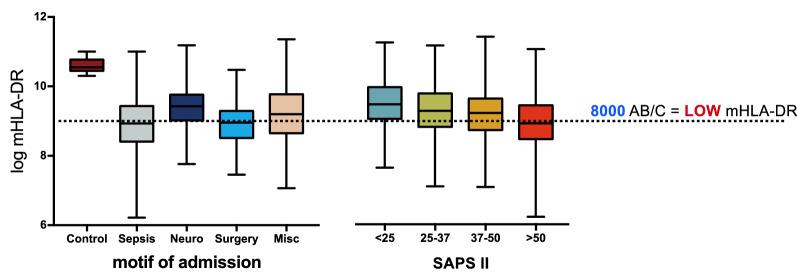
Downregulation of mHLA-DR following admission is observed in a vast number of patients whatever the initial motif for admission. IAI mostly occurs among patients with a high severity score on admission suggesting that immune monitoring should be reserved to the most severe patients. The initial downregulation did not preclude the later development of IAI. A decreasing or a persisting low mHLA-DR expression below 8000AB/C within the first 7 days of ICU admission was independently and reliably associated with subsequent IAI among ICU patients with performances superior to leukocyte subsets count alone.
引言
关于重症监护病房(ICU)患者出现早期且严重的获得性免疫抑制综合征(AIDs)的报告已获得足够的可信度,从而改变了急性炎症的模式。然而,尽管已发表了多篇关于AIDs及其通过单核细胞人类白细胞抗原-DR(mHLA-DR)监测进行评估的文章,但仍存在一些信息缺失:1-哪些患者更有可能从mHLA-DR测量中获益,2-mHLA-DR低表达的最低点或持续时间是需要考虑的主要参数吗?3-白细胞计数分析(淋巴细胞、单核细胞)的比较性能如何?
材料与方法
我们在法国一家三级医院的外科ICU进行了一项观察性研究。在入院后的前3天内进行首次mHLA-DR测量(固定流式细胞术方案),并在第5天至第10天之间进行第二次测量。收集的其他参数包括:简化急性生理学评分II(SAPS II)、性别、年龄、合并症、死亡率和ICU获得性感染(IAI)。通过调整后的Fine和Gray亚分布竞争风险模型测试mHLA-DR与结局之间的关联。
结果
1053例患者纳入研究,其中592例进行了第二次mHLA-DR测量。在该队列中,223例患者(37.7%)发生IAI。mHLA-DR的初始下降与随后IAI的发生无关(p = 0.721),然而,在第5天至第7天测量的mHLA-DR持续低水平(<8000 AB/C)与随后IAI的发生相关(p = 0.01)。同样,第一次和第二次测量值之间的负斜率与随后的IAI显著相关(p = 0.009)。将第二次mHLA-DR测量与入院时的SAPSII相结合可获得所选标志物的最佳性能。持续性淋巴细胞减少和单核细胞减少与随后IAI的发生无关。
结论
无论最初的入院原因如何,大量患者在入院后均观察到mHLA-DR下调。IAI主要发生在入院时严重程度评分高的患者中,这表明免疫监测应仅限于最严重的患者。初始下调并不排除IAI的后期发展。在ICU入院的前7天内,mHLA-DR表达持续降低或持续低于8000AB/C与ICU患者随后的IAI独立且可靠地相关,其性能优于单独的白细胞亚群计数。


 Zotero 插件