
异源与同源信使 RNA 疫苗加强针对严重急性呼吸综合征冠状病毒 2 型奥密克戎变异株的抗体反应:PRIBIVAC 研究的中期结果,一项随机临床试验。
Antibody Response of Heterologous vs Homologous Messenger RNA Vaccine Boosters Against the Severe Acute Respiratory Syndrome Coronavirus 2 Omicron Variant: Interim Results from the PRIBIVAC Study, a Randomized Clinical Trial.
机构信息
National Centre for Infectious Diseases, Singapore, Singapore.
Emerging Infectious Diseases Programme, Duke-National University of Singapore Medical School, Singapore, Singapore.
出版信息
Clin Infect Dis. 2022 Dec 19;75(12):2088-2096. doi: 10.1093/cid/ciac345.
BACKGROUND
Waning antibody levels post-vaccination and the emergence of variants of concern (VOCs) capable of evading protective immunity have raised the need for booster vaccinations. However, which combination of coronavirus disease 2019 (COVID-19) vaccines offers the strongest immune response against the Omicron variant is unknown.
METHODS
This randomized, participant-blinded, controlled trial assessed the reactogenicity and immunogenicity of different COVID-19 vaccine booster combinations. A total of 100 BNT162b2-vaccinated individuals were enrolled and randomized 1:1 to either homologous (BNT162b2 + BNT162b2 + BNT162b2; "BBB") or heterologous messenger RNA (mRNA) (BNT162b2 + BNT162b2 + mRNA-1273; "BBM") booster vaccine. The primary end point was the level of neutralizing antibodies against severe acute respiratory syndrome coronavirus 2 (SARS-CoV-2) wild-type and VOCs at day 28.
RESULTS
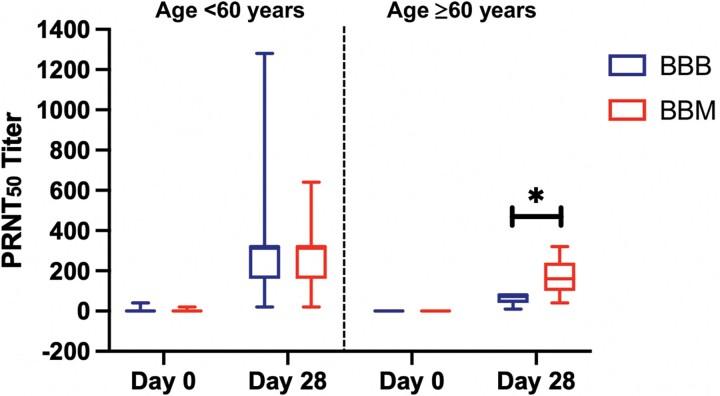
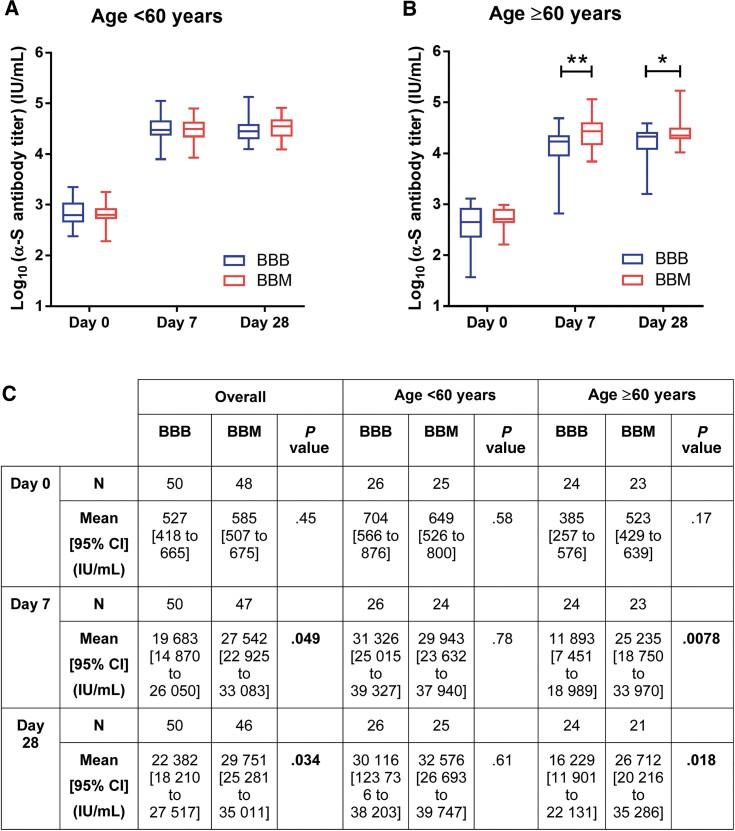
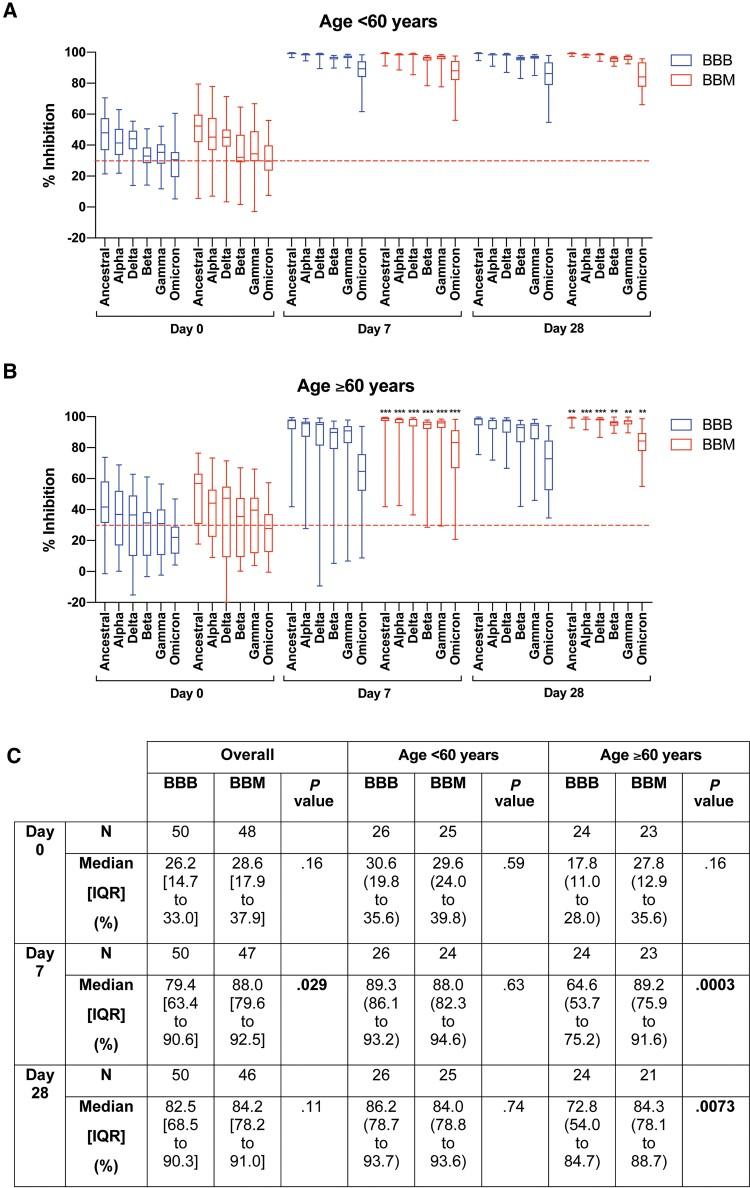
A total of 51 participants were allocated to BBB and 49 to BBM; 50 and 48, respectively, were analyzed for safety and immunogenicity outcomes. At day 28 post-boost, mean SARS-CoV-2 spike antibody titers were lower with BBB (22 382 IU/mL; 95% confidence interval [CI], 18 210 to 27 517) vs BBM (29 751 IU/mL; 95% CI, 25 281 to 35 011; P = .034) as was the median level of neutralizing antibodies: BBB 99.0% (interquartile range [IQR], 97.9% to 99.3%) vs BBM 99.3% (IQR, 98.8% to 99.5%; P = .021). On subgroup analysis, significant higher mean spike antibody titer, median surrogate neutralizing antibody level against all VOCs, and live Omicron neutralization titer were observed only in older adults receiving BBM. Both vaccines were well tolerated.
CONCLUSIONS
Heterologous mRNA-1273 booster vaccination compared with homologous BNT123b2 induced a stronger neutralizing response against the Omicron variant in older individuals.
CLINICAL TRIALS REGISTRATION
NCT05142319.
背景
接种疫苗后抗体水平下降,以及能够逃避保护性免疫的关注变体(VOCs)的出现,增加了加强针接种的需求。然而,哪种组合的 2019 冠状病毒病(COVID-19)疫苗对奥密克戎变体提供最强的免疫反应尚不清楚。
方法
这项随机、参与者设盲、对照试验评估了不同 COVID-19 疫苗加强组合的反应原性和免疫原性。共纳入 100 名已接种 BNT162b2 的个体,并按 1:1 随机分为同源(BNT162b2+BNT162b2+BNT162b2;“BBB”)或异源信使 RNA(mRNA)(BNT162b2+BNT162b2+mRNA-1273;“BBM”)加强疫苗。主要终点是第 28 天针对严重急性呼吸综合征冠状病毒 2(SARS-CoV-2)野生型和 VOCs 的中和抗体水平。
结果
共有 51 名参与者被分配到 BBB 组,49 名参与者被分配到 BBM 组;分别有 50 名和 48 名参与者对安全性和免疫原性结果进行了分析。在加强后第 28 天,与 BBM 组(29751IU/mL;95%置信区间[CI],25281 至 35011)相比,BBB 组(22382IU/mL;95%CI,18210 至 27517)的 SARS-CoV-2 刺突抗体滴度中位值较低,中和抗体的中位值也较低:BBB 组 99.0%(四分位距[IQR],97.9%至 99.3%),BM 组 99.3%(IQR,98.8%至 99.5%;P=0.021)。在亚组分析中,仅在接受 BBM 的老年人群中观察到较高的平均刺突抗体滴度、针对所有 VOC 的替代中和抗体中位水平和活奥密克戎中和滴度。两种疫苗均耐受良好。
结论
与同源 BNT123b2 相比,异源 mRNA-1273 加强疫苗接种在老年人中引起了针对奥密克戎变体更强的中和反应。
临床试验注册
NCT05142319。

 Zotero 插件