
哪些因素与北欧国家老年人护理服务中的 COVID-19 感染发病率相关?一项横断面调查。
Which factors are associated with COVID-19 infection incidence in care services for older people in Nordic countries? A cross-sectional survey.
机构信息
Åbo Akademi University, Turku, Finland.
Vaasa Central Hospital, Finland.
出版信息
Scand J Public Health. 2022 Aug;50(6):787-794. doi: 10.1177/14034948221085398. Epub 2022 May 12.
AIMS
To investigate the differences between Sweden, Denmark, Finland and Norway regarding residential/home care units' and frontline managers' background factors, the resources allocated and measures taken during the initial phases of the COVID-19 pandemic, and whether and how these differences were associated with COVID-19 among older people in residential/home units.
METHODS
Register- and survey-based data. Responses from managers in municipal and private residential/home units. Number of municipal COVID-19 cases from national registries. Multilevel logistic multivariate regression analysis with presence of COVID-19 among older people in residential/home units as the outcome variable.
RESULTS
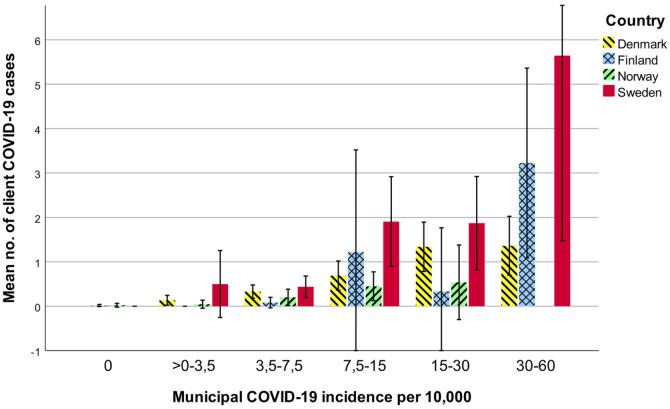
The proportions of residential/home units with client COVID-19 cases, mid-March-April 2020 were Denmark 22.7%, Finland 9.0%, Norway 9.7% and Sweden 38.8%, most cases found in clusters. The proportions were similar among employees. Client likelihood of having COVID-19 was six-fold higher if the employees had COVID-19. Mean client cases per residential/home unit were Denmark 0.78, Finland 0.46, Norway 0.22 and Sweden 1.23. For the same municipal infection incidence class, Sweden's mean client infection levels were three-fold those of other countries. The regression analysis variables country, municipal COVID-19 incidence proportion, and care type were associated with client cases at ⩽ .001. Compared with Denmark, the odds ratios (ORs) for Sweden, Norway and Finland were 1.86, 0.41 and 0.35 respectively. The variable difficulties in preventive testing had an OR of 1.56, ⩽ .05.
CONCLUSIONS
目的
调查瑞典、丹麦、芬兰和挪威在住宅/家庭护理单位和一线管理人员的背景因素、在 COVID-19 大流行初期分配的资源和采取的措施方面的差异,以及这些差异是否以及如何与住宅/家庭单位中老年人的 COVID-19 相关。
方法
基于登记和调查的数据。来自市政和私人住宅/家庭单位的管理人员的回复。来自国家登记处的市政 COVID-19 病例数。使用多水平逻辑多元回归分析,以住宅/家庭单位中老年人 COVID-19 的存在为因变量。
结果
2020 年 3 月至 4 月中旬,丹麦、芬兰、挪威和瑞典的住宅/家庭单位出现 COVID-19 患者的比例分别为 22.7%、9.0%、9.7%和 38.8%,大多数病例出现在集群中。员工中的比例相似。如果员工患有 COVID-19,客户感染 COVID-19 的可能性增加六倍。每所住宅/家庭单位的平均患者人数分别为丹麦 0.78、芬兰 0.46、挪威 0.22 和瑞典 1.23。对于相同的市政感染发生率类别,瑞典的平均患者感染水平是其他国家的三倍。回归分析变量国家、市政 COVID-19 发病率比例和护理类型与患者病例相关,差异具有统计学意义( ⩽ 0.001)。与丹麦相比,瑞典、挪威和芬兰的优势比(OR)分别为 1.86、0.41 和 0.35。在预防性检测方面存在困难的变量的 OR 为 1.56, ⩽ 0.05。
结论
 Zotero 插件