
使用Ga-NOTA-抗MMR纳米抗体可视化心肌梗死后心肌中的M2巨噬细胞:靶向M2巨噬细胞上的甘露糖受体(MR,CD206)
Visualization of M2 Macrophages in the Myocardium After Myocardial Infarction (MI) Using Ga-NOTA-Anti-MMR Nb: Targeting Mannose Receptor (MR, CD206) on M2 Macrophages.
作者信息
Varasteh Zohreh, Braeuer Miriam, Mohanta Sarajo, Steinsiek Anna-Lena, Habenicht Andreas, Omidvari Negar, Topping Geoffrey J, Rischpler Christoph, Weber Wolfgang A, Sager Hendrik B, Raes Geert, Hernot Sophie, Schwaiger Markus
机构信息
Department of Nuclear Medicine, Klinikum rechts der Isar, Technical University of Munich, Munich, Germany.
Department of Nuclear Medicine, University Hospital Essen, University of Duisburg-Essen, Essen, Germany.
出版信息
Front Cardiovasc Med. 2022 Apr 25;9:889963. doi: 10.3389/fcvm.2022.889963. eCollection 2022.
INTRODUCTION AND OBJECTIVES
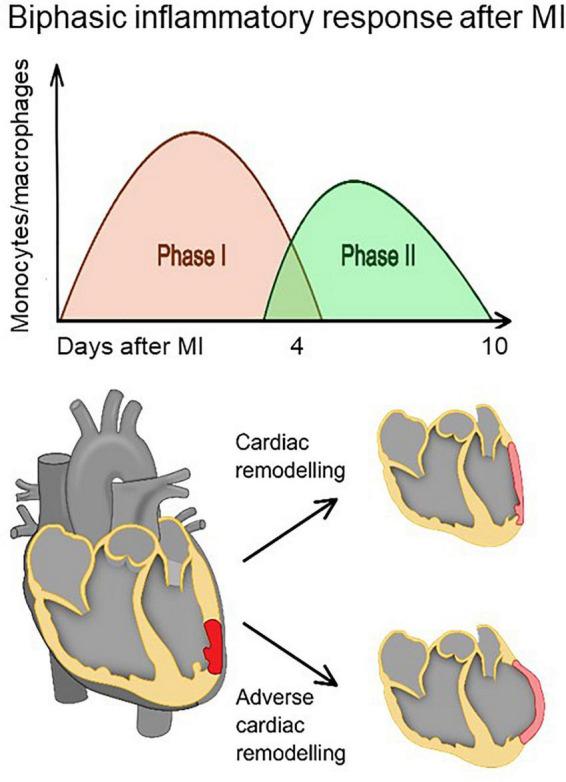
Wound healing after myocardial infarction (MI) is a dynamic and complex multiple phase process, and a coordinated cellular response is required for proper scar formation. The current paradigm suggests that pro-inflammatory monocytes infiltrate the MI zone during the initial pro-inflammatory phase and differentiate into inflammatory macrophages, and then switch their phenotypes to anti-inflammatory during the reparative phase. Visualization of the reparative phase post-MI is of great interest because it may reveal delayed resolution of inflammation, which in turn predicts adverse cardiac remodeling. Imaging of anti-inflammatory macrophages may also be used to assess therapy approaches aiming to modulate the inflammatory response in order to limit MI size. Reparative macrophages can be distinguished from inflammatory macrophages by the surface marker mannose receptor (MR, CD206). In this study we evaluated the feasibility of Ga-NOTA-anti-MMR Nb for imaging of MR on alternatively activated macrophages in murine MI models.
METHODS
Wildtype and MR-knockout mice and Wistar rats were subjected to MI via permanent ligation of the left coronary artery. Non-operated or sham-operated animals were used as controls. MR expression kinetics on cardiac macrophages was measured in mice using flow cytometry. PET/CT scans were performed 1 h after intravenous injection of Ga-NOTA-anti-MMR Nb. Mice and rats were euthanized and hearts harvested for PET/MRI, autoradiography, and staining. As a non-targeting negative control, Ga-NOTA-BCII10 was used.
RESULTS
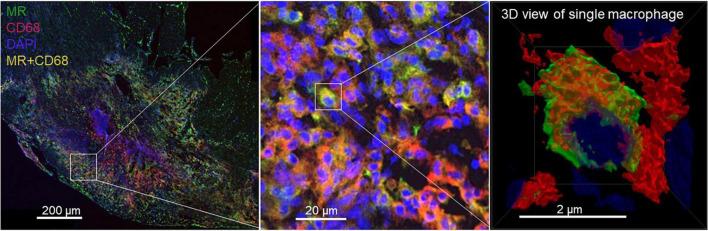
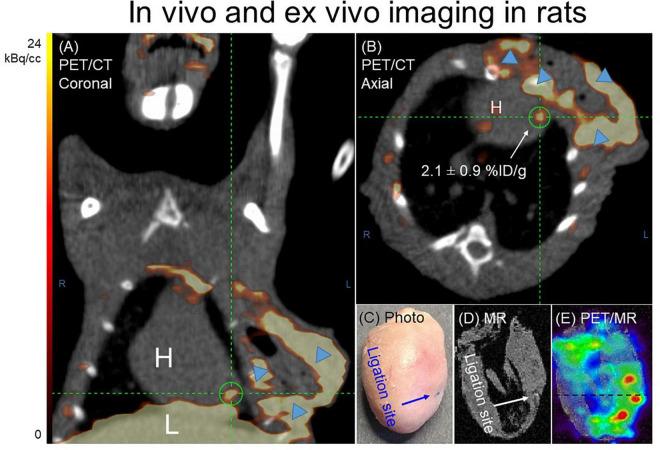
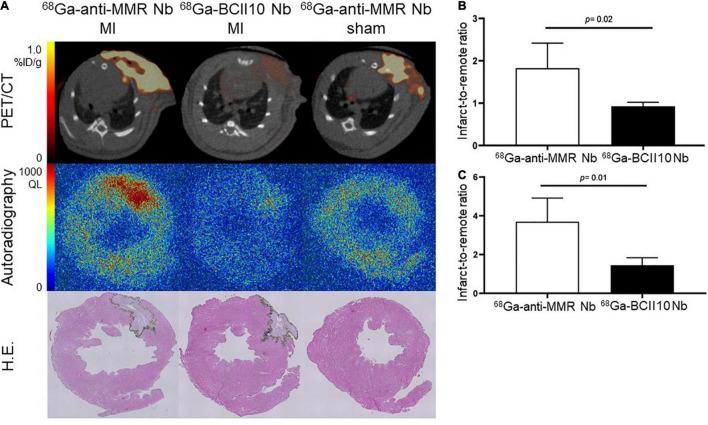
-PET/CT scans showed focal radioactivity signals in the infarcted myocardium for Ga-NOTA-anti-MMR Nb which were confirmed by -PET/MRI scans. In autoradiography images, augmented uptake of the tracer was observed in infarcts, as verified by the histochemistry analysis. Immunofluorescence staining demonstrated the presence and co-localization of CD206- and CD68-positive cells, in accordance to infarct zone. No or signal was observed in the animals injected with control Nb or in the sham-operated animals. Ga-NOTA-anti-MMR Nb uptake in the infarcts of MR-knockout mice was negligibly low, confirming the specificity of Ga-NOTA-anti-MMR Nb to MR.
CONCLUSION
This exploratory study highlights the potential of Ga-NOTA-anti-MMR Nb to image MR-positive macrophages that are known to play a pivotal role in wound healing that follows acute MI.
引言与目的
心肌梗死(MI)后的伤口愈合是一个动态且复杂的多阶段过程,适当的瘢痕形成需要协调的细胞反应。当前的范例表明,促炎性单核细胞在初始促炎阶段浸润MI区域并分化为炎性巨噬细胞,然后在修复阶段将其表型转变为抗炎性。MI后修复阶段的可视化非常重要,因为它可能揭示炎症的延迟消退,进而预测不良的心脏重塑。抗炎性巨噬细胞的成像也可用于评估旨在调节炎症反应以限制MI大小的治疗方法。修复性巨噬细胞可通过表面标志物甘露糖受体(MR,CD206)与炎性巨噬细胞区分开来。在本研究中,我们评估了Ga-NOTA-抗MMR Nb在小鼠MI模型中对交替激活的巨噬细胞上的MR进行成像的可行性。
方法
通过永久性结扎左冠状动脉使野生型和MR基因敲除小鼠以及Wistar大鼠发生MI。未手术或假手术的动物用作对照。使用流式细胞术测量小鼠心脏巨噬细胞上的MR表达动力学。静脉注射Ga-NOTA-抗MMR Nb 1小时后进行PET/CT扫描。对小鼠和大鼠实施安乐死并取出心脏进行PET/MRI、放射自显影和染色。作为非靶向阴性对照,使用Ga-NOTA-BCII10。
结果
PET/CT扫描显示Ga-NOTA-抗MMR Nb在梗死心肌中有局灶性放射性信号,PET/MRI扫描证实了这一点。在放射自显影图像中,梗死灶中观察到示踪剂摄取增加,组织化学分析证实了这一点。免疫荧光染色显示CD206和CD68阳性细胞的存在及其与梗死区域一致的共定位。在注射对照Nb的动物或假手术动物中未观察到信号。Ga-NOTA-抗MMR Nb在MR基因敲除小鼠梗死灶中的摄取极低,证实了Ga-NOTA-抗MMR Nb对MR的特异性。
结论
这项探索性研究突出了Ga-NOTA-抗MMR Nb对MR阳性巨噬细胞成像的潜力,已知这些巨噬细胞在急性MI后的伤口愈合中起关键作用。



 Zotero 插件