
从遗传相关、中介和因果关系的角度探讨出生体重与乳腺癌之间的关联,利用汇总统计数据。
Exploring the association between birthweight and breast cancer using summary statistics from a perspective of genetic correlation, mediation, and causality.
机构信息
Department of Biostatistics, School of Public Health, Xuzhou Medical University, Xuzhou, 221004, Jiangsu, China.
Center for Medical Statistics and Data Analysis, Xuzhou Medical University, Xuzhou, 221004, Jiangsu, China.
出版信息
J Transl Med. 2022 May 14;20(1):227. doi: 10.1186/s12967-022-03435-2.
BACKGROUND
Previous studies demonstrated a positive relationship between birthweight and breast cancer; however, inconsistent, sometimes even controversial, observations also emerged, and the nature of such relationship remains unknown.
METHODS
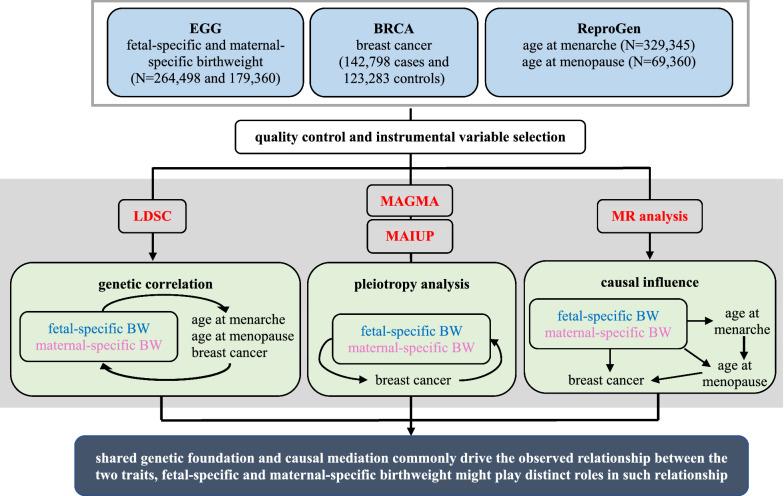
Using summary statistics of birthweight and breast cancer, we assessed the fetal/maternal-specific genetic correlation between them via LDSC and prioritized fetal/maternal-specific pleiotropic genes through MAIUP. Relying on summary statistics we conducted Mendelian randomization (MR) to evaluate the fetal/maternal-specific origin of causal relationship between birthweight, age of menarche, age at menopause and breast cancer.
RESULTS
With summary statistics we identified a positive genetic correlation between fetal-specific birthweight and breast cancer (r = 0.123 and P = 0.013) as well as a negative but insignificant correlation between maternal-specific birthweight and breast cancer (r = - 0.068, P = 0.206); and detected 84 pleiotropic genes shared by fetal-specific birthweight and breast cancer, 49 shared by maternal-specific birthweight and breast cancer. We also revealed fetal-specific birthweight indirectly influenced breast cancer risk in adulthood via the path of age of menarche or age at menopause in terms of MR-based mediation analysis.
CONCLUSION
This study reveals that shared genetic foundation and causal mediation commonly drive the connection between the two traits, and that fetal/maternal-specific birthweight plays substantially distinct roles in such relationship. However, our work offers little supportive evidence for the fetal origins hypothesis of breast cancer originating in utero.
背景
先前的研究表明,出生体重与乳腺癌之间存在正相关关系;然而,也出现了不一致的、有时甚至有争议的观察结果,这种关系的性质仍不清楚。
方法
我们使用出生体重和乳腺癌的汇总统计数据,通过 LDSC 评估了它们之间胎儿/母体特异性遗传相关性,并通过 MAIUP 优先考虑了胎儿/母体特异性多效性基因。我们依靠汇总统计数据进行了孟德尔随机化 (MR) 分析,以评估出生体重、初潮年龄、绝经年龄与乳腺癌之间因果关系的胎儿/母体特异性起源。
结果
利用汇总统计数据,我们确定了胎儿特异性出生体重与乳腺癌之间存在正的遗传相关性(r=0.123,P=0.013),以及母体特异性出生体重与乳腺癌之间存在负但无统计学意义的相关性(r=-0.068,P=0.206);并检测到 84 个胎儿特异性出生体重和乳腺癌之间共享的多效性基因,49 个母体特异性出生体重和乳腺癌之间共享的多效性基因。我们还通过基于 MR 的中介分析发现,胎儿特异性出生体重通过初潮年龄或绝经年龄的途径间接影响成年期乳腺癌的风险。
结论
本研究表明,共同的遗传基础和因果中介共同驱动了这两个特征之间的联系,并且胎儿/母体特异性出生体重在这种关系中起着截然不同的作用。然而,我们的工作几乎没有为乳腺癌起源于宫内的胎儿起源假说提供支持性证据。


 Zotero 插件