
术前炎症指数对胶质母细胞瘤患者生存的预后价值。
The prognostic value of the preoperative inflammatory index on the survival of glioblastoma patients.
机构信息
School of Nursing and Rehabilitation, Shandong University, No. 44 Wenhua Xi Road, Jinan, 250012, Shandong Province, China.
Department of Neurosurgery, Qilu Hospital of Shandong University and Brain Science Research Institute, Cheeloo College of Medicine, Shandong University, Wenhua Xi Road, Jinan, 250012, China.
出版信息
Neurol Sci. 2022 Sep;43(9):5523-5531. doi: 10.1007/s10072-022-06158-w. Epub 2022 May 23.
OBJECTIVES
The growth and development of tumors are closely related to the initiation and amplification of the inflammatory response. Various inflammatory biomarkers had attained growing attention for nearly two decades and were discovered strongly associated with cancer patients' prognosis, indicating that systemic inflammatory response is possibly essential to cancer progression. However, little was known about the sensitive biomarkers associated with the detection, persistence, treatment, and prognosis of GBM. Hence, the retrospective research endeavored to evaluate the prognostic value of preoperative inflammatory biomarkers in patients with GBM who initially received standardized treatment.
METHODS
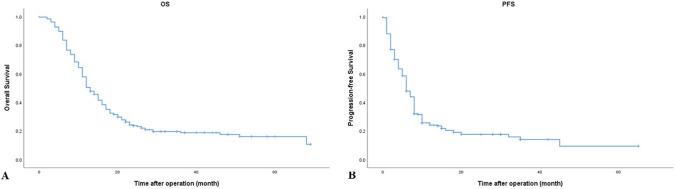
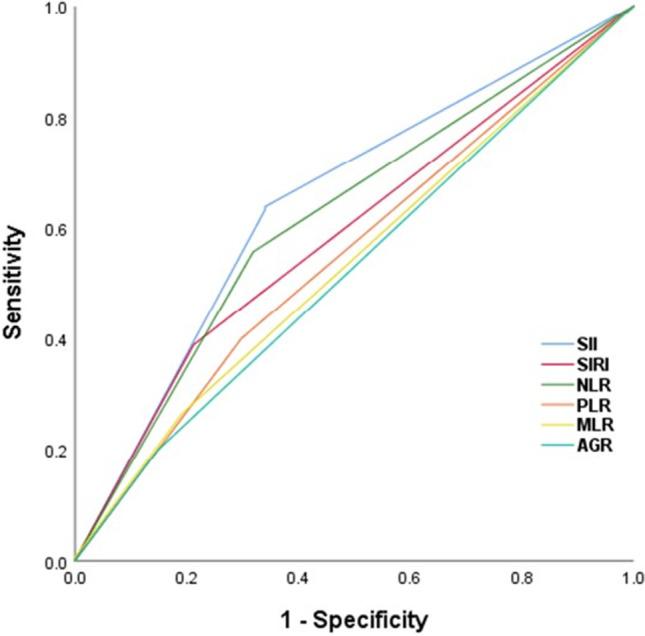
The 232 glioblastoma patients eligible who were admitted to Qilu Hospitals in Shandong Province from January 2014 to January 2018 were collected for this analysis. Inflammatory markers, including the systemic immune-inflammation index (SII), systemic immune response index (SIRI), neutrophil-lymphocyte ratio (NLR), platelet-lymphocyte ratio (PLR), monocyte-lymphocyte ratio (MLR), and albumin/globulin ratio (AGR), were designed. Progression-free survival (PFS) and overall survival (OS) were estimated using the Kaplan-Meier method, and we calculated the area under the ROC curve to determine the AUC value. Besides, we used the Cox proportional hazard model to estimate the relationship between variables and PFS and OS. The statistical differences between variables and PFS and OS were tested through the log-rank test. What is more, the LR method was used to perform Cox multiple regression analysis. The results were represented by hazard ratio (HR), 95% CI, any 2-tailed P < 0.01 was accepted as statistically different.
RESULTS
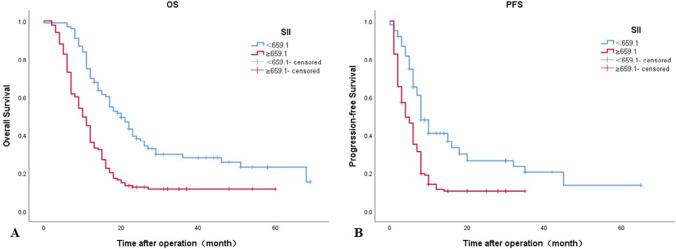
The multivariate Cox proportional hazard model presented that SII ≥ 659.1 was an independent risk factor affecting OS (HR = 2.238, 95% CI = 1.471-3.406, P < 0.001) and postoperative PFS (HR = 2.000, 95% CI = 1.472-2.716, P < 0.001) in GBM patients. The 1-, 3-, and 5-year OS of the SII < 659.1 group was 70.8%, 26.9%, and 14.1%, respectively, while the 1- and 3-year OS of the SII ≥ 659.1 group was 37.5% and 11.5% (P < 0.001). The 1-, 3-, and 5-year PFS of the SII < 659.1 group was 36.3%, 19.6%, and 13%, respectively, while the 1-year PFS of the SII ≥ 659.1 group was 11.3% (P < 0.001). Results of patients' clinical and pathological characteristics paraded that in comparison to the lower SII group, the higher SII group had significantly inferior Karnofsky Performance Scale (KPS) scores (P < 0.001) and more frequent cystic changes of the tumors (P < 0.001), whereas the values of SIRI, NLR, PLR, MLR, and AGR were low.
CONCLUSIONS
SII is an independent inflammatory indicator for predicting the prognosis of GBM patients after receiving initially standardized treatments.
目的
肿瘤的生长和发展与炎症反应的启动和放大密切相关。近二十年来,各种炎症生物标志物越来越受到关注,并发现与癌症患者的预后密切相关,这表明全身炎症反应可能对癌症的进展至关重要。然而,对于与 GBM 的检测、持续存在、治疗和预后相关的敏感生物标志物知之甚少。因此,本回顾性研究旨在评估在接受标准治疗的 GBM 患者中术前炎症标志物的预后价值。
方法
本研究纳入了 2014 年 1 月至 2018 年 1 月期间在山东省齐鲁医院就诊的 232 名胶质母细胞瘤患者。设计了炎症标志物,包括全身免疫炎症指数(SII)、全身免疫反应指数(SIRI)、中性粒细胞-淋巴细胞比值(NLR)、血小板-淋巴细胞比值(PLR)、单核细胞-淋巴细胞比值(MLR)和白蛋白/球蛋白比值(AGR)。采用 Kaplan-Meier 法估计无进展生存期(PFS)和总生存期(OS),并计算 ROC 曲线下的 AUC 值。此外,我们使用 Cox 比例风险模型来估计变量与 PFS 和 OS 之间的关系。通过对数秩检验检验变量与 PFS 和 OS 之间的统计学差异。此外,还使用 LR 方法进行 Cox 多因素回归分析。结果用风险比(HR)、95%置信区间(CI)表示,任何双侧 P 值<0.01 均被认为具有统计学差异。
结果
多变量 Cox 比例风险模型显示,SII≥659.1 是影响 GBM 患者 OS(HR=2.238,95%CI=1.471-3.406,P<0.001)和术后 PFS(HR=2.000,95%CI=1.472-2.716,P<0.001)的独立危险因素。SII<659.1 组的 1 年、3 年和 5 年 OS 分别为 70.8%、26.9%和 14.1%,而 SII≥659.1 组的 1 年和 3 年 OS 分别为 37.5%和 11.5%(P<0.001)。SII<659.1 组的 1 年、3 年和 5 年 PFS 分别为 36.3%、19.6%和 13%,而 SII≥659.1 组的 1 年 PFS 为 11.3%(P<0.001)。患者临床和病理特征的结果表明,与较低的 SII 组相比,较高的 SII 组的 Karnofsky 表现量表(KPS)评分明显较低(P<0.001),肿瘤囊性变化更为频繁(P<0.001),而 SIRI、NLR、PLR、MLR 和 AGR 值较低。
结论
SII 是预测接受初始标准治疗后 GBM 患者预后的独立炎症指标。
 Zotero 插件