
自然杀伤细胞介导的死亡全剧分两幕及意外加演:适应性免疫的启动、执行与激活
All About (NK Cell-Mediated) Death in Two Acts and an Unexpected Encore: Initiation, Execution and Activation of Adaptive Immunity.
作者信息
Ramírez-Labrada Ariel, Pesini Cecilia, Santiago Llipsy, Hidalgo Sandra, Calvo-Pérez Adanays, Oñate Carmen, Andrés-Tovar Alejandro, Garzón-Tituaña Marcela, Uranga-Murillo Iratxe, Arias Maykel A, Galvez Eva M, Pardo Julián
机构信息
Immunotherapy, Inflammation and Cancer, Aragón Health Research Institute (IIS Aragón), Biomedical Research Centre of Aragón (CIBA), Zaragoza, Spain.
Unidad de Nanotoxicología e Inmunotoxicología (UNATI), Centro de Investigación Biomédica de Aragón (CIBA), Aragón Health Research Institute (IIS Aragón), Zaragoza, Spain.
出版信息
Front Immunol. 2022 May 16;13:896228. doi: 10.3389/fimmu.2022.896228. eCollection 2022.
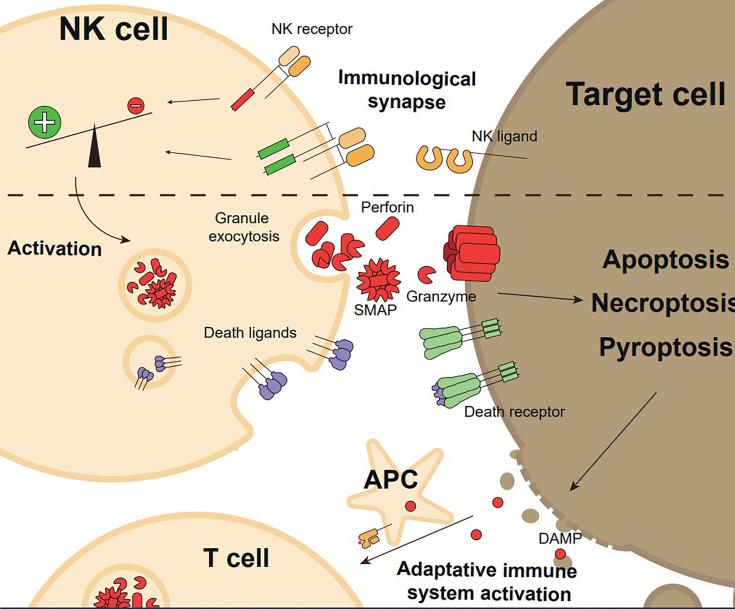
NK cells are key mediators of immune cell-mediated cytotoxicity toward infected and transformed cells, being one of the main executors of cell death in the immune system. NK cells recognize target cells through an array of inhibitory and activating receptors for endogenous or exogenous pathogen-derived ligands, which together with adhesion molecules form a structure known as immunological synapse that regulates NK cell effector functions. The main and best characterized mechanisms involved in NK cell-mediated cytotoxicity are the granule exocytosis pathway (perforin/granzymes) and the expression of death ligands. These pathways are recognized as activators of different cell death programmes on the target cells leading to their destruction. However, most studies analyzing these pathways have used pure recombinant or native proteins instead of intact NK cells and, thus, extrapolation of the results to NK cell-mediated cell death might be difficult. Specially, since the activation of granule exocytosis and/or death ligands during NK cell-mediated elimination of target cells might be influenced by the stimulus received from target cells and other microenvironment components, which might affect the cell death pathways activated on target cells. Here we will review and discuss the available experimental evidence on how NK cells kill target cells, with a special focus on the different cell death modalities that have been found to be activated during NK cell-mediated cytotoxicity; including apoptosis and more inflammatory pathways like necroptosis and pyroptosis. In light of this new evidence, we will develop the new concept of cell death induced by NK cells as a new regulatory mechanism linking innate immune response with the activation of tumour adaptive T cell responses, which might be the initiating stimulus that trigger the cancer-immunity cycle. The use of the different cell death pathways and the modulation of the tumour cell molecular machinery regulating them might affect not only tumour cell elimination by NK cells but, in addition, the generation of T cell responses against the tumour that would contribute to efficient tumour elimination and generate cancer immune memory preventing potential recurrences.
自然杀伤细胞(NK细胞)是免疫细胞介导的针对受感染细胞和转化细胞的细胞毒性的关键介质,是免疫系统中细胞死亡的主要执行者之一。NK细胞通过一系列针对内源性或外源性病原体衍生配体的抑制性和激活性受体识别靶细胞,这些受体与黏附分子一起形成一种称为免疫突触的结构,调节NK细胞的效应功能。NK细胞介导的细胞毒性所涉及的主要且特征最明确的机制是颗粒胞吐途径(穿孔素/颗粒酶)和死亡配体的表达。这些途径被认为是靶细胞上不同细胞死亡程序的激活剂,导致靶细胞被破坏。然而,大多数分析这些途径的研究使用的是纯重组蛋白或天然蛋白,而非完整的NK细胞,因此,将结果外推至NK细胞介导的细胞死亡可能存在困难。特别是,由于在NK细胞介导的靶细胞清除过程中颗粒胞吐和/或死亡配体的激活可能受靶细胞和其他微环境成分所接收刺激的影响,这可能会影响在靶细胞上激活的细胞死亡途径。在此,我们将回顾和讨论关于NK细胞如何杀伤靶细胞的现有实验证据,特别关注在NK细胞介导的细胞毒性过程中发现被激活的不同细胞死亡方式;包括凋亡以及更多炎症途径,如坏死性凋亡和焦亡。鉴于这一新证据,我们将提出由NK细胞诱导的细胞死亡这一新概念,作为一种将先天免疫反应与肿瘤适应性T细胞反应激活相联系的新调节机制,这可能是触发癌症免疫循环的起始刺激因素。使用不同的细胞死亡途径以及调节肿瘤细胞调节它们的分子机制,可能不仅会影响NK细胞对肿瘤细胞的清除,此外,还会影响针对肿瘤的T细胞反应的产生,这将有助于有效清除肿瘤并产生癌症免疫记忆,预防潜在复发。


 Zotero 插件