
新型冠状病毒肺炎疫情下的抗菌药物耐药性:抗感染抗体和抗菌肽是否有机会?
Antimicrobial Resistance in the COVID-19 Landscape: Is There an Opportunity for Anti-Infective Antibodies and Antimicrobial Peptides?
机构信息
Biotechnology of Macromolecules, Instituto de Productos Naturales y Agrobiología, IPNA (CSIC), San Cristóbal de la Laguna, Spain.
Department of Life Sciences, Ben-Gurion University of the Negev, Beer-Sheva, Israel.
出版信息
Front Immunol. 2022 Jun 2;13:921483. doi: 10.3389/fimmu.2022.921483. eCollection 2022.
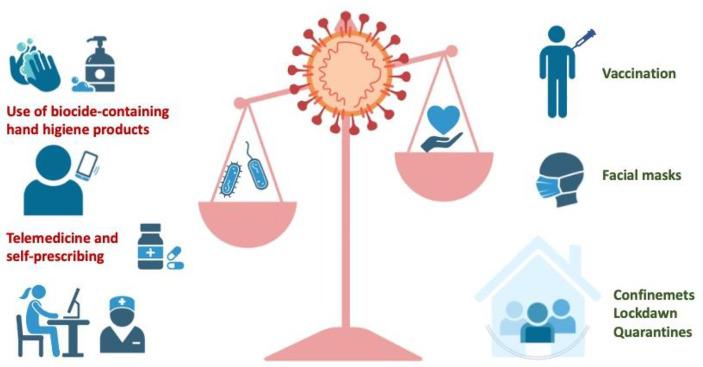
Although COVID-19 has captured most of the public health attention, antimicrobial resistance (AMR) has not disappeared. To prevent the escape of resistant microorganisms in animals or environmental reservoirs a "one health approach" is desirable. In this context of COVID-19, AMR has probably been affected by the inappropriate or over-use of antibiotics. The increased use of antimicrobials and biocides for disinfection may have enhanced the prevalence of AMR. Antibiotics have been used empirically in patients with COVID-19 to avoid or prevent bacterial coinfection or superinfections. On the other hand, the measures to prevent the transmission of COVID-19 could have reduced the risk of the emergence of multidrug-resistant microorganisms. Since we do not currently have a sterilizing vaccine against SARS-CoV-2, the virus may still multiply in the organism and new mutations may occur. As a consequence, there is a risk of the appearance of new variants. Nature-derived anti-infective agents, such as antibodies and antimicrobial peptides (AMPs), are very promising in the fight against infectious diseases, because they are less likely to develop resistance, even though further investigation is still required.
虽然 COVID-19 引起了公众对大部分卫生问题的关注,但抗菌药物耐药性(AMR)并未消失。为了防止动物或环境储库中的耐药微生物逃逸,需要采用“同一健康”方法。在 COVID-19 的这种情况下,AMR 可能受到了抗生素的不适当或过度使用的影响。为了进行消毒而增加使用抗生素和杀生物剂可能会增强 AMR 的流行。在 COVID-19 患者中,经验性地使用抗生素以避免或预防细菌合并感染或继发感染。另一方面,预防 COVID-19 传播的措施可能降低了出现耐多药微生物的风险。由于我们目前尚无针对 SARS-CoV-2 的杀菌疫苗,该病毒仍可能在体内繁殖并可能发生新的突变。因此,出现新变种的风险仍然存在。天然来源的抗感染剂,如抗体和抗菌肽(AMPs),在对抗传染病方面非常有前途,因为它们不太可能产生耐药性,尽管仍需要进一步研究。




 Zotero 插件