
母亲儿童期逆境与儿童情绪和行为发展关系中的调解者和调节因素:系统评价和荟萃分析。
Mediators and moderators in the relationship between maternal childhood adversity and children's emotional and behavioural development: a systematic review and meta-analysis.
机构信息
Department of Psychological Medicine, Institute of Psychiatry, Psychology, and Neuroscience, King's College London, London, UK.
Department of Developmental Psychology and Socialisation, University of Padova, Padua, Italy.
出版信息
Psychol Med. 2022 Jul;52(10):1817-1837. doi: 10.1017/S0033291722001775. Epub 2022 Jun 22.
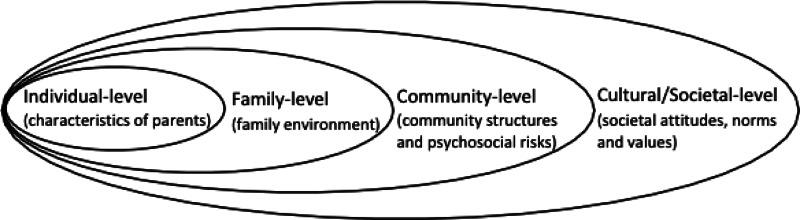
Maternal experiences of childhood adversity can increase the risk of emotional and behavioural problems in their children. This systematic review and meta-analysis provide the first narrative and quantitative synthesis of the mediators and moderators involved in the link between maternal childhood adversity and children's emotional and behavioural development. We searched EMBASE, PsycINFO, Medline, Cochrane Library, grey literature and reference lists. Studies published up to February 2021 were included if they explored mediators or moderators between maternal childhood adversity and their children's emotional and behavioural development. Data were synthesised narratively and quantitatively by meta-analytic approaches. The search yielded 781 articles, with 74 full-text articles reviewed, and 41 studies meeting inclusion criteria. Maternal mental health was a significant individual-level mediator, while child traumatic experiences and insecure maternal-child attachment were consistent family-level mediators. However, the evidence for community-level mediators was limited. A meta-analysis of nine single-mediating analyses from five studies indicated three mediating pathways: maternal depression, negative parenting practices and maternal insecure attachment, with pooled indirect standardised effects of 0.10 [95% CI (0.03-0.17)), 0.01 (95% CI (-0.02 to 0.04)] and 0.07 [95% CI (0.01-0.12)], respectively. Research studies on moderators were few and identified some individual-level factors, such as child sex (e.g. the mediating role of parenting practices being only significant in girls), biological factors (e.g. maternal cortisol level) and genetic factors (e.g. child's serotonin-transporter genotype). In conclusion, maternal depression and maternal insecure attachment are two established mediating pathways that can explain the link between maternal childhood adversity and their children's emotional and behavioural development and offer opportunities for intervention.
母亲在儿童时期经历逆境会增加其子女出现情绪和行为问题的风险。本系统评价和荟萃分析首次对母亲在儿童时期经历逆境与子女情绪和行为发展之间关系的中介因素和调节因素进行了叙述性和定量综合分析。我们检索了 EMBASE、PsycINFO、Medline、Cochrane 图书馆、灰色文献和参考文献列表。如果研究探讨了母亲在儿童时期经历逆境与其子女情绪和行为发展之间的中介因素或调节因素,则将其纳入研究范围。通过荟萃分析方法对数据进行了叙述性和定量综合分析。该检索共产生了 781 篇文章,其中 74 篇文章的全文被审阅,41 篇文章符合纳入标准。母亲的心理健康是一个重要的个体水平中介因素,而儿童创伤经历和不安全的母婴依恋是一致的家庭水平中介因素。然而,社区水平中介因素的证据有限。对来自五项研究的九项单一中介分析的荟萃分析表明了三种中介途径:母亲抑郁、消极的育儿实践和母亲不安全的依恋,其汇总的间接标准化效应分别为 0.10 [95%置信区间 (0.03-0.17)]、0.01 [95%置信区间 (-0.02 至 0.04)] 和 0.07 [95%置信区间 (0.01-0.12)]。关于调节因素的研究很少,仅确定了一些个体水平因素,例如儿童性别(例如,育儿实践的中介作用仅在女孩中显著)、生物因素(例如,母亲皮质醇水平)和遗传因素(例如,儿童的 5-羟色胺转运体基因型)。总之,母亲抑郁和母亲不安全的依恋是两个已确立的中介途径,可以解释母亲在儿童时期经历逆境与子女情绪和行为发展之间的关系,并为干预提供机会。



 Zotero 插件