
老年人对抗肌肉减少症和2型糖尿病的运动与营养策略
Exercise and Nutrition Strategies for Combating Sarcopenia and Type 2 Diabetes Mellitus in Older Adults.
作者信息
Argyropoulou Dionysia, Geladas Nikolaos D, Nomikos Tzortzis, Paschalis Vassilis
机构信息
School of Physical Education and Sport Science, National and Kapodistrian University of Athens, 17237 Athens, Greece.
Department of Nutrition and Dietetics, Harokopio University, 17676 Athens, Greece.
出版信息
J Funct Morphol Kinesiol. 2022 Jun 8;7(2):48. doi: 10.3390/jfmk7020048.
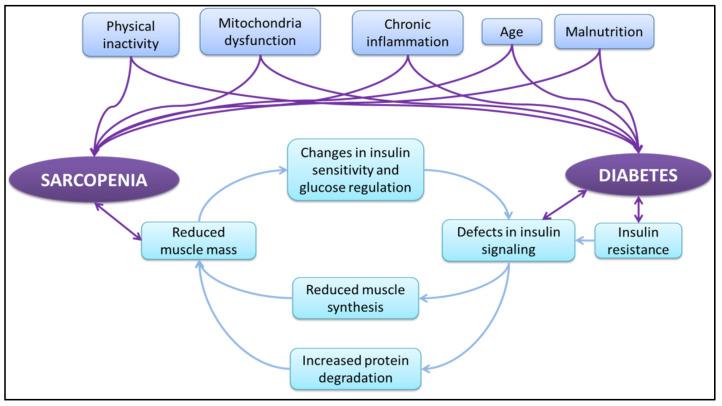
Medical and technology development have drastically the improved quality of life and, consequently, life expectancy. Nevertheless, the more people who enter the third-age, the more geriatric syndromes expand in the elderly. Sarcopenia and Type 2 diabetes mellitus (T2DM) are common diseases among the elderly and the literature has extensively studied these two diseases separately. Recent evidence, however, revealed that there is a bidirectional relationship between sarcopenia and T2DM. The aims of the present review were: (1) to present diet and exercise interventions for the management of sarcopenia and T2DM and (2) identify which diet and exercise interventions can be used simultaneously in order to effectively deal with these two disorders. Exercise and a balanced diet are used as effective countermeasures for combating sarcopenia and T2DM in older adults based on their bidirectional relationship. Lifestyle changes such as exercise and a balanced diet seem to play an important role in the remission of the diseases. Results showed that chronic exercise can help towards glycemic regulation as well as decrease the incidence rate of muscle degradation, while diet interventions which focus on protein or amino acids seem to successfully treat both disorders. Despite the fact that there are limited studies that deal with both disorders, it seems that a combined exercise regime (aerobic and resistance) along with protein intake > 1gr/kg/d is the safest strategy to follow in order to manage sarcopenia and T2DM concurrently.
医学和技术的发展极大地提高了生活质量,从而延长了预期寿命。然而,进入老年阶段的人越多,老年人中出现的老年综合征就越多。肌肉减少症和2型糖尿病(T2DM)是老年人中的常见疾病,并且文献已经分别对这两种疾病进行了广泛研究。然而,最近的证据表明,肌肉减少症和T2DM之间存在双向关系。本综述的目的是:(1)介绍用于管理肌肉减少症和T2DM的饮食和运动干预措施;(2)确定哪些饮食和运动干预措施可以同时使用,以便有效应对这两种疾病。基于运动和均衡饮食之间的双向关系,它们被用作对抗老年人肌肉减少症和T2DM的有效对策。诸如运动和均衡饮食等生活方式的改变似乎在疾病的缓解中起着重要作用。结果表明,长期运动有助于血糖调节,并降低肌肉退化的发生率,而专注于蛋白质或氨基酸的饮食干预似乎能成功治疗这两种疾病。尽管针对这两种疾病的研究有限,但似乎联合运动方案(有氧运动和抗阻运动)以及蛋白质摄入量>1克/千克/天是同时管理肌肉减少症和T2DM的最安全策略。

 Zotero 插件