
意大利淋巴瘤基金会 MCL0208 三期临床试验中实时、动力学微小残留病灶分析在套细胞淋巴瘤中的应用。
Punctual and kinetic MRD analysis from the Fondazione Italiana Linfomi MCL0208 phase 3 trial in mantle cell lymphoma.
机构信息
Department of Molecular Biotechnologies and Health Sciences, University of Torino, Torino, Italy.
AOU Città della Salute e della Scienza di Torino, Torino, Italy.
出版信息
Blood. 2022 Sep 22;140(12):1378-1389. doi: 10.1182/blood.2021014270.
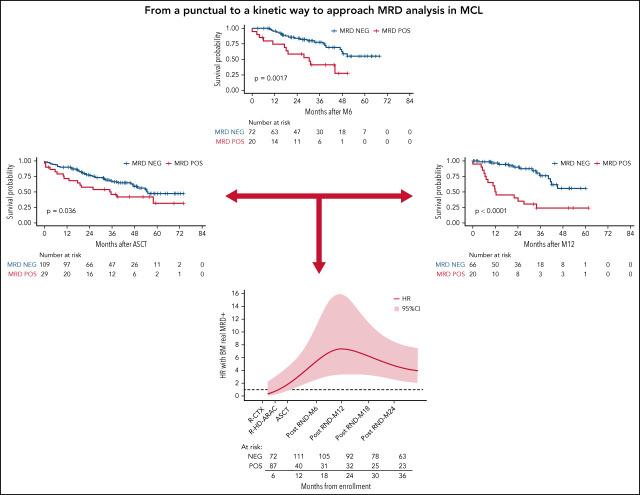
Minimal residual disease (MRD) analysis is a known predictive tool in mantle cell lymphoma (MCL). We describe MRD results from the Fondazione Italiana Linfomi phase 3 MCL0208 prospective clinical trial assessing lenalidomide (LEN) maintenance vs observation after autologous stem cell transplantation (ASCT) in the first prospective comprehensive analysis of different techniques, molecular markers, and tissues (peripheral blood [PB] and bone marrow [BM]), taken at well-defined time points. Among the 300 patients enrolled, a molecular marker was identified in 250 (83%), allowing us to analyze 234 patients and 4351 analytical findings from 10 time points. ASCT induced high rates of molecular remission (91% in PB and 83% in BM, by quantitative real-time polymerase chain reaction [RQ-PCR]). Nevertheless, the number of patients with persistent clinical and molecular remission decreased over time in both arms (up to 30% after 36 months). MRD predicted early progression and long-term outcome, particularly from 6 months after ASCT (6-month time to progression [TTP] hazard ratio [HR], 3.83; P < .001). In single-timepoint analysis, BM outperformed PB, and RQ-PCR was more reliable, while nested PCR appeared applicable to a larger number of patients (234 vs 176). To improve MRD performance, we developed a time-varying kinetic model based on regularly updated MRD results and the MIPI (Mantle Cell Lymphoma International Prognostic Index), showing an area under the ROC (Receiver Operating Characteristic) curve (AUROC) of up to 0.87 using BM. Most notably, PB reached an AUROC of up to 0.81; with kinetic analysis, it was comparable to BM in performance. MRD is a powerful predictor over the entire natural history of MCL and is suitable for models with a continuous adaptation of patient risk. The study can be found in EudraCT N. 2009-012807-25 (https://eudract.ema.europa.eu/).
微小残留病灶 (MRD) 分析是套细胞淋巴瘤 (MCL) 的一种已知的预测工具。我们描述了意大利淋巴瘤基金会 3 期 MCL0208 前瞻性临床试验的 MRD 结果,该试验评估了来那度胺(LEN)维持治疗与 ASCT 后观察在不同技术、分子标志物和组织(外周血 [PB] 和骨髓 [BM])中的前瞻性综合分析中的作用,这些标志物和组织在明确的时间点采集。在入组的 300 例患者中,250 例(83%)确定了分子标志物,我们能够对 234 例患者和 4351 个分析结果进行分析,这些结果来自 10 个时间点。ASCT 诱导了高比例的分子缓解(PB 为 91%,BM 为 83%,采用实时定量聚合酶链反应 [RQ-PCR])。然而,在两个治疗组中,持续临床和分子缓解的患者数量随时间减少(36 个月后多达 30%)。MRD 预测了早期进展和长期结局,尤其是在 ASCT 后 6 个月(6 个月时无进展生存 [TTP] 风险比 [HR],3.83;P<.001)。在单次时间点分析中,BM 优于 PB,RQ-PCR 更可靠,而巢式 PCR 似乎适用于更多的患者(234 例比 176 例)。为了提高 MRD 的性能,我们基于定期更新的 MRD 结果和 MIPI(套细胞淋巴瘤国际预后指数)开发了一个时变动力学模型,使用 BM 时,ROC(Receiver Operating Characteristic)曲线下面积(AUROC)高达 0.87。值得注意的是,PB 的 AUROC 高达 0.81;使用动力学分析,其与 BM 的性能相当。MRD 是整个 MCL 自然史中的一个强大预测因子,适用于患者风险的连续适应模型。该研究可在 EudraCT 号 2009-012807-25 中找到(https://eudract.ema.europa.eu/)。



 Zotero 插件