
非酒精性脂肪性肝炎中肝星状细胞-免疫相互作用。
Hepatic Stellate Cell-Immune Interactions in NASH.
机构信息
Division of Liver Diseases, Icahn School of Medicine at Mount Sinai, New York, NY, United States.
Medical Scientist Training Program, Icahn School of Medicine at Mount Sinai, New York, NY, United States.
出版信息
Front Endocrinol (Lausanne). 2022 Jun 9;13:867940. doi: 10.3389/fendo.2022.867940. eCollection 2022.
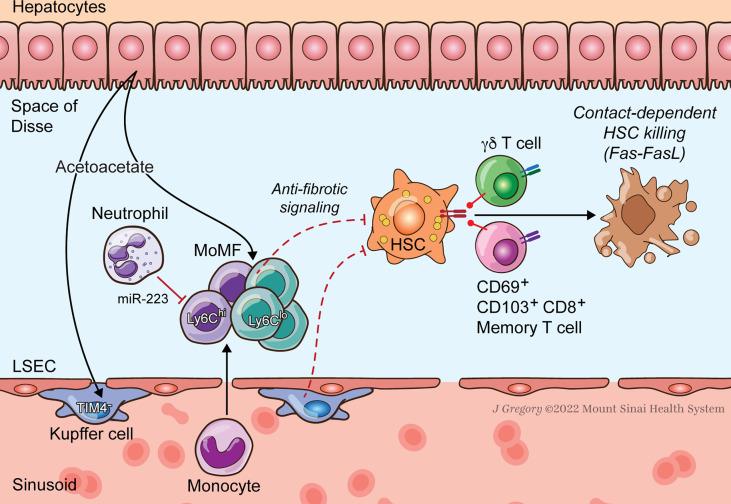
Nonalcoholic fatty liver disease (NAFLD) is the dominant cause of liver disease worldwide. Nonalcoholic steatohepatitis (NASH), a more aggressive presentation of NAFLD, is characterized by severe hepatocellular injury, inflammation, and fibrosis. Chronic inflammation and heightened immune cell activity have emerged as hallmark features of NASH and key drivers of fibrosis through the activation of hepatic stellate cells (HSCs). Recent advances in our understanding of the molecular and cellular pathways in NASH have highlighted extensive crosstalk between HSCs and hepatic immune populations that strongly influences disease activity. Here, we review these findings, emphasizing the roles of HSCs in liver immunity and inflammation, key cell-cell interactions, and exciting areas for future investigation.
非酒精性脂肪性肝病 (NAFLD) 是全球范围内肝脏疾病的主要病因。非酒精性脂肪性肝炎 (NASH) 是 NAFLD 更为严重的表现形式,其特征为严重的肝细胞损伤、炎症和纤维化。慢性炎症和免疫细胞活性增强已成为 NASH 的标志特征,也是通过激活肝星状细胞 (HSCs) 导致纤维化的关键驱动因素。我们对 NASH 中分子和细胞途径的理解的最新进展强调了 HSCs 与肝免疫细胞群体之间的广泛相互作用,这强烈影响疾病的活动度。在这里,我们回顾这些发现,强调 HSCs 在肝脏免疫和炎症中的作用、关键的细胞-细胞相互作用,以及未来令人兴奋的研究领域。

 Zotero 插件