Wang Xuelian, Zhang Mi, Zhang Mengyao, Han Yantao, Chen Xuehong, Zhao Wenwen, Han Zhiwu, Sun Jialin
School of Basic Medicine, Qingdao University, Qingdao, Shandong 266071, P.R. China.
Department of Pharmacy, The Affiliated Hospital of Qingdao University, Qingdao, Shandong 266003, P.R. China.
Exp Ther Med. 2022 Jun 1;24(1):485. doi: 10.3892/etm.2022.11412. eCollection 2022 Jul.
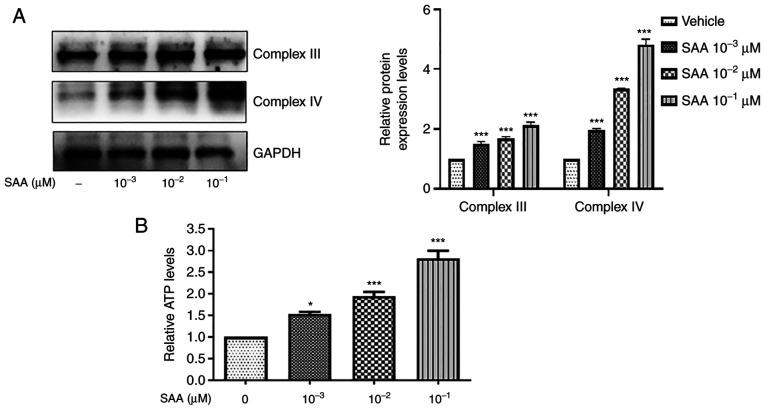
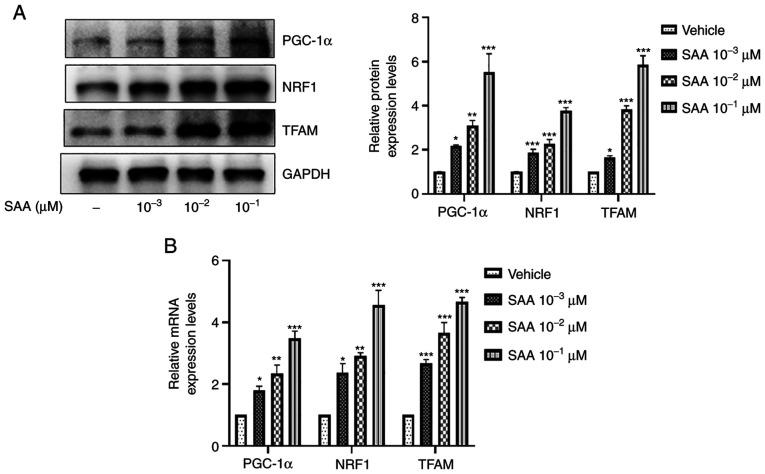
Mitochondrial dysregulation is an important pathology that leads to endothelial dysfunction, and the occurrence and development of cardiovascular diseases. Salvianolic acid A (SAA) has been demonstrated to be effective in the treatment of vascular complications of type 2 diabetes mellitus. Limited information has been reported on the effects of SAA on mitochondrial function in endothelial cells. In the present study, the effects of SAA on mitochondrial biogenesis and the related underlying mechanisms were investigated in human umbilical vein endothelial cells (HUVECs). Mitotracker red staining and transmission electron microscopy were used to evaluate the effect of SAA on mitochondrial quality. The effect of SAA treatment on mitochondrial DNA/nuclear DNA ratio of HUVECs was detected by real-time quantitative PCR. Western blot was used to determine the protein expression levels of complex III and Complex IV of mitochondrial oxidative phosphorylation subunit, and ATP production was determined by ATP test kit. Real-time quantitative PCR and Western blot were used to determine the effects of SAA on the expression of peroxisome proliferator-activated receptor γ coactivator (PGC-1α) and its target genes nuclear respiratory factor 1 (NRF1) and mitochondrial transcription factor A (TFAM) proteins and genes. Finally, in the presence of 5'AMP-activated protein kinase (AMPK) specific inhibitors, the expression of PGC-1α, NRF1 and TFAM proteins and the phosphorylation levels of AMPK and Acetyl CoA Carboxylase (ACC) were detected by Western blot or real-time quantitative PCR. The results showed that SAA treatment significantly promoted mitochondrial biogenesis and enhanced mitochondrial function of HUVECs. SAA significantly increased the expression levels of PGC-1α and its target genes NRF1 and (TFAM), a key regulator of mitochondrial biogenesis in HUVECs. These enhancements were accompanied by significantly increased phosphorylation of AMPK and ACC, and were significantly inhibited by specific AMPK inhibitors. These results suggest that SAA may promote mitochondrial biogenesis in endothelial cells by activating the AMPK-mediated PGC-1α/TFAM signaling pathway. These data provide new insights into the mechanism of action of SAA in treating diabetic vascular complications.
线粒体功能失调是导致内皮功能障碍以及心血管疾病发生和发展的重要病理过程。丹酚酸A(SAA)已被证明对2型糖尿病血管并发症的治疗有效。关于SAA对内皮细胞线粒体功能影响的报道较少。在本研究中,我们在人脐静脉内皮细胞(HUVECs)中研究了SAA对线粒体生物合成的影响及其相关潜在机制。使用线粒体红色荧光探针染色和透射电子显微镜评估SAA对线粒体质量的影响。通过实时定量PCR检测SAA处理对HUVECs线粒体DNA/核DNA比率的影响。采用蛋白质免疫印迹法测定线粒体氧化磷酸化亚基复合物III和复合物IV的蛋白表达水平,并用ATP检测试剂盒测定ATP生成量。运用实时定量PCR和蛋白质免疫印迹法测定SAA对过氧化物酶体增殖物激活受体γ共激活因子(PGC-1α)及其靶基因核呼吸因子1(NRF1)和线粒体转录因子A(TFAM)蛋白及基因表达的影响。最后,在存在5'AMP激活的蛋白激酶(AMPK)特异性抑制剂的情况下,通过蛋白质免疫印迹法或实时定量PCR检测PGC-1α、NRF1和TFAM蛋白的表达以及AMPK和乙酰辅酶A羧化酶(ACC)的磷酸化水平。结果表明,SAA处理显著促进了HUVECs的线粒体生物合成并增强了其线粒体功能。SAA显著增加了PGC-1α及其靶基因NRF1和(TFAM)(HUVECs线粒体生物合成的关键调节因子)的表达水平。这些增强伴随着AMPK和ACC磷酸化的显著增加,并被特异性AMPK抑制剂显著抑制。这些结果表明,SAA可能通过激活AMPK介导的PGC-1α/TFAM信号通路促进内皮细胞的线粒体生物合成。这些数据为SAA治疗糖尿病血管并发症的作用机制提供了新的见解。


 Zotero 插件