
理解胎儿保护和孕期母体感染中的免疫系统。
Understanding the Immune System in Fetal Protection and Maternal Infections during Pregnancy.
机构信息
College of Animal Science and Technology, Hunan Agricultural University, Changsha, 410128 Hunan, China.
Animal Sciences Division Nuclear Institute for Agriculture and Biology College, Pakistan Institute of Engineering and Applied Sciences (NIAB-C, PIEAS), Faisalabad 38000, Pakistan.
出版信息
J Immunol Res. 2022 Jun 24;2022:7567708. doi: 10.1155/2022/7567708. eCollection 2022.
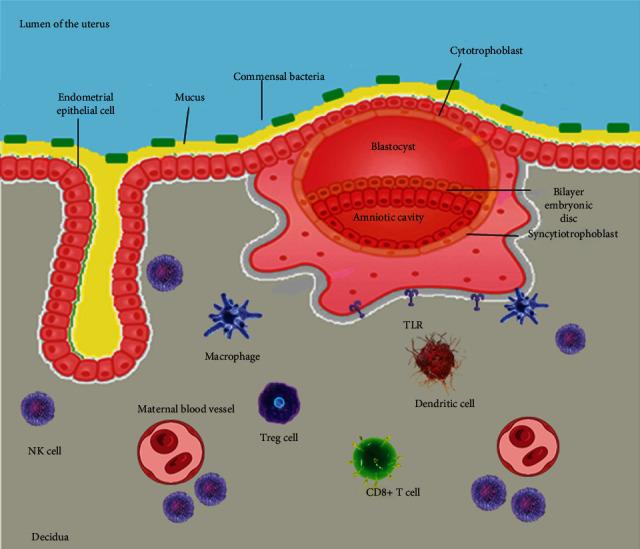
The fetal-maternal immune system determines the fate of pregnancy. The trophoblast cells not only give an active response against external stimuli but are also involved in secreting most of the cytokines. These cells have an essential function in fetal acceptance or fetal rejection. Other immune cells also play a pivotal role in carrying out a successful pregnancy. The disruption in this mechanism may lead to harmful effects on pregnancy. The placenta serves as an immune barrier in fetus protection against invading pathogens. Once the infections prevail, they may localize in placental and fetal tissues, and the presence of inflammation due to cytokines may have detrimental effects on pregnancy. Moreover, some pathogens are responsible for congenital fetal anomalies and affect almost all organs of the developing fetus. This review article is designed to address the bacterial and viral infections that threaten pregnancy and their possible outcomes. Moreover, training of the fetal immune system against the exposure of infections and the role of CD49a + NK cells in embryonic development will also be highlighted.
胎儿-母体免疫系统决定妊娠的命运。滋养层细胞不仅对外部刺激做出积极反应,还参与分泌大多数细胞因子。这些细胞在胎儿接受或排斥中起着至关重要的作用。其他免疫细胞也在成功妊娠中发挥着关键作用。该机制的破坏可能对妊娠产生有害影响。胎盘作为胎儿免受入侵病原体侵害的免疫屏障。一旦感染流行,它们可能在胎盘和胎儿组织中定位,细胞因子引起的炎症可能对妊娠产生不利影响。此外,一些病原体可导致先天性胎儿畸形,并影响发育中胎儿的几乎所有器官。这篇综述文章旨在探讨威胁妊娠的细菌和病毒感染及其可能的后果。此外,还将强调胎儿免疫系统对感染暴露的训练以及 CD49a+NK 细胞在胚胎发育中的作用。
 Zotero 插件