
鉴定肝细胞癌铁死亡相关分子模型和免疫亚型,以实现个体化治疗。
Identification of Ferroptosis-related molecular model and immune subtypes of hepatocellular carcinoma for individual therapy.
机构信息
Department of General Surgery, Institute of Molecular Precision Medicine and Hunan Key Laboratory of Molecular Precision Medicine, Xiangya Hospital, Central South University, Changsha, Hunan, China.
The First Affiliated Hospital, Institute of Oncology, Hengyang Medical School, University of South China, Hengyang, Hunan, China.
出版信息
Cancer Med. 2023 Jan;12(2):2134-2147. doi: 10.1002/cam4.5032. Epub 2022 Jul 16.
BACKGROUND
Excessive iron accumulation and lipid peroxidation are primary characteristics of ferroptosis in hepatocellular carcinoma (HCC). Ferroptosis inducer combined with immunotherapy has become a new hope for HCC patients. Therefore, the construction and validation of subtype-specific sensitivity to ferroptosis inducer will be helpful for hierarchical management and precise individual therapy.
METHODS
RNA-seq transcriptome and clinical data of HCC patients were extracted from International Cancer Genome Consortium (ICGC) dataset and The Cancer Genome Atlas (TCGA) dataset. Consistency matrix and data clustering of the both cohorts were constructed by 'ConsensusClusterPlus' package. Single-sample gene set enrichment analysis (ssGSEA) analysis was performed to evaluate immune infiltration. Cox analysis was utilized to construct a ferroptosis phenotype-related prognostic model (FRPM) in HCC. The predictive efficiency of the constructed FRPM was evaluated through Kaplan Meier (K-M) survival analyses and Receiver Operating Characteristic (ROC) curves. The expression levels of candidate genes were detected and validated by Real-Time PCR between liver cancer tissues and adjacent non-tumor liver tissues.
RESULTS
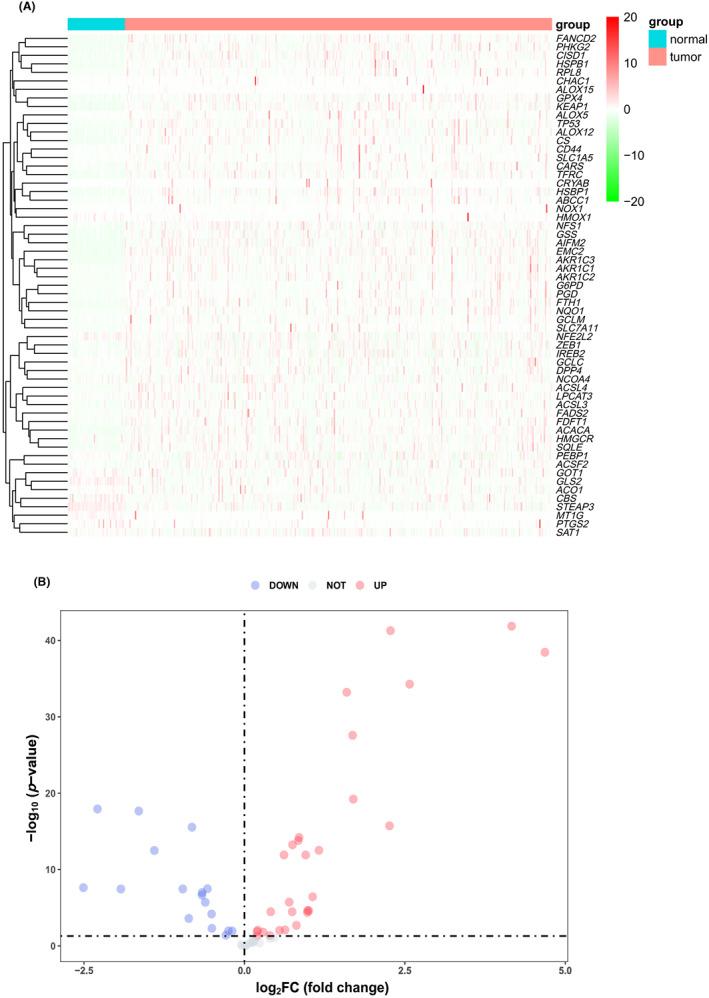
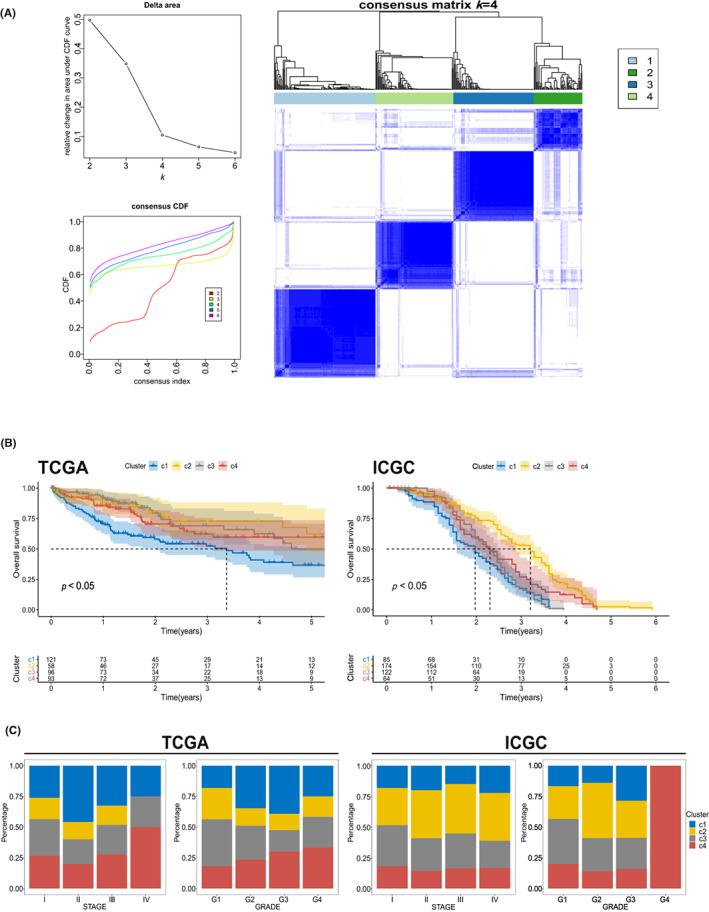
45 differentially expressed ferroptosis-related genes (FRGs) were identified between HCC tissues and non-tumor liver tissues. Furthermore, four ferroptosis-associated clusters (FACs) of HCC were established via consensus clustering. Subsequently, we established a FRPM, consisting of four prognostic genes (SLC7A11, SLC1A5, GCLM and SAT1), to evaluate the survival of HCC patients, based on which, patients were divided into high-risk group and low-risk group. The high-risk group exhibited worse survival compared to low-risk group (p < 0.0001 both in TCGA and ICGC cohorts). Patients belong to different FACs or different risk scores showed distinct clinical characteristics. Moreover, in the validation experiment, the transcriptional expression levels of the four prognostic genes were consistent with the results drew from datasets.
CONCLUSION
We revealed a novel FRGs signature, which may provide the molecular characteristic data for effectively prognostic evaluation and potential personalized therapy for HCC patients.
背景
铁蓄积和脂质过氧化过度是肝癌(HCC)中铁死亡的主要特征。铁死亡诱导剂联合免疫治疗已成为 HCC 患者的新希望。因此,构建和验证对铁死亡诱导剂的亚型特异性敏感性将有助于分层管理和精确的个体化治疗。
方法
从国际癌症基因组联盟(ICGC)数据集和癌症基因组图谱(TCGA)数据集中提取 HCC 患者的 RNA-seq 转录组和临床数据。使用“ConsensusClusterPlus”包构建一致性矩阵和两个队列的数据聚类。进行单样本基因集富集分析(ssGSEA)分析以评估免疫浸润。Cox 分析用于构建 HCC 中铁死亡表型相关的预后模型(FRPM)。通过 Kaplan-Meier(K-M)生存分析和接收器操作特征(ROC)曲线评估构建的 FRPM 的预测效率。通过实时 PCR 在肝癌组织和相邻非肿瘤肝组织之间检测和验证候选基因的表达水平。
结果
在 HCC 组织和非肿瘤肝组织之间鉴定出 45 个差异表达的铁死亡相关基因(FRGs)。此外,通过共识聚类建立了四个 HCC 中铁死亡相关的簇(FACs)。随后,我们建立了一个 FRPM,由四个预后基因(SLC7A11、SLC1A5、GCLM 和 SAT1)组成,用于评估 HCC 患者的生存情况,根据该模型,患者被分为高风险组和低风险组。高风险组的生存情况明显差于低风险组(TCGA 和 ICGC 队列中均为 p<0.0001)。属于不同 FACs 或不同风险评分的患者具有不同的临床特征。此外,在验证实验中,四个预后基因的转录表达水平与从数据集得出的结果一致。
结论
我们揭示了一个新的 FRGs 特征,它可能为 HCC 患者的有效预后评估和潜在的个性化治疗提供分子特征数据。




 Zotero 插件