
维奈克拉联合吉特替尼治疗 - 突变的复发/难治性急性髓系白血病。
Venetoclax Plus Gilteritinib for -Mutated Relapsed/Refractory Acute Myeloid Leukemia.
机构信息
Department of Leukemia, The University of Texas MD Anderson Cancer Center, Houston, TX.
Division of Hematology/Oncology, Department of Medicine, Abramson Cancer Center, University of Pennsylvania, Philadelphia, PA.
出版信息
J Clin Oncol. 2022 Dec 10;40(35):4048-4059. doi: 10.1200/JCO.22.00602. Epub 2022 Jul 18.
PURPOSE
The FMS-related tyrosine kinase 3 (FLT3) inhibitor gilteritinib is standard therapy for relapsed/refractory -mutated () acute myeloid leukemia (AML) but seldom reduces burden or induces sustained efficacy. Gilteritinib combines synergistically with the BCL-2 inhibitor venetoclax in preclinical models of AML.
METHODS
This phase Ib open-label, dose-escalation/dose-expansion study (ClinicalTrials.gov identifier: NCT03625505) enrolled patients with wild-type and (escalation) or (expansion) relapsed/refractory AML. Patients received 400 mg oral venetoclax once daily and 80 mg or 120 mg oral gilteritinib once daily. The primary objectives were safety, identification of the recommended phase II dose, and the modified composite complete response (mCRc) rate (complete response [CR] + CR with incomplete blood count recovery + CR with incomplete platelet recovery + morphologic leukemia-free state) using ADMIRAL phase III-defined response criteria.
RESULTS
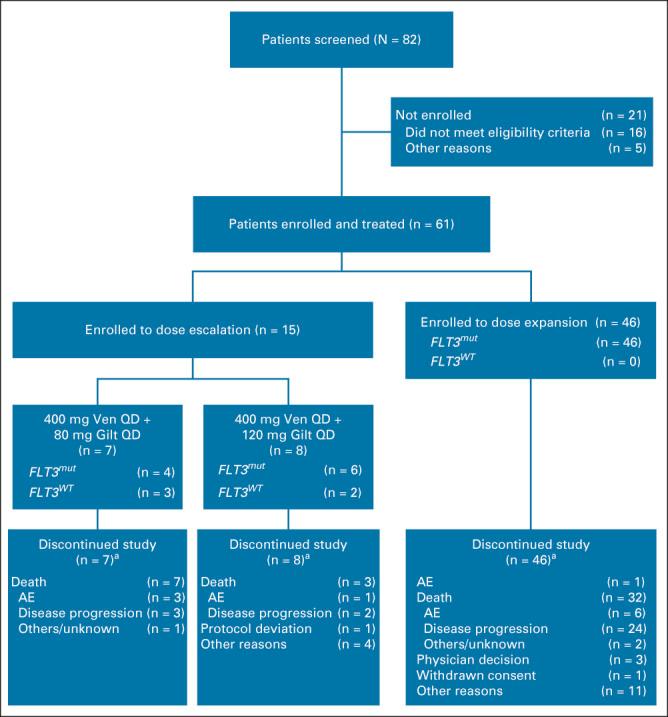
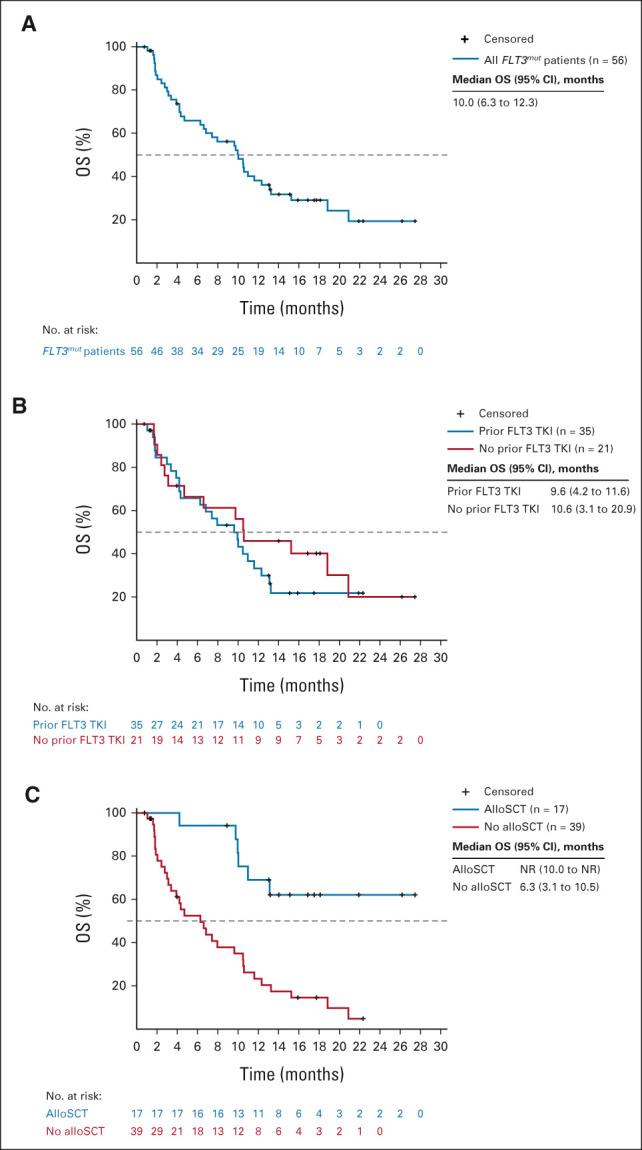
Sixty-one patients were enrolled (n = 56 ); 64% (n = 36 of 56) of patients had received prior FLT3 inhibitor therapy. The recommended phase II dose was 400 mg venetoclax once daily and 120 mg gilteritinib once daily. The most common grade 3/4 adverse events were cytopenias (n = 49; 80%). Adverse events prompted venetoclax and gilteritinib dose interruptions in 51% and 48%, respectively. The mCRc rate for patients was 75% (CR, 18%; CR with incomplete blood count recovery, 4%; CR with incomplete platelet recovery, 18%; and morphologic leukemia-free state, 36%) and was similar among patients with or without prior FLT3 inhibitor therapy (80% 67%, respectively). The median follow-up was 17.5 months. The median time to response was 0.9 months, and the median remission duration was 4.9 months (95% CI, 3.4 to 6.6). molecular response (< 10) was achieved in 60% of evaluable mCRc patients (n = 15 of 25). The median overall survival for patients was 10.0 months.
CONCLUSION
The combination of venetoclax and gilteritinib was associated with high mCRc and molecular response rates regardless of prior FLT3 inhibitor exposure. Dose interruptions were needed to mitigate myelosuppression.
目的
FLT3 相关酪氨酸激酶 3(FLT3)抑制剂吉特替尼是治疗复发/难治性突变()急性髓系白血病(AML)的标准疗法,但很少能减轻负担或诱导持续疗效。吉特替尼与 BCL-2 抑制剂维奈托克在 AML 的临床前模型中具有协同作用。
方法
这是一项开放标签、剂量递增/剂量扩展的 Ib 期研究(临床试验.gov 标识符:NCT03625505),纳入了野生型和(递增)或(扩展)复发/难治性 AML 患者。患者每日口服 400mg 维奈托克和 80mg 或 120mg 口服吉特替尼。主要目的是安全性、确定 II 期推荐剂量以及使用 ADMIRAL III 期定义的反应标准的改良复合完全缓解(mCRc)率(完全缓解[CR]+不完全血细胞计数恢复的 CR+不完全血小板恢复的 CR+形态白血病自由状态)。
结果
共有 61 名患者入组(n=56);64%(n=56 名患者中的 36 名)患者接受过 FLT3 抑制剂治疗。II 期推荐剂量为每日口服 400mg 维奈托克和 120mg 吉特替尼。最常见的 3/4 级不良事件是细胞减少症(n=49;80%)。维奈托克和吉特替尼分别导致 51%和 48%的剂量中断。患者的 mCRc 率为 75%(CR,18%;CR 不完全血细胞计数恢复,4%;CR 不完全血小板恢复,18%;形态白血病自由状态,36%),且在既往接受过 FLT3 抑制剂治疗的患者和未接受过 FLT3 抑制剂治疗的患者中相似(分别为 80%和 67%)。中位随访时间为 17.5 个月。中位反应时间为 0.9 个月,中位缓解持续时间为 4.9 个月(95%CI,3.4 至 6.6)。可评估的 mCRc 患者中,有 60%(n=15/25)达到了<10 的分子反应。患者的总生存期中位数为 10.0 个月。
结论
无论既往是否接受过 FLT3 抑制剂治疗,维奈托克联合吉特替尼均能获得较高的 mCRc 和分子反应率。需要中断剂量以减轻骨髓抑制。


 Zotero 插件