
面对全球威胁的自由民主治理的悲剧。
The Tragedy of Liberal Democratic Governance in the Face of Global Threats.
机构信息
Laboratoire de Parasitologie, ULB Center for Research in Immunology (U-CRI), Université Libre de Bruxelles, Gosselies, Belgium.
INSEEC Grande Ecole, OMNES Education, Paris, France.
出版信息
Front Public Health. 2022 Jul 8;10:902724. doi: 10.3389/fpubh.2022.902724. eCollection 2022.
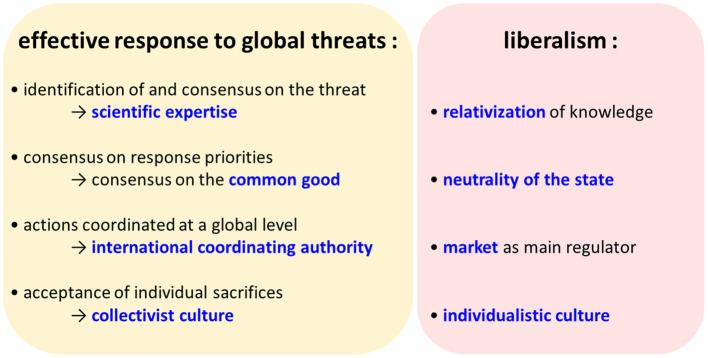
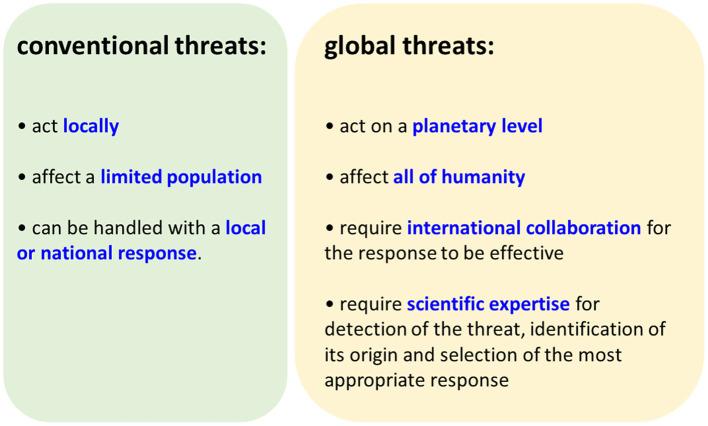
In hindsight, the early response of liberal governments to the SARS-CoV-2 pandemic was chaotic and generally inefficient. Though one might be tempted to attribute these failures to the incompetence of certain political decision-makers, we propose another explanation. Global threats require a coordinated international response, which is only possible if the threat is perceived in the same way by all, and if government priorities are similar. The effectiveness of the response also relies on massive adhesion of citizens to the measures imposed, which in turn requires trust in government. Our hypothesis is that certain fundamental features of liberalism complicate such global and collective responses: neutrality of the state and primacy of the individual over collective society. Liberalism considers that institutions and public policy must not be designed to favor any specific conception of the common good. That which is best for all is usually determined by a "competition of opinions," which frequently leads to scientific expertise being considered as only one opinion among many. Liberalism also imposes strict respect for individual freedoms and private interests and tends to reject any form of collectivism or dictate imposed by the common good. In order to solve these structural problems and improve society's management of global threats, we make several proposals, such as the introduction of a minimal and consensual definition of the common good and the promotion of a health policy guided by One Health-like concepts. Overall, our analysis suggests that because political ideologies provide their own definitions of the common good and the place of scientific knowledge in the governance process and can thus affect the response to global threats, they should be urgently taken into consideration by public health experts.
事后看来,自由政府对 SARS-CoV-2 大流行的早期反应是混乱的,总体上效率低下。尽管人们可能会将这些失败归因于某些政治决策者的无能,但我们提出了另一种解释。全球威胁需要协调一致的国际应对,而只有当所有国家都以同样的方式看待威胁,并且政府的优先事项相似时,这种应对才有可能。应对的有效性还依赖于公民对所实施措施的大规模支持,而这反过来又需要对政府的信任。我们的假设是,自由主义的某些基本特征使这种全球和集体应对变得复杂:国家的中立性以及个人相对于集体社会的首要地位。自由主义认为,机构和公共政策的设计不应有利于任何特定的共同利益观念。对所有人最好的通常是通过“意见竞争”来确定的,这往往会导致科学专业知识被视为众多意见之一。自由主义还严格尊重个人自由和私人利益,并倾向于拒绝任何形式的集体主义或共同利益强加的规定。为了解决这些结构性问题,改善社会对全球威胁的管理,我们提出了一些建议,例如引入一个最小的和共识性的共同利益定义,并促进以类似于“One Health”的概念为指导的卫生政策。总的来说,我们的分析表明,由于政治意识形态为共同利益和科学知识在治理过程中的地位提供了自己的定义,因此可能会影响对全球威胁的应对,公共卫生专家应紧急考虑这些定义。

 Zotero 插件