
中东国家戊型肝炎病毒感染的血清流行率:系统评价和荟萃分析。
Seroprevalence of Hepatitis E Virus Infection in Middle Eastern Countries: A Systematic Review and Meta-Analysis.
机构信息
Department of Microbiology, College of Medicine, Umm Al-Qura University, Makkah 24381, Saudi Arabia.
出版信息
Medicina (Kaunas). 2022 Jul 6;58(7):905. doi: 10.3390/medicina58070905.
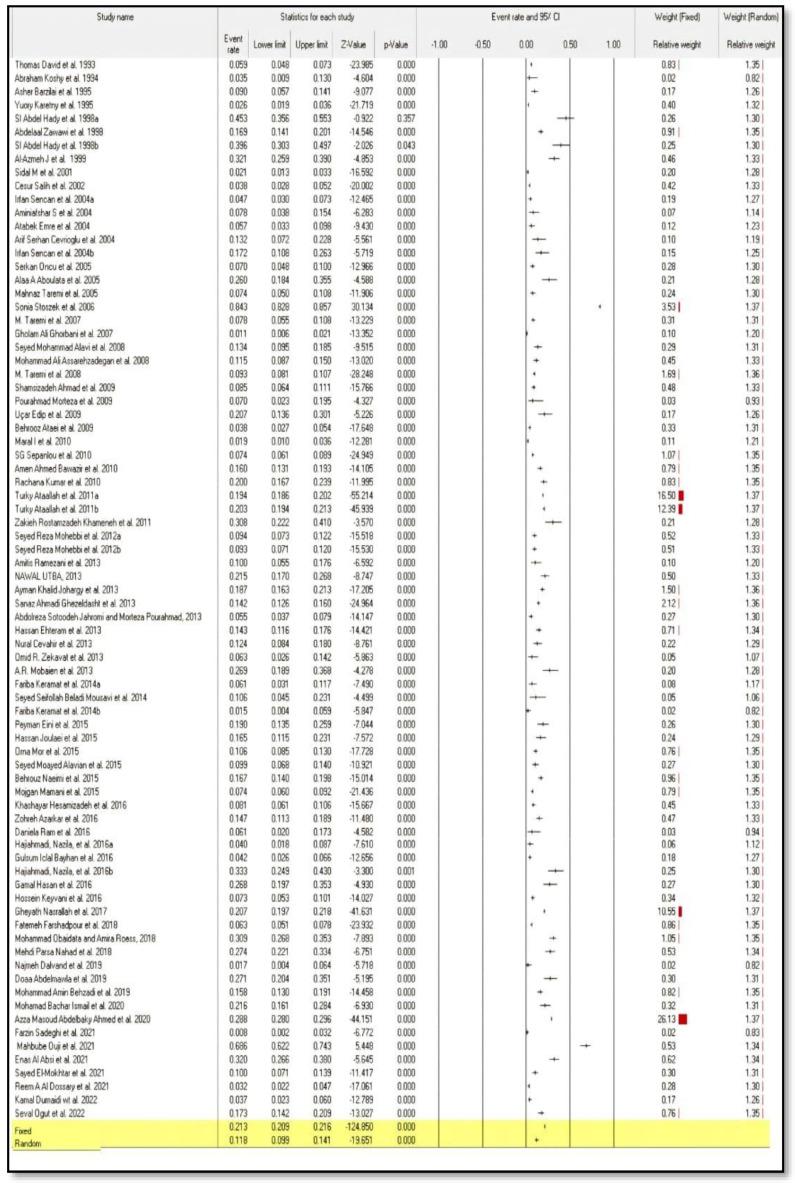
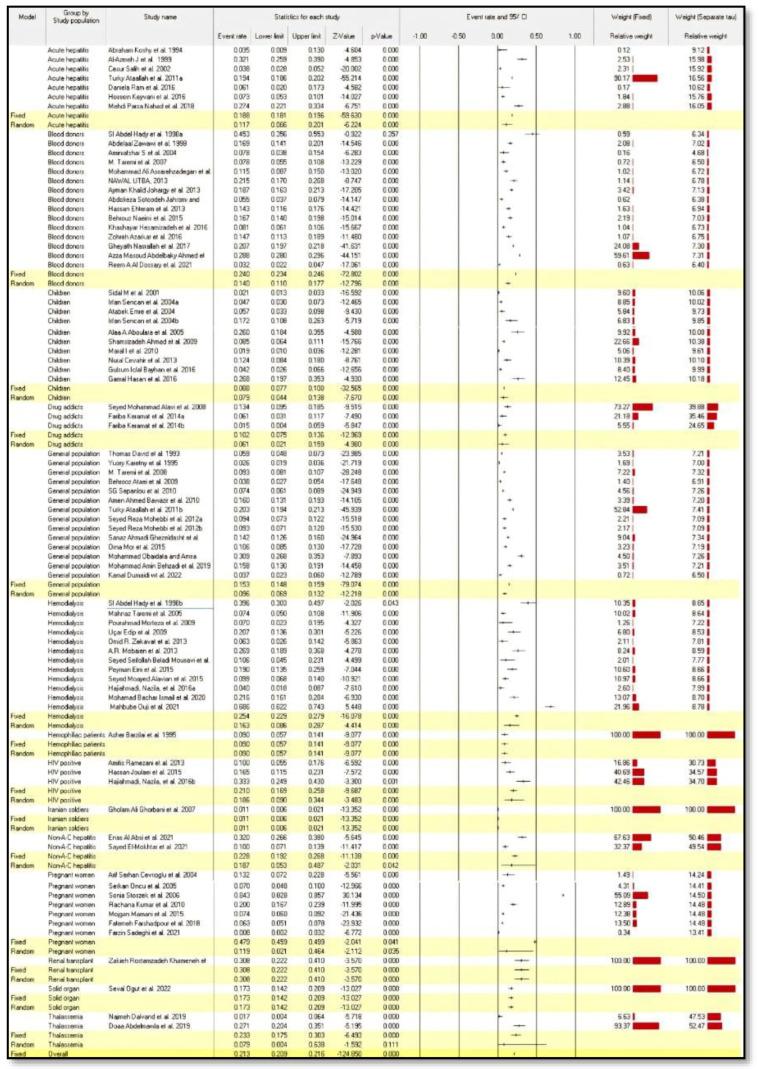
Hepatitis E virus (HEV) is a hepatotropic virus that is a major public health concern worldwide. Autochthonous HEV is spread through oral feces in unsanitary environments, as well as vertical and, occasionally, blood transfusion. HEV is more common in developing countries, but it has recently become more widespread in developed countries as well. The Middle East (ME) has long been an endemic location for HEV infection. Therefore, the aim of this systematic review and meta-analysis was to assess the seroprevalence of anti-HEV antibodies in ME countries. The author systematically searched five databases, namely ScienceDirect, EMBASE, Scopus, PubMed, and Google Scholar, to identify English-language articles published on or before 25 April 2022. Comprehensive meta-analysis software was used for all statistical analyses (CMA, version 3, BioStat, Englewood, CO, USA). After quality control and exclusion of irrelevant studies, 80 studies were included in the qualitative synthesis and meta-analysis. A forest plot showed that the overall pooled seroprevalence of HEV infection in ME countries in the fixed-effect and random-effect models were 21.3% (95% CI: 0.209-0.216) and 11.8% (95% CI: 0.099-0.144), respectively. Furthermore, the findings showed a high level of heterogeneity (I2 = 98.733%) among the included studies. In both fixed-effect and random-effect models, the seroprevalence of HEV infection by country was high in Egypt as compared to other regions, at 35.0% (95% CI: 0.342-0.359), and 34.7% (95% CI: 0.153-0.611), respectively. The seroprevalence of HEV infection by country was high among pregnant women, at 47.9% (95% CI: 0.459-0.499) in the fixed-effect model, and in renal transplant recipients, at 30.8% (95% CI: 0.222-0.410) in the random-effect model. The seroprevalence of HEV infection varies by country and study population in the Middle East. More research is needed to determine the disease's incidence, morbidity, and mortality in the region, where it is prevalent.
戊型肝炎病毒 (HEV) 是一种嗜肝病毒,是全球主要的公共卫生关注点。本土 HEV 通过不卫生环境中的口粪传播,以及垂直传播,偶尔也通过输血传播。HEV 在发展中国家更为常见,但最近在发达国家也更为普遍。中东(ME)一直是 HEV 感染的地方性地区。因此,本系统评价和荟萃分析的目的是评估 ME 国家抗 HEV 抗体的血清流行率。作者系统地检索了五个数据库,即 ScienceDirect、EMBASE、Scopus、PubMed 和 Google Scholar,以确定截至 2022 年 4 月 25 日发表的英文文章。所有统计分析均使用综合荟萃分析软件(CMA,版本 3,BioStat,Englewood,CO,USA)。经过质量控制和排除不相关的研究后,80 项研究被纳入定性合成和荟萃分析。森林图显示,在固定效应和随机效应模型中,中东国家 HEV 感染的总合并血清流行率分别为 21.3%(95%CI:0.209-0.216)和 11.8%(95%CI:0.099-0.144)。此外,研究结果表明,纳入研究之间存在高度异质性(I2=98.733%)。在固定效应和随机效应模型中,与其他地区相比,埃及的 HEV 感染血清流行率较高,分别为 35.0%(95%CI:0.342-0.359)和 34.7%(95%CI:0.153-0.611)。在固定效应模型中,孕妇的 HEV 感染血清流行率较高,为 47.9%(95%CI:0.459-0.499),在随机效应模型中,肾移植受者的 HEV 感染血清流行率较高,为 30.8%(95%CI:0.222-0.410)。HEV 感染的血清流行率因国家和中东地区的研究人群而异。需要进一步研究确定该疾病在该地区的发病率、发病率和死亡率,因为该疾病在该地区很普遍。



 Zotero 插件