
自乳化药物递送系统:一种通过鼻腔给药提高难溶性药物脑生物利用度的替代方法。
Self-Emulsifying Drug Delivery Systems: An Alternative Approach to Improve Brain Bioavailability of Poorly Water-Soluble Drugs through Intranasal Administration.
作者信息
Meirinho Sara, Rodrigues Márcio, Santos Adriana O, Falcão Amílcar, Alves Gilberto
机构信息
CICS-UBI-Health Sciences Research Centre, University of Beira Interior, Av. Infante D. Henrique, 6200-506 Covilha, Portugal.
Faculty of Health Sciences, University of Beira Interior, Av. Infante D. Henrique, 6200-506 Covilha, Portugal.
出版信息
Pharmaceutics. 2022 Jul 18;14(7):1487. doi: 10.3390/pharmaceutics14071487.
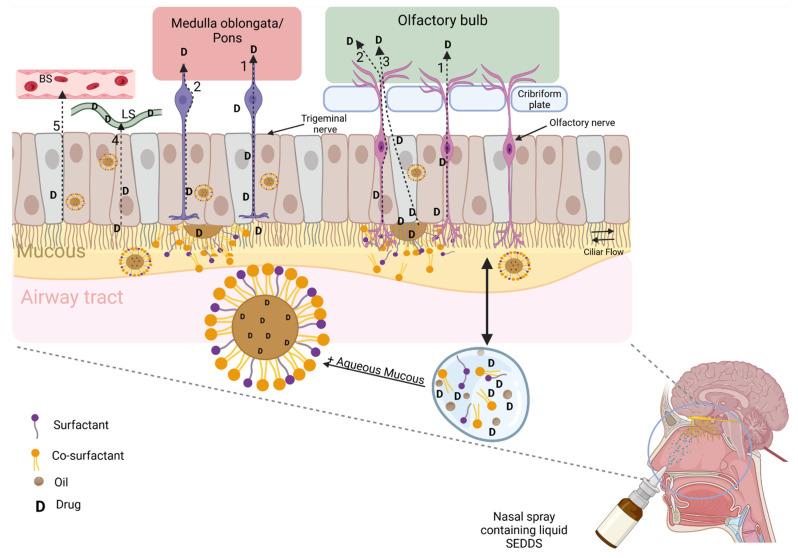
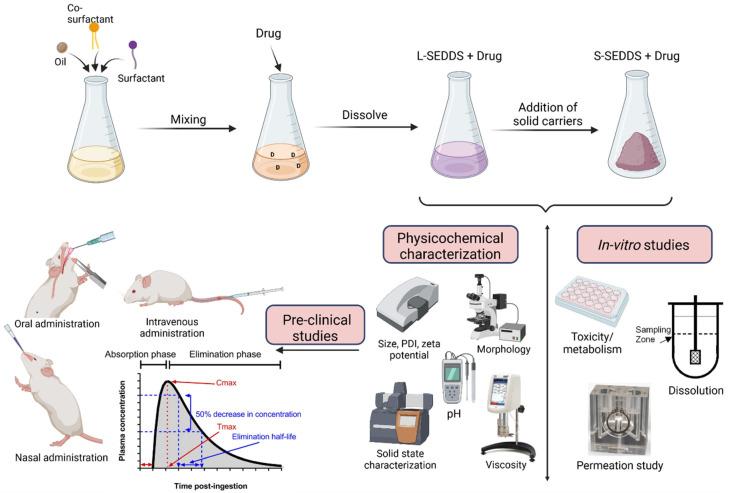
Efforts in discovering new and effective neurotherapeutics are made daily, although most fail to reach clinical trials. The main reason is their poor bioavailability, related to poor aqueous solubility, limited permeability through biological membranes, and the hepatic first-pass metabolism. Nevertheless, crossing the blood-brain barrier is the major drawback associated with brain drug delivery. To overcome it, intranasal administration has become more attractive, in some cases even surpassing the oral route. The unique anatomical features of the nasal cavity allow partial direct drug delivery to the brain, circumventing the blood-brain barrier. Systemic absorption through the nasal cavity also avoids the hepatic first-pass metabolism, increasing the systemic bioavailability of highly metabolized entities. Nevertheless, most neurotherapeutics present physicochemical characteristics that require them to be formulated in lipidic nanosystems as self-emulsifying drug delivery systems (SEDDS). These are isotropic mixtures of oils, surfactants, and co-surfactants that, after aqueous dilution, generate micro or nanoemulsions loading high concentrations of lipophilic drugs. SEDDS should overcome drug precipitation in absorption sites, increase their permeation through absorptive membranes, and enhance the stability of labile drugs against enzymatic activity. Thus, combining the advantages of SEDDS and those of the intranasal route for brain delivery, an increase in drugs' brain targeting and bioavailability could be expected. This review deeply characterizes SEDDS as a lipidic nanosystem, gathering important information regarding the mechanisms associated with the intranasal delivery of drugs loaded in SEDDS. In the end, in vivo results after SEDDS intranasal or oral administration are discussed, globally revealing their efficacy in comparison with common solutions or suspensions.
人们每天都在努力寻找新的有效神经治疗药物,尽管大多数药物未能进入临床试验阶段。主要原因是它们的生物利用度差,这与水溶性差、生物膜通透性有限以及肝脏首过代谢有关。然而,跨越血脑屏障是脑药物递送的主要障碍。为了克服这一障碍,鼻内给药变得更具吸引力,在某些情况下甚至超过了口服途径。鼻腔独特的解剖结构允许药物部分直接递送至大脑,从而避开血脑屏障。通过鼻腔的全身吸收还避免了肝脏首过代谢,提高了高代谢药物的全身生物利用度。然而,大多数神经治疗药物的物理化学特性要求它们被制成脂质纳米系统,即自乳化药物递送系统(SEDDS)。这些是油、表面活性剂和助表面活性剂的各向同性混合物,在用水稀释后会形成负载高浓度亲脂性药物的微乳液或纳米乳液。SEDDS应能克服药物在吸收部位的沉淀,增加其透过吸收膜的渗透率,并增强不稳定药物对酶活性的稳定性。因此,将SEDDS的优势与鼻内给药途径相结合用于脑递送,有望提高药物的脑靶向性和生物利用度。本综述深入描述了SEDDS作为一种脂质纳米系统的特性,收集了有关与SEDDS中负载药物的鼻内递送相关机制的重要信息。最后,讨论了SEDDS鼻内或口服给药后的体内结果,全面揭示了它们与普通溶液或混悬液相比的疗效。

 Zotero 插件