
台湾地区新冠疫情早期社区老年人幸福感的多维影响因素
Multidimensional Determinants of Well-Being Among Community-Dwelling Older Adults During the Early Stage of the COVID-19 Pandemic in Taiwan.
作者信息
Chen Jia-Jen, Liu Li-Fan, Lin Chung-I, Lin Heng-Chun
机构信息
National Cheng Kung University, Tainan.
出版信息
Gerontol Geriatr Med. 2022 Jul 21;8:23337214221111227. doi: 10.1177/23337214221111227. eCollection 2022 Jan-Dec.
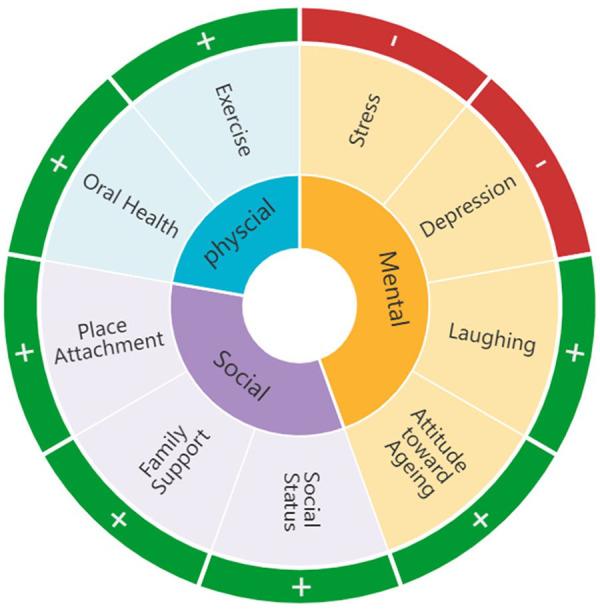
Due to the insufficient and inadequate policies on the psychological well-being of the aged population, we aimed to examine the multidimensional determinants of well-being during the early stage of the COVID-19 pandemic. Data were collected from face-to-face interviews with1,232 participants aged 50 and older living in Southern Taiwan. We used multivariate logistic regression to examine the associations between demographics, the physical health, mental health, social ties domains, and well-being. We found that (i) in physical health, no dental problems and exercise were related to better well-being; (ii) in mental health, stress and depression decreased well-being, but laughing every day, and a positive attitude toward aging had adverse effects; and (iii) in social ties, subjective social status, family support, and place attachment to the community were positively associated with well-being. Our findings highlight the multidimensional needs at the individual and community levels for the Chinese population.
由于针对老年人群心理健康的政策不足且不完善,我们旨在研究新冠疫情早期幸福感的多维度决定因素。数据来自对居住在台湾南部的1232名50岁及以上参与者的面对面访谈。我们使用多变量逻辑回归来研究人口统计学、身体健康、心理健康、社会关系领域与幸福感之间的关联。我们发现:(i)在身体健康方面,没有牙齿问题和进行锻炼与更高的幸福感相关;(ii)在心理健康方面,压力和抑郁会降低幸福感,但每天大笑以及对衰老持积极态度有负面影响;(iii)在社会关系方面,主观社会地位、家庭支持以及对社区的归属感与幸福感呈正相关。我们的研究结果凸显了中国人群在个人和社区层面的多维度需求。
 Zotero 插件