
德国巴伐利亚地区的贫困与 COVID-19 发病率和死亡率:一项贝叶斯地理分析。
Area Deprivation and COVID-19 Incidence and Mortality in Bavaria, Germany: A Bayesian Geographical Analysis.
机构信息
Institute for Medical Information Processing, Biometry and Epidemiology (IBE), Ludwig-Maximilians-Universität (LMU), Munich, Germany.
Helmholtz Zentrum München - German Research Center for Environmental Health (GmbH), Institute of Health Economics and Health Care Management, Neuherberg, Germany.
出版信息
Front Public Health. 2022 Jul 15;10:927658. doi: 10.3389/fpubh.2022.927658. eCollection 2022.
BACKGROUND
Area deprivation has been shown to be associated with various adverse health outcomes including communicable as well as non-communicable diseases. Our objective was to assess potential associations between area deprivation and COVID-19 standardized incidence and mortality ratios in Bavaria over a period of nearly 2 years. Bavaria is the federal state with the highest infection dynamics in Germany and demographically comparable to several other European countries.
METHODS
In this retrospective, observational ecological study, we estimated the strength of associations between area deprivation and standardized COVID-19 incidence and mortality ratios (SIR and SMR) in Bavaria, Germany. We used official SARS-CoV-2 reporting data aggregated in monthly periods between March 1, 2020 and December 31, 2021. Area deprivation was assessed using the quintiles of the 2015 version of the Bavarian Index of Multiple Deprivation (BIMD 2015) at district level, analyzing the overall index as well as its single domains.
RESULTS
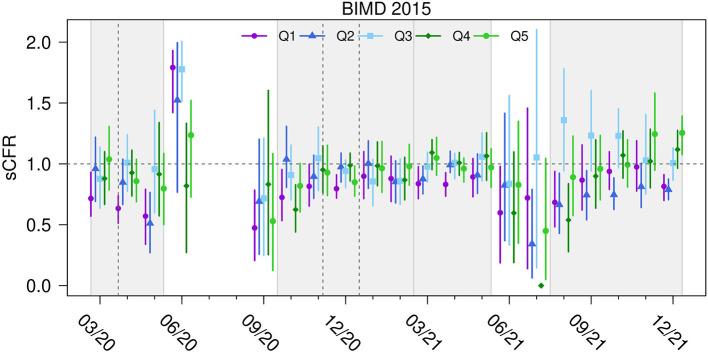
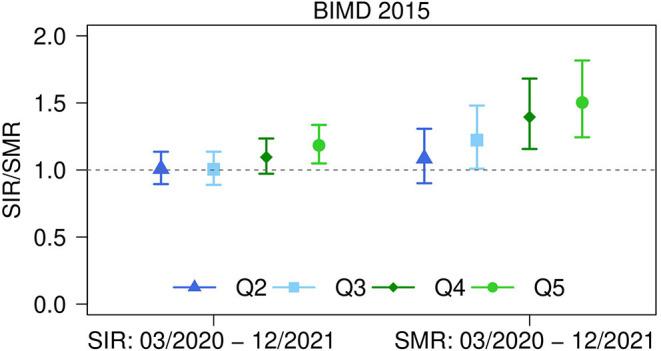
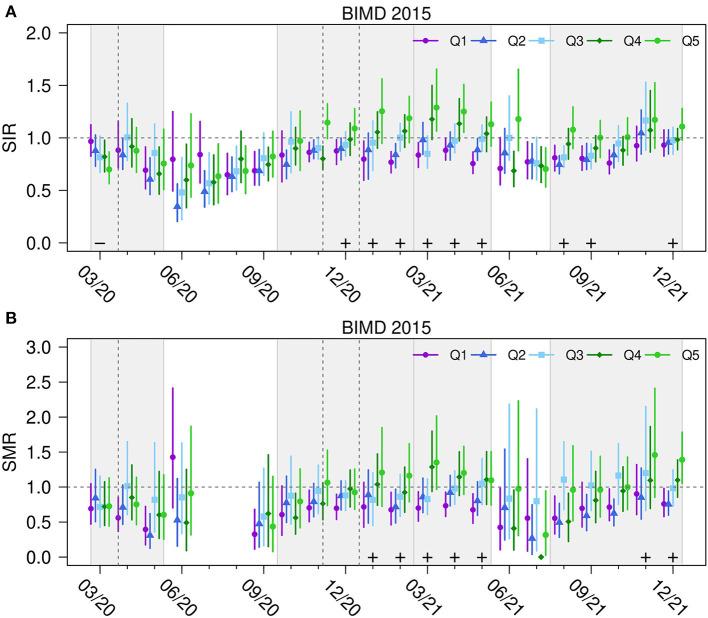
Deprived districts showed higher SIR and SMR than less deprived districts. Aggregated over the whole period, the SIR increased by 1.04 (95% confidence interval (95% CI): 1.01 to 1.07, = 0.002), and the SMR by 1.11 (95% CI: 1.07 to 1.16, < 0.001) per BIMD quintile. This represents a maximum difference of 41% between districts in the most and least deprived quintiles in the SIR and 110% in the SMR. Looking at individual months revealed clear linear association between the BIMD quintiles and the SIR and SMR in the first, second and last quarter of 2021. In the summers of 2020 and 2021, infection activity was low.
CONCLUSIONS
In more deprived areas in Bavaria, Germany, higher incidence and mortality ratios were observed during the COVID-19 pandemic with particularly strong associations during infection waves 3 and 4 in 2020/2021. Only high infection levels reveal the effect of risk factors and socioeconomic inequalities. There may be confounding between the highly deprived areas and border regions in the north and east of Bavaria, making the relationship between area deprivation and infection burden more complex. Vaccination appeared to balance incidence and mortality rates between the most and least deprived districts. Vaccination makes an important contribution to health equality.
背景
区域贫困与各种不良健康结果有关,包括传染病和非传染病。我们的目的是评估近 2 年来巴伐利亚地区贫困与 COVID-19 标准化发病率和死亡率之间的潜在关联。巴伐利亚是德国感染动态最高的联邦州,在人口统计学上与其他几个欧洲国家相当。
方法
在这项回顾性观察性生态学研究中,我们估计了巴伐利亚地区贫困与 COVID-19 标准化发病率和死亡率(SIR 和 SMR)之间的关联强度,德国。我们使用了 2020 年 3 月 1 日至 2021 年 12 月 31 日期间每月汇总的官方 SARS-CoV-2 报告数据。使用 2015 年版巴伐利亚多重剥夺指数(BIMD 2015)的五分位数在地区层面评估区域贫困,分析整体指数及其单个领域。
结果
贫困地区的 SIR 和 SMR 高于不贫困地区。在整个时期内,SIR 增加了 1.04(95%置信区间(95%CI):1.01 至 1.07, = 0.002),SMR 增加了 1.11(95%CI:1.07 至 1.16, < 0.001)每个 BIMD 五分位数。这代表了最贫困和最不贫困五分位数之间在 SIR 中的最大差异为 41%,在 SMR 中为 110%。观察个别月份,在 2021 年第一、二和最后一个季度,BIMD 五分位数与 SIR 和 SMR 之间存在明显的线性关联。在 2020 年和 2021 年的夏季,感染活动水平较低。
结论
在德国巴伐利亚州较贫困地区,COVID-19 大流行期间观察到更高的发病率和死亡率,尤其是在 2020/2021 年的第 3 波和第 4 波感染中。只有高感染水平才能揭示危险因素和社会经济不平等的影响。高度贫困地区与巴伐利亚州北部和东部的边境地区之间可能存在混杂因素,这使得地区贫困与感染负担之间的关系更加复杂。疫苗接种似乎使最贫困和最不贫困地区之间的发病率和死亡率保持平衡。疫苗接种对健康平等做出了重要贡献。


 Zotero 插件