
评估idecabtagene vicleucel治疗多发性骨髓瘤的治疗潜力:迄今的证据
Evaluating the Therapeutic Potential of Idecabtagene Vicleucel in the Treatment of Multiple Myeloma: Evidence to Date.
作者信息
Mann Hashim, Comenzo Raymond L
机构信息
Division of Hematology/Oncology, Tufts Medical Center, Boston, MA, USA.
The John Conant Davis Myeloma and Amyloid Program, Tufts Medical Center, Boston, MA, USA.
出版信息
Onco Targets Ther. 2022 Jul 22;15:799-813. doi: 10.2147/OTT.S305429. eCollection 2022.
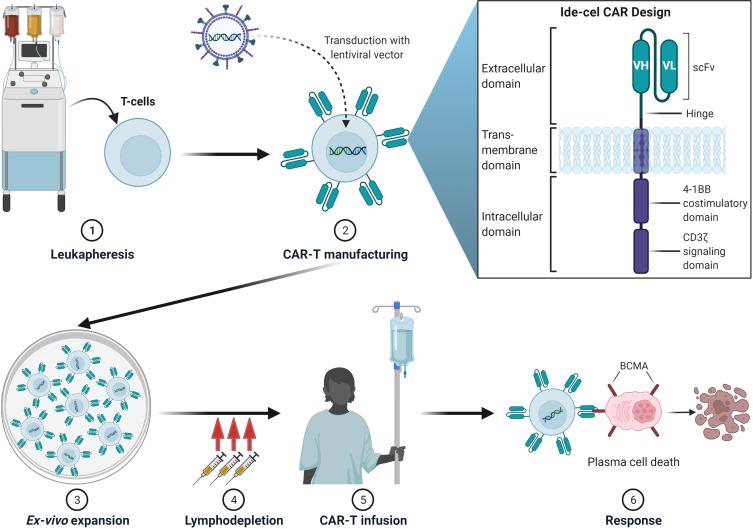
Over the past two decades, significant progress has been made in the diagnosis, risk assessment and treatment of patients with multiple myeloma, translating into remarkable improvements in survival outcomes. Yet, cure remains elusive, and almost all patients eventually experience relapse, particularly those with high-risk and refractory disease. Immune-based approaches have emerged as highly effective therapeutic options that have heralded a new era in the treatment of multiple myeloma. Idecabtagene vicleucel (ide-cel) is one such therapy that employs the use of genetically modified autologous T-cells to redirect immune activation in a tumor-directed fashion. It has yielded impressive responses even in patients with poor-risk disease and is the first chimeric antigen receptor (CAR) T-cell therapy to be approved for treatment in relapsed or refractory multiple myeloma. In this review, we examine the design and pharmacokinetics of ide-cel, audit evidence that led to its incorporation into the current treatment paradigm and provide insight into its clinical utilization with a focus on real-life intricacies.
在过去二十年中,多发性骨髓瘤患者的诊断、风险评估和治疗取得了重大进展,生存结果有了显著改善。然而,治愈仍然难以实现,几乎所有患者最终都会复发,尤其是那些患有高危和难治性疾病的患者。基于免疫的方法已成为高效的治疗选择,开创了多发性骨髓瘤治疗的新时代。伊德凯布他赛(ide-cel)就是这样一种疗法,它利用基因改造的自体T细胞以肿瘤导向的方式重新引导免疫激活。即使在患有高危疾病的患者中,它也产生了令人印象深刻的反应,并且是首个被批准用于复发或难治性多发性骨髓瘤治疗的嵌合抗原受体(CAR)T细胞疗法。在这篇综述中,我们研究了ide-cel的设计和药代动力学,审查了使其纳入当前治疗模式的证据,并深入了解其临床应用,重点关注实际应用中的复杂性。
 Zotero 插件