
复发/难治性多发性骨髓瘤:可用疗法综述及骨髓瘤复发时的临床情况。
Relapsed/Refractory Multiple Myeloma: A Review of Available Therapies and Clinical Scenarios Encountered in Myeloma Relapse.
机构信息
Tufts University Medical Center, Boston, MA 02145, USA.
出版信息
Curr Oncol. 2023 Feb 15;30(2):2322-2347. doi: 10.3390/curroncol30020179.
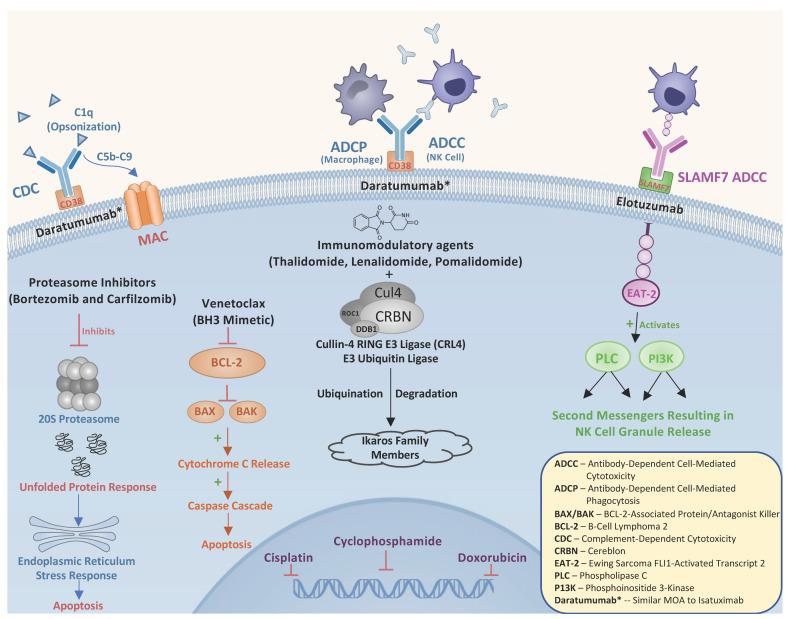
Multiple myeloma remains an incurable disease with the usual disease course requiring induction therapy, autologous stem cell transplantation for eligible patients, and long-term maintenance. Risk stratification tools and cytogenetic alterations help inform individualized therapeutic choices for patients in hopes of achieving long-term remissions with preserved quality of life. Unfortunately, relapses occur at different stages of the course of the disease owing to the biological heterogeneity of the disease. Addressing relapse can be complex and challenging as there are both therapy- and patient-related factors to consider. In this broad scoping review of available therapies in relapsed/refractory multiple myeloma (RRMM), we cover the pharmacologic mechanisms underlying active therapies such as immunomodulatory agents (IMiDs), proteasome inhibitors (PIs), monoclonal antibodies (mAbs), traditional chemotherapy, and Venetoclax. We then review the clinical data supporting the use of these therapies, organized based on drug resistance/refractoriness, and the role of autologous stem cell transplant (ASCT). Approaches to special situations during relapse such as renal impairment and extramedullary disease are also covered. Lastly, we look towards the future by briefly reviewing the clinical data supporting the use of chimeric antigen receptor (CAR-T) therapy, bispecific T cell engagers (BITE), and Cereblon E3 Ligase Modulators (CELMoDs).
多发性骨髓瘤仍然是一种无法治愈的疾病,通常需要诱导治疗、适合患者的自体干细胞移植和长期维持治疗。风险分层工具和细胞遗传学改变有助于为患者提供个体化的治疗选择,以期实现长期缓解并保持生活质量。不幸的是,由于疾病的生物学异质性,复发发生在疾病过程的不同阶段。由于需要考虑治疗和患者相关的因素,处理复发可能会很复杂和具有挑战性。在对复发/难治性多发性骨髓瘤 (RRMM) 可用治疗方法进行的广泛范围审查中,我们涵盖了免疫调节药物 (IMiD)、蛋白酶体抑制剂 (PI)、单克隆抗体 (mAb)、传统化疗和 Venetoclax 等活性治疗药物的药理机制。然后,我们根据耐药性/难治性和自体干细胞移植 (ASCT) 的作用,按药物分类综述了支持这些治疗方法使用的临床数据。还涵盖了复发期间特殊情况(如肾功能不全和髓外疾病)的处理方法。最后,我们简要回顾了支持嵌合抗原受体 (CAR-T) 疗法、双特异性 T 细胞衔接器 (BITE) 和 Cereblon E3 连接酶调节剂 (CELMoD) 使用的临床数据,以此展望未来。
 Zotero 插件