
客观和感知社会孤立对心血管和大脑健康的影响:美国心脏协会的科学声明。
Effects of Objective and Perceived Social Isolation on Cardiovascular and Brain Health: A Scientific Statement From the American Heart Association.
出版信息
J Am Heart Assoc. 2022 Aug 16;11(16):e026493. doi: 10.1161/JAHA.122.026493. Epub 2022 Aug 4.
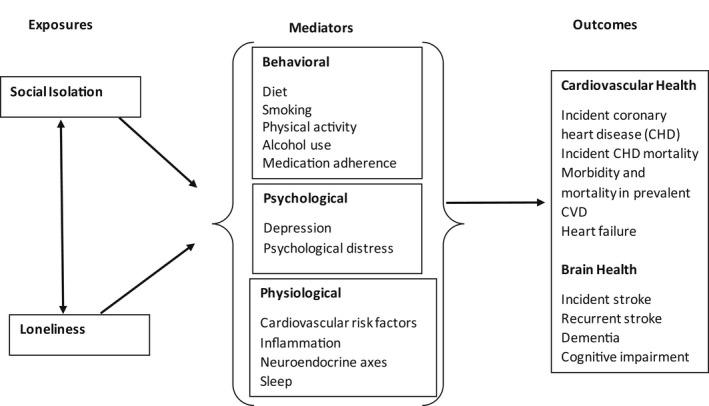
Background Social isolation, the relative absence of or infrequency of contact with different types of social relationships, and loneliness (perceived isolation) are associated with adverse health outcomes. Objective To review observational and intervention research that examines the impact of social isolation and loneliness on cardiovascular and brain health and discuss proposed mechanisms for observed associations. Methods We conducted a systematic scoping review of available research. We searched 4 databases, PubMed, PsycInfo, Cumulative Index of Nursing and Allied Health, and Scopus. Findings Evidence is most consistent for a direct association between social isolation, loneliness, and coronary heart disease and stroke mortality. However, data on the association between social isolation and loneliness with heart failure, dementia, and cognitive impairment are sparse and less robust. Few studies have empirically tested mediating pathways between social isolation, loneliness, and cardiovascular and brain health outcomes using appropriate methods for explanatory analyses. Notably, the effect estimates are small, and there may be unmeasured confounders of the associations. Research in groups that may be at higher risk or more vulnerable to the effects of social isolation is limited. We did not find any intervention studies that sought to reduce the adverse impact of social isolation or loneliness on cardiovascular or brain health outcomes. Conclusions Social isolation and loneliness are common and appear to be independent risk factors for worse cardiovascular and brain health; however, consistency of the associations varies by outcome. There is a need to develop, implement, and test interventions to improve cardiovascular and brain health for individuals who are socially isolated or lonely.
背景
社会隔离,即与不同类型社会关系的接触相对较少或不频繁,以及孤独感(感知到的隔离)与不良健康结果相关。目的:综述观察性和干预性研究,以探讨社会隔离和孤独感对心血管和大脑健康的影响,并讨论观察到的关联的潜在机制。方法:我们进行了系统的范围综述。我们在 4 个数据库(PubMed、PsycInfo、护理与健康相关学科累积索引和 Scopus)中进行了检索。结果:有证据表明,社会隔离、孤独感与冠心病和中风死亡率之间存在直接关联,但关于社会隔离与孤独感与心力衰竭、痴呆和认知障碍之间关联的数据较少且不够稳健。很少有研究使用适当的解释性分析方法来实证检验社会隔离、孤独感与心血管和大脑健康结果之间的中介途径。值得注意的是,效应估计值较小,且可能存在关联的未测量混杂因素。针对可能面临更高风险或更易受到社会隔离影响的群体的研究有限。我们没有发现任何旨在减轻社会隔离或孤独感对心血管或大脑健康结果的不良影响的干预研究。结论:社会隔离和孤独感很常见,似乎是心血管和大脑健康状况恶化的独立危险因素;然而,关联的一致性因结果而异。需要开发、实施和测试干预措施,以改善社会隔离或孤独感个体的心血管和大脑健康。
 Zotero 插件