
用于协同化学动力学/光动力疗法的基于玉米醇溶蛋白的纳米药物
Zein-Based Nanomedicines for Synergistic Chemodynamic/Photodynamic Therapy.
作者信息
Li Xiang, Wang Yupeng, Shi Qiankun, Zhen Nuo, Xue Jin, Liu Jingsheng, Zhou Dongfang, Zhang Hao
机构信息
College of Food Science and Engineering, National Engineering Laboratory for Wheat and Corn Deep Processing, Jilin Agricultural University, Changchun, Jilin 130118, China.
Guangdong Provincial Key Laboratory of New Drug Screening, School of Pharmaceutical Sciences, Southern Medical University, Guangzhou 510515, China.
出版信息
ACS Omega. 2022 Aug 8;7(33):29256-29265. doi: 10.1021/acsomega.2c03404. eCollection 2022 Aug 23.
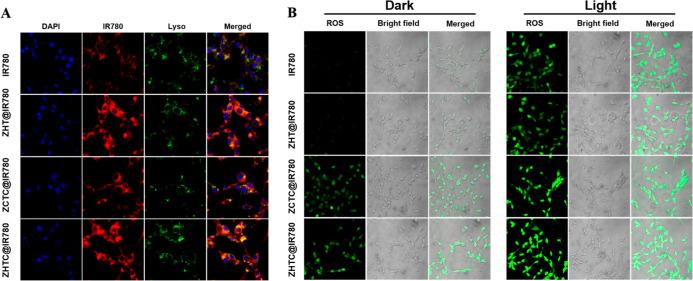
Current cancer treatment is not only limited to monotherapy but is also influenced by limited drug delivery options. Combined chemokinetic-photokinetic therapy has great promise in enhancing anticancer effects. Meanwhile, zein has superior self-assembly properties and can be loaded with photosensitizers. Herein, the targeted multifunctional nanoparticles based on zein/hyaluronate acid (HA)/tannin (TA)/Cu loaded with IR780 (ZHTC@IR780) are constructed for synergetic cancer therapy by chemo-dynamic therapy (CDT) and photodynamic therapy (PDT). There is experimental proof that ZHTC@IR780 nanoparticles (NPs) can relieve the tumor hypoxic microenvironment by catalytic decomposition of endogenous HO to O and further react with O to produce toxic O with 808 nm laser irradiation. The glutathione oxidase-like effects of ZHTC@IR780 NPs can generate Fenton-like Cu ions and deplete GSH for efficient hydroxyl radical (OH) production. In addition, CDT combined with PDT enhances the antitumor effect. Photodynamic therapy can cause immunogenic cell death, increase calreticulin eversion, release histone with high mobility, and promote apoptosis of tumor cells.
当前的癌症治疗不仅局限于单一疗法,还受到药物递送选择有限的影响。化学动力学-光动力学联合疗法在增强抗癌效果方面具有巨大潜力。同时,玉米醇溶蛋白具有优异的自组装性能,且能够负载光敏剂。在此,构建了基于玉米醇溶蛋白/透明质酸(HA)/单宁(TA)/负载IR780的铜(ZHTC@IR780)的靶向多功能纳米颗粒,用于通过化学动力学疗法(CDT)和光动力疗法(PDT)进行协同癌症治疗。有实验证明,ZHTC@IR780纳米颗粒(NPs)可通过将内源性HO催化分解为O,并在808 nm激光照射下进一步与O反应生成有毒的O,从而缓解肿瘤缺氧微环境。ZHTC@IR780 NPs的谷胱甘肽氧化酶样作用可产生类芬顿铜离子并消耗GSH,以有效产生羟基自由基(OH)。此外,CDT与PDT联合可增强抗肿瘤效果。光动力疗法可导致免疫原性细胞死亡,增加钙网蛋白外翻,释放高迁移率组蛋白,并促进肿瘤细胞凋亡。



 Zotero 插件