
弓形虫感染与精神障碍的关联:中国的一项横断面研究。
Association between Toxoplasma gondii infection and psychiatric disorders: a cross-sectional study in China.
机构信息
Department of Clinical Laboratory, Shandong Daizhuang Hospital, Jining, 272051, Shandong, People's Republic of China.
Department of Clinical Laboratory, Qingdao Sanatorium of Shandong Province, Qingdao, 266071, Shandong, People's Republic of China.
出版信息
Sci Rep. 2022 Sep 5;12(1):15092. doi: 10.1038/s41598-022-16420-y.
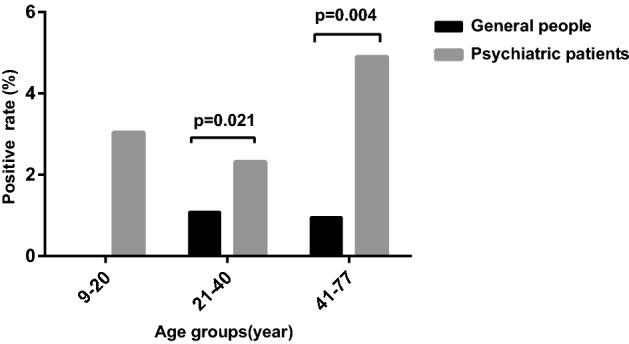
Psychiatric patients have become the focus of public attention, and current research suggests a possible link between Toxoplasma gondii (T. gondii) infection and mental illness. To understand the current situation of T. gondii infection in psychiatric patients in the study area, the relationship between T. gondii infection and mental diseases, and the influence of T. gondii infection on psychiatric patients, this study examined 3101 psychiatric inpatients from 2015 to 2020. All people included in the study were tested for anti-Toxoplasma IgM antibody and anti-Toxoplasma IgG antibody. Additionally, 4040 individuals from the general population were included as controls. The chi-square test and logistic regression analysis were carried out to determine the association between psychiatric disorders and T. gondii infection. The seroprevalence of anti-Toxoplasma IgM antibody was 0.23% (7/3101) in psychiatric inpatients and 0.11% (2/1846) in the general population, and there was no significant difference (p > 0.05). The seroprevalence rate of anti-Toxoplasma IgG antibodies was 3.03% (94/3101) in psychiatric inpatients and 1.05% (23/2194) in the general population, and there was a significant difference (p < 0.01). The seroprevalence of anti-Toxoplasma IgG antibody in psychiatric inpatients was significantly different between different age groups (p < 0.01). The positivity rate of anti-Toxoplasma IgG antibodies was 5.17% (3/58) in patients with mania, 3.24% (8/247) in patients with recurrent depressive disorder, 3.54% (13/367) in patients with depression, 3.22% (39/1213) in patients with schizophrenia, 2.41% (18/748) in patients with bipolar disorder and 2.25% (2/89) in patients with dissociative disorder. Compared to the general population, patients with mania (OR = 5.149 95% CI 1.501-17.659 p = 0.009), schizophrenia (OR = 3.136 95% CI 1.864-5.275 p = 0.000), depression (OR = 3.466 95% CI 1.740-6.906 p = 0.000), recurrent depressive disorder (OR = 3.160 95% CI 1.398-7.142 p = 0.006) and bipolar disorder (OR = 2.327 95% CI 1.249-4.337 p = 0.008) were found to be significantly associated with the seroprevalence of anti-Toxoplasma IgG antibody. This study suggests that the seroprevalence of T. gondii infection in psychiatric patients was higher and that age was an influencing factor of T. gondii infection in psychiatric patients. T. gondii infection was associated with mania, schizophrenia, depression, recurrent depressive disorder and bipolar disorder.
精神科患者已成为公众关注的焦点,目前的研究表明,刚地弓形虫(Toxoplasma gondii,T. gondii)感染与精神疾病之间可能存在关联。为了解研究区域内精神科患者 T. gondii 感染的现状、T. gondii 感染与精神疾病的关系以及 T. gondii 感染对精神科患者的影响,本研究对 2015 年至 2020 年间的 3101 名精神科住院患者进行了检查。所有纳入研究的人都进行了抗弓形虫 IgM 抗体和抗弓形虫 IgG 抗体检测。此外,还纳入了 4040 名一般人群作为对照。采用卡方检验和 logistic 回归分析确定精神疾病与 T. gondii 感染之间的关联。精神科住院患者抗弓形虫 IgM 抗体的血清阳性率为 0.23%(7/3101),一般人群为 0.11%(2/1846),差异无统计学意义(p>0.05)。精神科住院患者抗弓形虫 IgG 抗体的血清阳性率为 3.03%(94/3101),一般人群为 1.05%(23/2194),差异有统计学意义(p<0.01)。不同年龄组的精神科住院患者抗弓形虫 IgG 抗体血清阳性率差异有统计学意义(p<0.01)。精神科住院患者抗弓形虫 IgG 抗体阳性率在躁狂症患者中为 5.17%(3/58),在复发性抑郁症患者中为 3.24%(8/247),在抑郁症患者中为 3.54%(13/367),在精神分裂症患者中为 3.22%(39/1213),在双相情感障碍患者中为 2.41%(18/748),在分离性障碍患者中为 2.25%(2/89)。与一般人群相比,躁狂症患者(OR=5.149 95%CI 1.501-17.659 p=0.009)、精神分裂症患者(OR=3.136 95%CI 1.864-5.275 p=0.000)、抑郁症患者(OR=3.466 95%CI 1.740-6.906 p=0.000)、复发性抑郁症患者(OR=3.160 95%CI 1.398-7.142 p=0.006)和双相情感障碍患者(OR=2.327 95%CI 1.249-4.337 p=0.008)与抗弓形虫 IgG 抗体的血清阳性率显著相关。本研究表明,精神科患者的 T. gondii 感染血清阳性率较高,年龄是影响精神科患者 T. gondii 感染的一个因素。T. gondii 感染与躁狂症、精神分裂症、抑郁症、复发性抑郁症和双相情感障碍有关。

 Zotero 插件